If you are preparing for Hajj or Umrah, the word miqat and “what is miqat” will come up quickly – and it matters far more than it might seem at first glance. The word comes from the Arabic root meaning a fixed time or place, and in Islamic law it refers to the designated boundaries that every pilgrim must enter into the state of ihram before crossing.
Think of the miqat as the sacred threshold of the Haram. It is a boundary set by the Prophet Muhammad (peace be upon him) himself, marking where the journey of the heart shifts from ordinary travel to sacred worship. Once you pass these boundaries without ihram, you have technically committed a violation even if your plane was at 35,000 feet when it happened.
There are two types of miqat. The first is the miqat zamani (the time boundary)which refers to the specific lunar months during which Hajj can be performed (Shawwal, Dhul Qi’dah, and the first ten days of Dhul Hijjah). The second, and the one most commonly discussed, is the miqat makani (the spatial boundary) which is the geographical line every pilgrim must be in ihram before crossing.
This guide focuses primarily on the miqat makani, since it is what creates confusion and anxiety for so many travellers, particularly those flying from the UK and other Western countries.
I still remember the panic I felt on my first Umrah trip. I was on a flight from London Heathrow, half asleep, when the captain announced we were approaching the miqat. I had not yet changed into my ihram. I scrambled to the toilet, wrapped myself in the towels as best I could, and made the niyyah in a cramped airplane lavatory. Not exactly the serene spiritual moment I had pictured. That experience is exactly why I wish I had read a guide like this before I left. Personal experience, Hajj 2026
What Is Miqat?
Why it matters – more than you might think
Some pilgrims treat the miqat as a formality a box to tick before the “real” journey begins. That is a misunderstanding that can cost you dearly, both spiritually and practically.
Crossing the miqat without wearing ihram and making the intention (niyyah) is a violation known in Islamic law as committing an act against the sanctity of the sacred boundary. The consequence, according to the majority of scholars, is that a dam — a compensatory sacrifice — becomes obligatory. This is not a minor issue. It is an act with a real financial and religious consequence, and it is entirely avoidable with a little preparation.
Beyond the legal dimension, there is a deeply spiritual one. The miqat is the moment you leave the dunya behind. The moment you shed your ordinary clothes and wrap yourself in two plain white sheets is the moment you declare — to yourself, to those around you, and to Allah — that you are here as His guest, equal to every other pilgrim regardless of wealth, status, or nationality. That moment deserves to be intentional, calm, and spiritually present.
Key ruling to remember
If a pilgrim crosses the miqat without ihram, they must either return to the miqat to put on ihram (if feasible) or, if they cannot return, they must offer a dam — slaughtering a sheep or a share in a larger animal in Makkah or the surrounding area.
This is the ruling according to the majority of scholars including the Hanafi, Maliki, Shafi’i, and Hanbali madhabs.
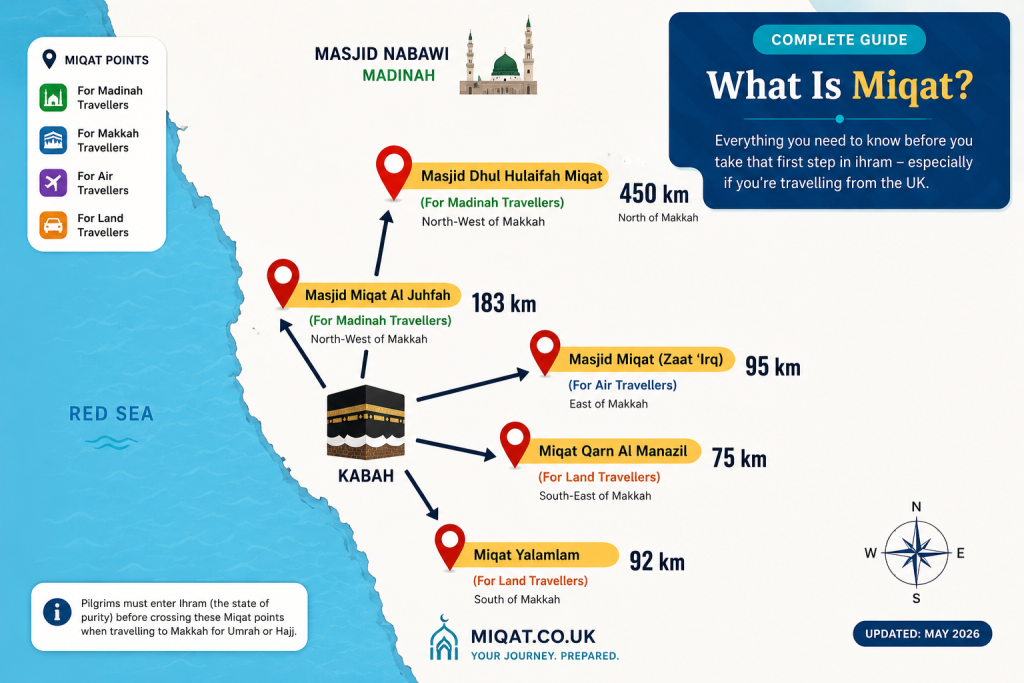
The 5 Miqat locations
The Prophet (peace be upon him) designated five miqat points to serve pilgrims approaching Makkah from different directions. These were established during his lifetime and remain the same boundaries used today, now clearly marked and equipped with mosques where pilgrims can change and pray.
1. Dhul Hulayfah
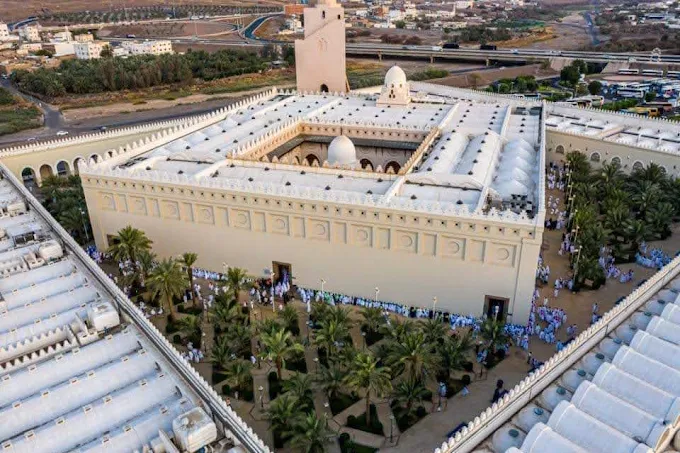
ذو الحليفة — Dhul Hulayfah (also known as Abyar ‘Ali or Masjid ash-Shajarah)
The miqat for those coming from Madinah to Makkah. It is approximately 450 km from Makkah, making it the farthest miqat from the city. Pilgrims flying to Madinah first will pass through this miqat, which has a large and well-appointed mosque.
2. Al-Juhfah
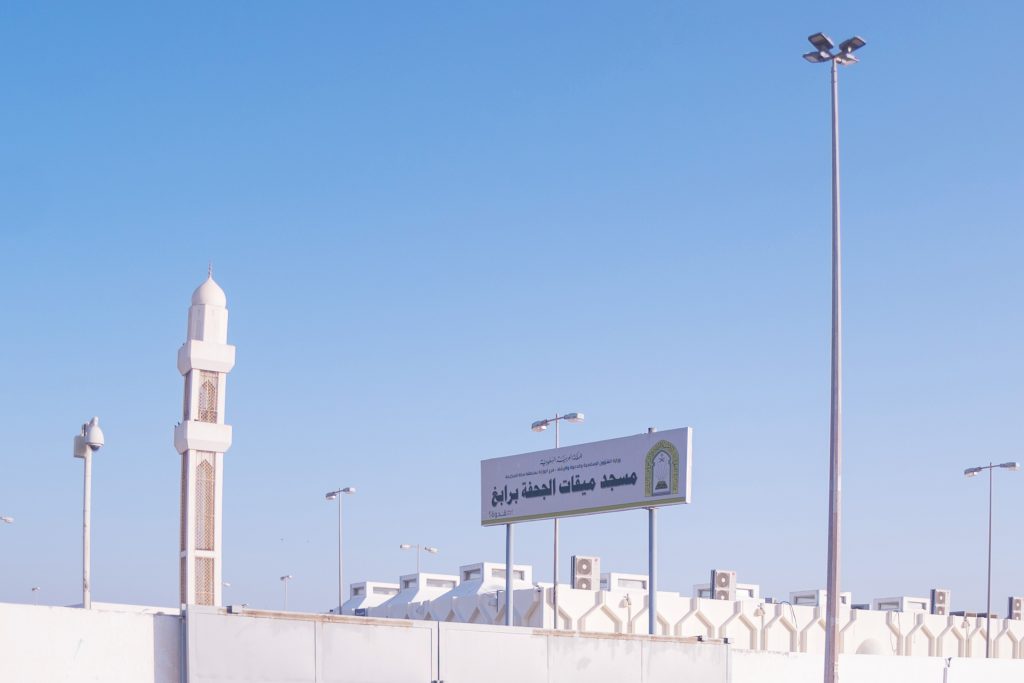
The miqat for those arriving from the direction of Syria, Egypt, Morocco, and much of North Africa and Europe. It is approximately 183 km northwest of Makkah. Most UK pilgrims flying directly to Jeddah will cross this miqat.
3. Qarn al-Manazil
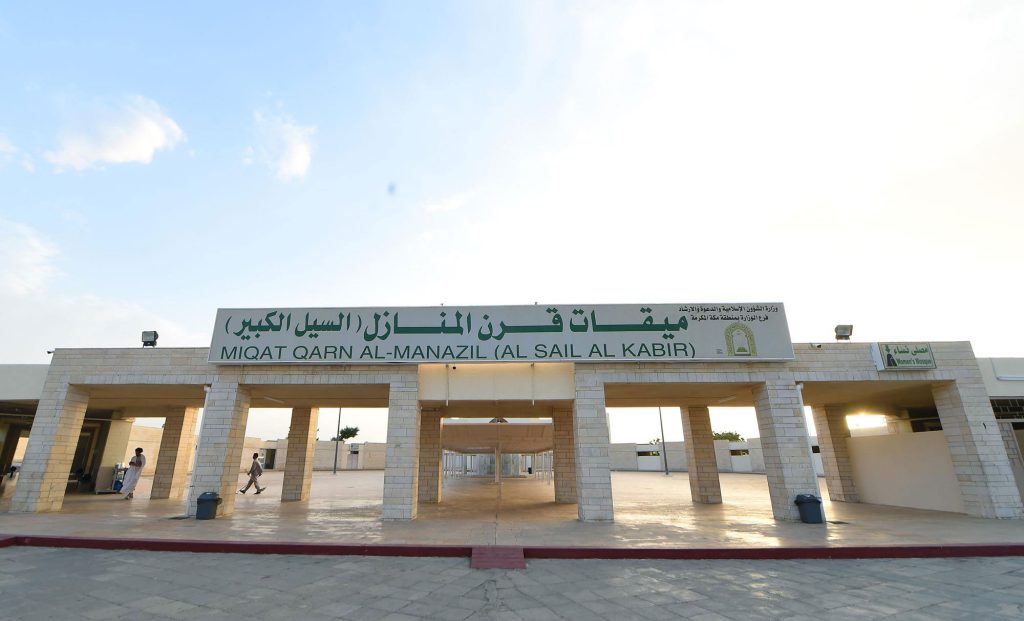
قرن المنازل — Also called Miqat al-Sail
The miqat for those coming from Najd, and for many pilgrims flying from the Gulf countries. Located about 75 km east of Makkah. Well-marked and easily accessible for overland pilgrims.
4. Yalamlam
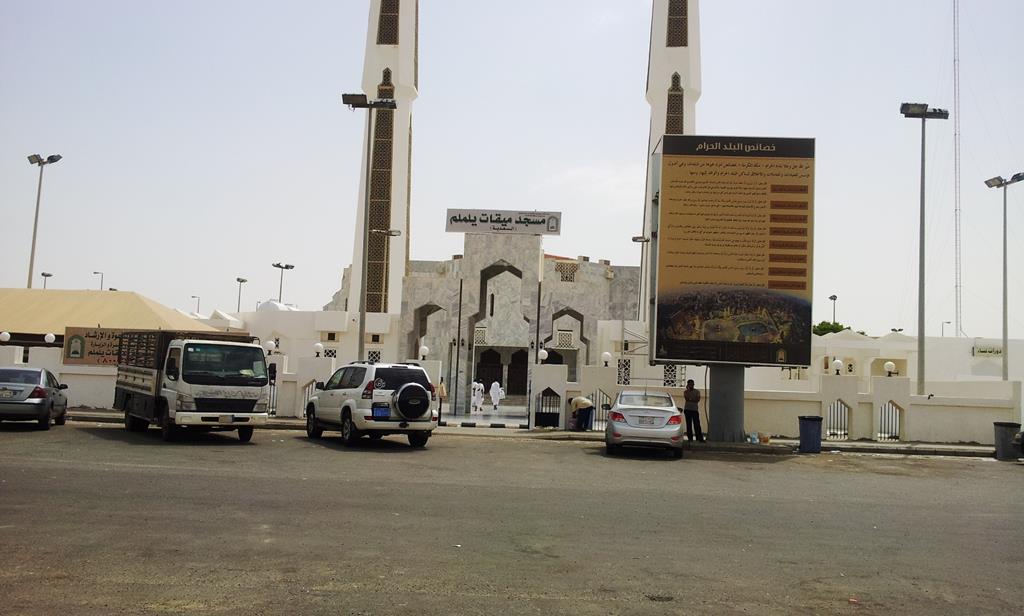
The Yalamlam miqat for those arriving from Yemen and parts of South Asia. Located about 94 km southeast of Makkah. Many pilgrims flying from Pakistan, India, and Bangladesh may cross near this miqat.
5. Dhat Irq
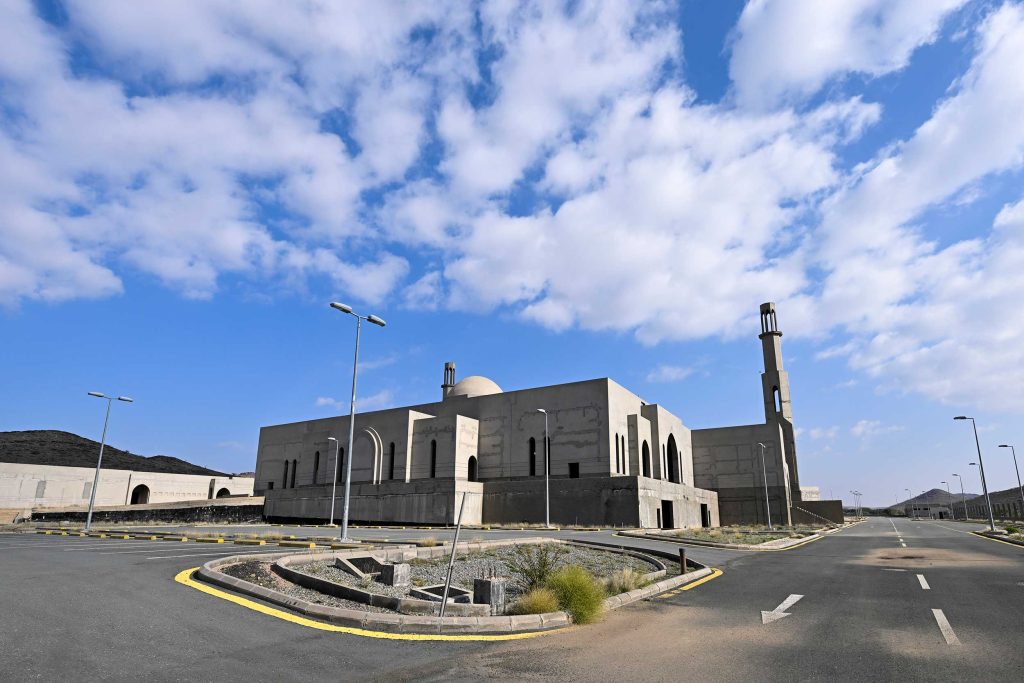
ذات عرق — The eastern boundary
The Dhat Irq miqat for those coming from Iraq and parts of Iran. Located approximately 94 km northeast of Makkah. Less commonly used today but still valid for pilgrims arriving from that direction.
When I visited Masjid al-Miqat in Dhul Hulayfah after flying to Madinah, I was struck by how many thousands of pilgrims were there all doing the same thing — showering, putting on ihram, praying two rak’ahs, and making their niyyah. There was something incredibly moving about standing in that same spot where the companions of the Prophet (peace be upon him) once stood. Take your time there if you can. It is worth it. Personal experience, Hajj 2026
Miqat for UK travellers
This is where it gets specific and genuinely important. Most UK pilgrims travel on one of three main routes, and each has different miqat implications.
Flying directly to Jeddah
The vast majority of UK Umrah travellers fly directly to King Abdulaziz International Airport in Jeddah. Since Jeddah sits inside the miqat boundary, you must be in ihram before your plane crosses the miqat which for flights from the UK will typically be the Al-Juhfah miqat boundary.
On most direct flights from the UK to Jeddah, the captain will make an announcement when the plane is approximately 10–15 minutes from crossing the miqat. This has become increasingly standard practice on Saudia, flynas, and other carriers operating Hajj and Umrah routes. However, you should not rely on this announcement alone. Many pilgrims put their ihram on before boarding, or change shortly after take-off while the aircraft is still cruising over Europe.
Flying to Madinah first
If your package includes time in Madinah before Makkah, a common and blessed arrangement — you have much more flexibility. Madinah is outside the miqat boundary, so you can arrive there in your normal clothes, rest, pray at the Prophet’s Mosque, and then put on your ihram at Masjid al-Miqat (Dhul Hulayfah) when you are ready to depart for Makkah. This is, in many ways, the more comfortable and spiritually ideal approach.
Transiting through another airport
Some UK travellers transit through Istanbul, Dubai, Abu Dhabi, Doha, or other hubs. The miqat rules still apply based on where your flight crosses the boundary, not where you departed from. If you are connecting through a city that is itself outside the miqat (which all those hubs are), you have options — but you still need to be in ihram before your onward flight crosses the miqat boundary.
Important for UK travellers
Jeddah is inside the miqat. If you land in Jeddah without having crossed the miqat in ihram, you cannot simply put on ihram at the airport and proceed. You would need to travel to the nearest miqat — typically a purpose-built mosque near the city — to rectify the situation. This adds time and cost to your trip. Get it right before you board.
Flights & ihram timing
This section deals with the practicalities that most guides gloss over. Wearing ihram on an aeroplane is manageable, but it requires a bit of planning.
When to put on ihram
The simplest and most stress-free approach is to shower and put on your ihram before you leave for the airport. Many scholars recommend this, and many experienced pilgrims will tell you it removes all the anxiety of trying to change on a moving aircraft. You board already in the sacred state, and you can spend the flight in dhikr, du’a, and recitation rather than worrying about the toilet queue.
If you prefer to change on the flight, do so well before the miqat crossing – ideally at least an hour before. Do not wait for the captain’s announcement, as by the time the announcement is made you may already be close to the boundary.
What about women?
Women’s ihram is their ordinary modest clothing — there is no specific garment required. Women should still make the intention (niyyah) and observe the ihram restrictions, but they can wear their regular abaya and do not need to change into anything special. Women should not cover their faces (niqab) or wear gloves while in the state of ihram, though they may lower a headscarf or veil near the face if in the presence of unrelated men.
Practical tips for the plane
- Pack your ihram garments in your carry-on, not in checked luggage. If your bag is lost, you need your ihram accessible.
- Wear the ihram belt (nifad) to keep the lower garment secure — the aircraft cabin can be cold and you will be moving around.
- Bring a pair of sandals (no covered heels) and a small bag for your removed shoes.
- Avoid perfume entirely once you intend to enter ihram — this includes perfumed soaps and deodorants.
- Make your niyyah verbally and quietly: “Labbayk Allahumma bi Umrah” (or Hajj). Then begin the talbiyah.
On my second Umrah, I changed at home, took the Tube to Heathrow in my ihram, and boarded like that. I got some curious looks on the Central line. One elderly gentleman asked if I was on my way to a fancy dress party. I explained what I was doing and we had a lovely conversation about pilgrimage traditions across different faiths. It turned out he was Jewish and had visited Israel on a deeply personal religious journey the year before. We sat together on the bus to the terminal. Sometimes the journey starts before you even get on the plane.— Personal experience, Umrah 2021
Rules and exceptions
The miqat has a set of established rules, but Islamic jurisprudence is rich with nuance and the scholars have addressed many of the complicated scenarios that modern travel creates.
Residents of Makkah
If you already live inside the miqat boundary — including the residents of Makkah itself — your miqat for Hajj is the Hill (the area between the miqat and the Haram boundary). For Umrah, residents of Makkah must exit to the Hill or beyond before entering ihram. The Prophet (peace be upon him) directed Aisha (may Allah be pleased with her) to do precisely this during the Farewell Pilgrimage.
Those passing through without intending pilgrimage
A non-Muslim traveller, or a Muslim travelling to Saudi Arabia for business or tourism with no intention of Hajj or Umrah, does not need to wear ihram when crossing the miqat. The obligation is tied specifically to the intention to perform pilgrimage. However, a Muslim who crosses the miqat and then later decides to perform Umrah should ideally return to the miqat to put on ihram, or enter from a direction where they can don ihram at the boundary.
Illness and physical inability
A person who is physically unable to change into ihram garments — due to surgery, injury, or medical devices — may make the niyyah and intention without changing, with the full state of ihram applying. Scholars differ on the specific details of this ruling so it is worth consulting a qualified scholar if you are in this situation.
The issue of ishtiraT (conditional ihram)
If you have a genuine concern — illness, uncertainty about completing the pilgrimage — you can make a conditional ihram. This means saying at the point of niyyah: “If I am prevented from completing my pilgrimage, my ihram ends at the point of prevention.” This exempts you from the dam if you are genuinely forced to stop. This is a legitimate and established practice supported by a hadith narrated by Dubaa’ah bint al-Zubayr (may Allah be pleased with her).
Performing Hajj al-Tamattu’ (the most common form for UK pilgrims)
Most UK Hajj pilgrims perform Hajj al-Tamattu’ — where Umrah and Hajj are performed separately in the same season. For this type, you enter ihram for Umrah at the miqat, complete Umrah, then exit ihram. You then re-enter ihram for Hajj on 8th Dhul Hijjah from wherever you are in Makkah. You do not need to go back to the miqat for the Hajj ihram.
Common confusion and mistakes
Can I just put on ihram when I land in Jeddah?
No. Jeddah is inside the miqat boundary. If you arrive in Jeddah without having been in ihram when you crossed the miqat, you have already passed the boundary. You would need to travel out to the nearest miqat mosque (roughly 45 minutes from Jeddah airport) to rectify this. It is far easier to put on ihram before boarding or early in the flight.
I’m flying from Manchester, not London – does that change anything?
No. The miqat crossing is determined by the flight path, not the departure airport. Whether you fly from Heathrow, Manchester, Birmingham, or Glasgow, your flight will cross the Al-Juhfah miqat boundary on its way to Jeddah. The timing of when you cross it may differ slightly, but the ruling is the same.
What if I’m doing Hajj and need to travel for work before I leave – do I have to be in ihram from the UK?
No. You only enter ihram at the miqat — not from your home country. You travel to Saudi Arabia in your regular clothes and enter ihram at the designated miqat either at the airport, on the plane as you cross the boundary, or at a miqat mosque on the ground.
My travel agent told me I can put ihram on at Jeddah airport – is that true?
This is one of the most common and dangerous pieces of misinformation in the Umrah travel industry. Some agents claim there is a designated area at Jeddah airport for this. While there are ihram-changing facilities at the airport, using them does not fulfil the miqat obligation because you have already crossed the miqat boundary. Please do not rely on this advice without consulting a qualified scholar.
What if I fall asleep and miss the miqat crossing on the plane?
This is exactly why putting on ihram before you board — or early in the flight — is the safest approach. If you genuinely fell asleep and were unable to put on ihram in time, the same ruling applies as for any other crossing without ihram: you should consult a scholar about your options, which may include offering a dam.
Can women wear ihram stitched clothing?
Yes. The prohibition on stitched clothing applies only to men. Women wear their ordinary modest clothing as their ihram garment. There is no specific white garment required for women, though many choose to wear white as a personal preference.
Final guidance
If you take nothing else from this guide, let it be this: the miqat is not a bureaucratic hurdle — it is a sacred threshold. It is the line where the pilgrimage truly begins. The Prophet (peace be upon him) chose these boundaries with wisdom, and crossing them in the correct state is the first act of worship of your journey. Give it the reverence it deserves.
For UK travellers, the most practical advice is this: shower the night before or morning of your departure, apply no perfume, and put on your ihram before you leave the house or at the airport before boarding. Make your niyyah and begin the talbiyah. Let the journey start on your own terms, calmly and intentionally, not in a panic in an aeroplane toilet over the Mediterranean.
And if something does go wrong — if you do cross the miqat without ihram due to genuine circumstances beyond your control — do not despair. Consult a qualified scholar as soon as possible. The scholars of Islam have addressed these exact situations, and the religion is built on mercy and ease. What matters is that you seek to rectify it properly rather than ignoring it.
Summary checklist before you fly
Research whether your flight to Jeddah crosses the miqat (it will).
Decide whether to put on ihram at home, at the airport, or early in the flight — not at the announcement.
Pack ihram garments in carry-on luggage only.
Shower and avoid perfume before entering ihram.
Learn the niyyah and talbiyah in advance so you are not scrambling.
If flying Madinah-first, you can relax — put on ihram at Masjid al-Miqat before departing for Makkah.
Consult your group scholar or a reputable local imam if you have any specific circumstances.
Every Hajj and Umrah I have done, the miqat has felt different. The first time was rushed and anxious. The second time was calmer. By the third, I found myself genuinely emotional at that threshold — aware of what it meant to be crossing it again. May Allah accept from all of us, and may He make the journey easy for everyone preparing to go.— Personal reflection
The miqat is your beginning. Cross it with awareness, with gratitude, and with your heart already pointed toward Makkah.
Labbayk Allahumma Labbayk.
FAQs
What exactly is the difference between Miqat and Ihram?
They are two different but connected things. The miqat is a physical boundary — a geographical line designated by the Prophet (peace be upon him) that surrounds the sacred territory of Makkah. Ihram, on the other hand, is both a state of sacred consecration and the specific garments worn by male pilgrims. The miqat is the where; ihram is the what and the how. You must be in the state of ihram before you cross the miqat boundary. Think of the miqat as the gate and ihram as the key you need before you can pass through it.
Do I need to perform ghusl (ritual bath) before entering ihram at the Miqat?
Performing ghusl before entering ihram is a confirmed sunnah — meaning the Prophet (peace be upon him) did it and it is strongly recommended. However, it is not a condition for the validity of your ihram. If you genuinely cannot perform ghusl due to unavailability of water, illness, or circumstances beyond your control, your ihram is still valid. That said, most pilgrims find it very easy to shower at home before leaving for the airport, and doing so sets a clean and intentional tone for the journey ahead. For women who are in a state of menstruation or postnatal bleeding, the ghusl is still recommended even though they cannot pray the two rak’ahs of ihram.
Can I put on ihram at home in the UK before travelling?
Yes, you absolutely can — and for many pilgrims this is the most practical and spiritually satisfying approach. There is no requirement to wait until you reach the miqat boundary to put on ihram. You are permitted to enter the state of ihram from any point before the miqat, including your own home. The key thing is that you must make your niyyah and begin the talbiyah before you actually cross the miqat boundary. Some scholars note that entering ihram well in advance means observing all the ihram restrictions for a longer period, so be mindful of that — no perfume, no cutting of hair or nails, and all the other requirements apply from the moment you make your intention.
What is the penalty (dam) if I accidentally cross the Miqat without ihram?
The majority of scholars hold that if a pilgrim crosses the miqat without ihram, a dam becomes obligatory. A dam in this context means slaughtering a sheep or goat — or contributing a seventh share of a cow or camel — in Makkah or the surrounding Haram area, with the meat distributed to the poor. If you realise the mistake before completing your pilgrimage, you should ideally return to the miqat, enter ihram there, and then proceed. If returning is not feasible, the dam serves as the expiation. The exact ruling can vary slightly depending on which madhab (school of jurisprudence) you follow, so it is always worth consulting a qualified scholar rather than assuming. The important thing is not to ignore it.
Is the Miqat the same for Hajj and Umrah?
Yes — the five designated miqat points apply to both Hajj and Umrah. The boundary does not change depending on which pilgrimage you are performing. What does change is the timing and the specific intention (niyyah) you make when you enter ihram. For Umrah you say “Labbayk Allahumma bi Umrah,” and for Hajj you say “Labbayk Allahumma bi Hajj” (or the appropriate phrase depending on whether you are performing Hajj al-Ifrad, Qiran, or Tamattu’). The miqat boundary itself, however, is the same fixed line regardless.
My family member has mobility issues and we are travelling by road from Madinah – how does the Miqat work for them?
For pilgrims travelling by road from Madinah to Makkah, the miqat is Dhul Hulayfah (also known as Abyar Ali), where the large Masjid al-Miqat mosque is located. It is very well equipped, with wheelchair access, accessible toilet facilities, and space for those with mobility needs. The mosque is a regular stop for all pilgrim coaches on this route, and you should have ample time to prepare. If your family member is physically unable to put on ihram garments due to their condition, they should make their niyyah and the ihram is still valid — a qualified Islamic scholar travelling with your group, or your tour operator’s religious guide, can advise on their specific circumstances. The religion makes genuine concessions for those with real difficulty, and your family member should not feel anxious about this.