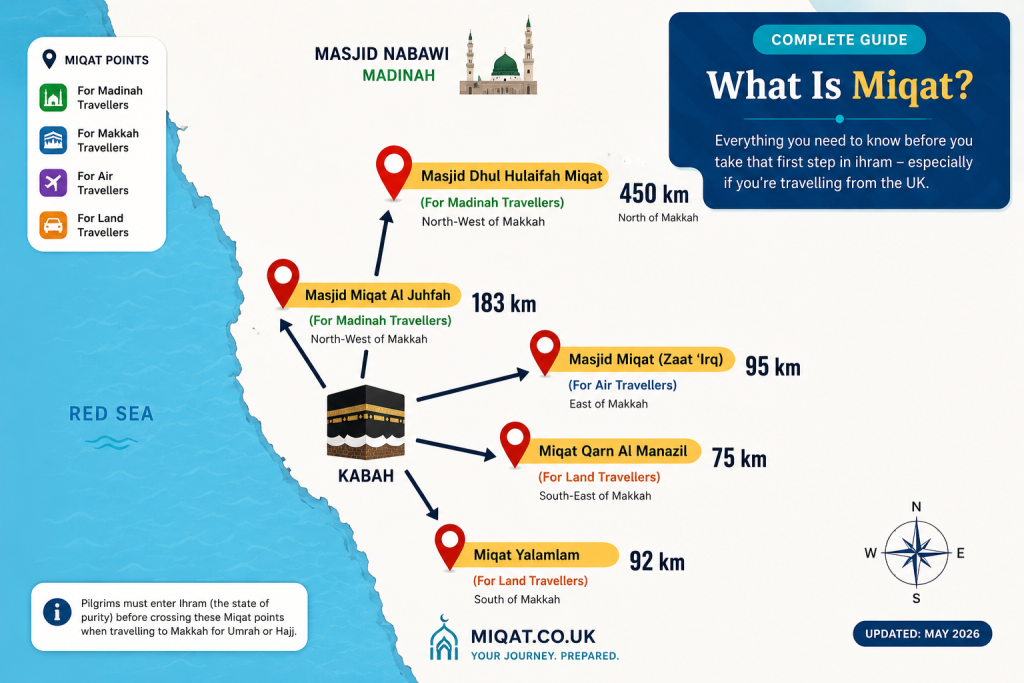
Of the five Mawaqit that encircle Makkah, Yalamlam guards the southern gateway — the approach from Yemen, from the coastlines of the Red Sea, and from the great continents of Africa and Asia beyond.
Yalamlam (Arabic: يلملم) is one of the five designated Mawaqit of Islam — the sacred boundary points from which every pilgrim intending Hajj or Umrah must enter the state of ihram before approaching the Holy City of Makkah. Each Miqat serves a direction of the compass. Yalamlam serves the south, standing as the threshold for the people of Yemen and for all those whose journey to Makkah carries them from that general direction.
Yalamlam
This includes pilgrims travelling from countries across sub-Saharan Africa – among them South Africa and Nigeria as well as pilgrims from parts of Asia whose flight paths cross the southern approach to the Arabian Peninsula. For these millions, Yalamlam is not an obscure geographical name. It is the gate through which their pilgrimage truly begins.
| Arabic Name | يلملم (Yalamlam) |
| Direction | Southwest of Makkah — Yemen, Africa, and the south |
| Distance from Makkah | 100 km (62 miles) southwest |
| Distance from al-Lith | 90 km (56 miles) north |
| Appointed By | The Prophet Muhammad ﷺ — narrated in Sahih Bukhari & Muslim |
| Mosque | Masjid Miqat Yalamlam — 1,500 worshipper capacity |
Where Is Yalamlam?

Location
Yalamlam sits 100 kilometres southwest of Makkah, positioned in the low-lying coastal region between the Hijaz mountain range and the Red Sea. It lies 90 kilometres north of the coastal city of al-Lith — a stretch of land that, for centuries before motorised transport, was traversed on foot and by camel by pilgrims pouring northward from Yemen and beyond.
Geographically, it occupies the southwestern arc of the ring of Mawaqit that surrounds Makkah — a ring so thoughtfully positioned that no pilgrim approaching the Holy City from any direction can arrive without first encountering, or passing in line with, one of these five sacred boundaries.
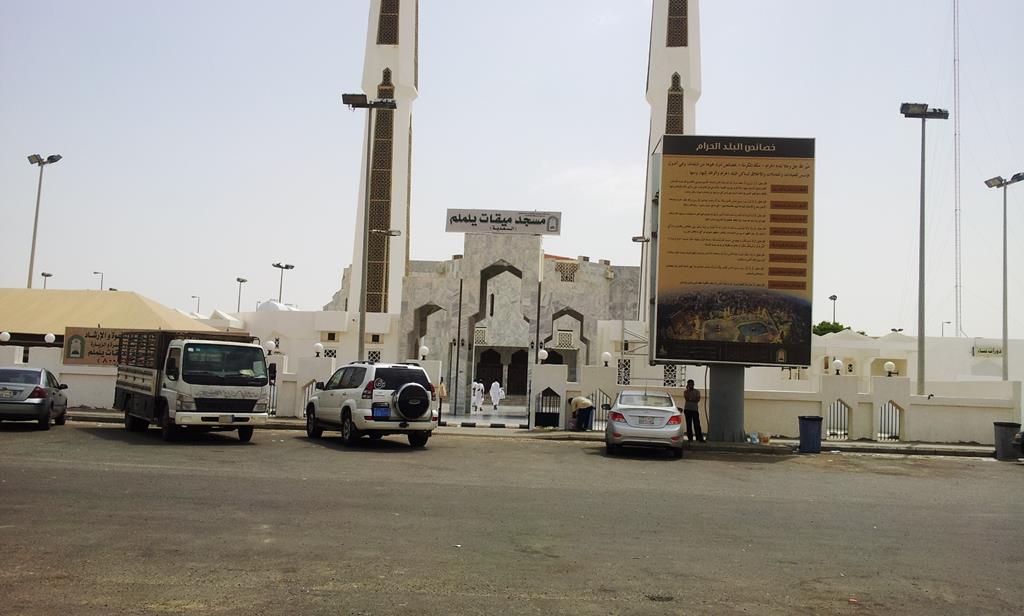
The Masjid Miqat Yalamlam — the mosque serving this Miqat — is located 130 kilometres from Masjid al-Haram and 21 kilometres southwest of the old Miqat location in al-Sadiah (Arabic: السعدية). The mosque marks the official boundary point where pilgrims today pause to complete their preparations before entering ihram.
Who Uses Yalamlam?
For Pilgrims
Yalamlam is the Miqat for any pilgrim whose route to Makkah approaches from the south — whether they are travelling from Yemen directly, or from any country whose geographic position or air corridor brings them across this southern threshold.
Primary
Yemen — the historic pilgrims of the southern Arabian Peninsula
Africa
South Africa — a major community of Hajj pilgrims
Africa
Nigeria — one of the largest Muslim populations in the world
Africa
Tanzania, Kenya, and East African nations
Africa
Ethiopia, Somalia, and the Horn of Africa
General
Any pilgrim whose flight path crosses the southern approach
The ruling for all of these pilgrims is the same: ihram must be entered before the Miqat boundary is crossed. For those travelling by air from sub-Saharan Africa or southern Asia, this typically means entering ihram on the aircraft before it passes over the Miqat’s latitude, or boarding the flight already in ihram. Most Hajj operators and experienced scholars advise the latter — it removes any uncertainty and allows the pilgrim to begin their spiritual journey the moment they leave home.
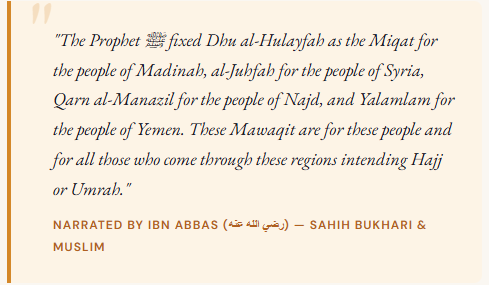
“The Prophet ﷺ fixed Dhu al-Hulayfah as the Miqat for the people of Madinah, al-Juhfah for the people of Syria, Qarn al-Manazil for the people of Najd, and Yalamlam for the people of Yemen. These Mawaqit are for these people and for all those who come through these regions intending Hajj or Umrah.”
Narrated by Ibn Abbas (رضي الله عنه) — Sahih Bukhari & Muslim
The History of Yalamlam
History
Unlike Dhat Irq — whose designation came through the judgement of Umar ibn al-Khattab (رضي الله عنه) — Yalamlam was appointed directly by the Prophet Muhammad ﷺ. It is named in the same famous hadith in which the Prophet designated all five principal Mawaqit, aligning each one with the direction from which pilgrims were already arriving.
For the people of Yemen, Yalamlam was not an arbitrary line drawn on a map. It was positioned where the terrain naturally funnelled southbound travellers — a practical threshold as much as a spiritual one. Caravans descending from the Yemeni highlands, having travelled for weeks, would know that Yalamlam meant they were close to the Holy City. It was the point at which their hearts shifted gear.
Over the centuries, as Hajj caravans became sailing voyages across the Red Sea, and then aeroplanes crossing entire continents, the relevance of Yalamlam only expanded. It was designated for a direction, not a specific road — and that direction encompasses today a population of hundreds of millions of Muslims across Africa, the Arabian Peninsula, and parts of Asia.
“Yalamlam was appointed by the Prophet ﷺ for a direction. That direction, fourteen centuries later, leads from every corner of the Muslim world in the south — and they all still pass through it.”
Masjid Miqat Yalamlam
The Mosque
At the boundary of Yalamlam stands Masjid Miqat Yalamlam (Arabic: مسجد ميقات يلملم) — the mosque that serves as the practical gateway for pilgrims arriving at this Miqat. Like the mosques at the other Mawaqit, its purpose is both practical and deeply symbolic: it provides the facilities and the sacred space for pilgrims to complete their preparations and formally enter the state of ihram.
مسجد ميقات يلملم
Masjid Miqat Yalamlam
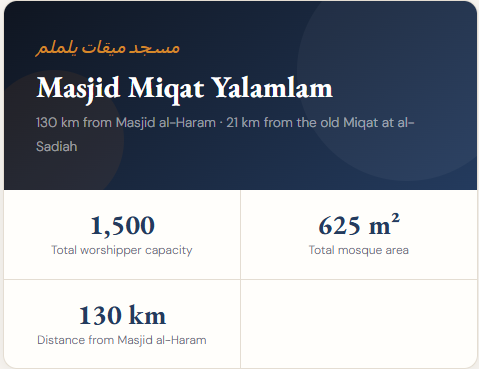
130 km from Masjid al-Haram · 21 km from the old Miqat at al-Sadiah
1,500
Total worshipper capacity
625 m²
Total mosque area
130 km
Distance from Masjid al-Haram
The mosque has a total area of 625 square metres and accommodates approximately 1,500 worshippers — a facility built to serve the steady flow of pilgrims who arrive at this southern Miqat throughout the Hajj and Umrah seasons. It is located 130 kilometres from Masjid al-Haram, and 21 kilometres southwest of the historical Miqat site at al-Sadiah, which marked the boundary in earlier centuries.
For the pilgrim arriving here after a long journey from Africa or Yemen, the mosque is where the transformation happens. Men change into the two white, unstitched cloths of ihram. Women ensure their modest covering is in place. Wudu or ghusl is performed. Two rak’ahs of Sunnah prayer are prayed. The niyyah — the sincere intention — is made in the heart. And then, for the first time, the Talbiyah rises from the lips:
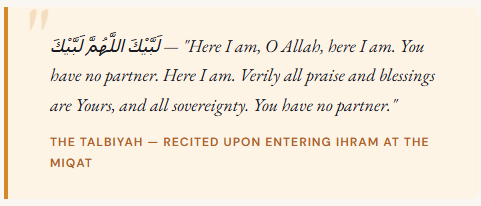
لَبَّيْكَ اللَّهُمَّ لَبَّيْكَ — “Here I am, O Allah, here I am. You have no partner. Here I am. Verily all praise and blessings are Yours, and all sovereignty. You have no partner.”
The Talbiyah — recited upon entering ihram at the Miqat
Guidance for Pilgrims
Practical Advice
Whether arriving by road from Yemen or by aircraft from South Africa or Nigeria, the obligation at Yalamlam is the same as at every Miqat: the pilgrim intending Hajj or Umrah must not cross this threshold without first entering the state of ihram. To do so knowingly renders a dam (penalty sacrifice) obligatory — and while this can be corrected, it is something every pilgrim should seek to avoid.
For air travellers from Africa and southern Asia
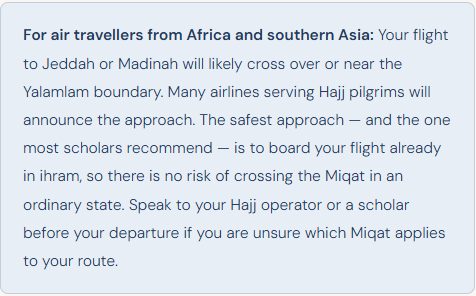
Your flight to Jeddah or Madinah will likely cross over or near the Yalamlam boundary. Many airlines serving Hajj pilgrims will announce the approach. The safest approach — and the one most scholars recommend — is to board your flight already in ihram, so there is no risk of crossing the Miqat in an ordinary state. Speak to your Hajj operator or a scholar before your departure if you are unsure which Miqat applies to your route.
The Miqat system is, at its heart, a gift. It asks the pilgrim to begin consciously — to mark the transition from ordinary life to sacred journey not at the airport or at the hotel, but here, at this ancient threshold, where generations of pilgrims before them have stood and said the same words, made the same intention, and taken the same step forward.
Yalamlam has been that step for the people of the south for fourteen centuries. May Allah accept the Hajj of every pilgrim who crosses it.
Explore More Miqat Guides
Dhu al-Hulayfah — The Miqat of Madinah
Al-Juhfah — The Miqat of Syria and the Northwest
Qarn al-Manazil — The Miqat of Najd