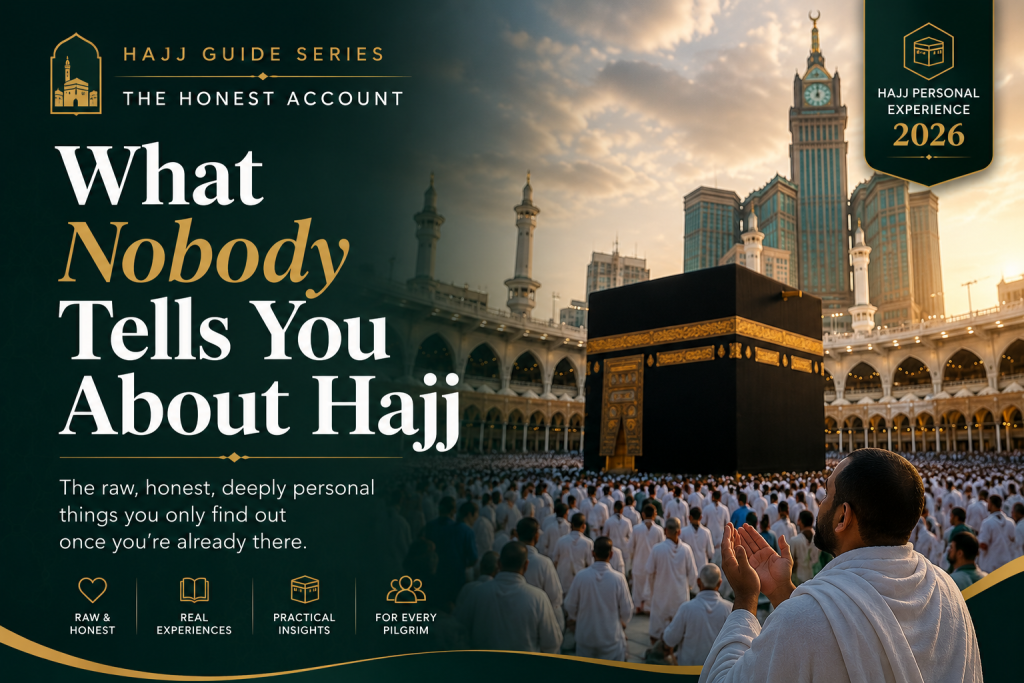
“I thought I knew what I was going for. I had read every guide, watched every video, spoken to everyone who had been. And still, nothing fully prepared me for what Hajj actually was.”
Everyone who comes back from Hajj says the same thing – it changed them (life changing journey) or should go earlier. What they don’t always say is how, or what the journey cost them to get there. Not financially. Emotionally. Physically. Spiritually.
This post isn’t a guide about rituals. There are plenty of those. This is the post I wish someone had written for me before I went in May 2026- the honest one, the one that tells you about crying without knowing why, about standing in 45-degree heat in Mina, Arafat or Jamarat wondering if your legs will hold, about the crowd that moved through you like water through stone, about the unexpected silence inside all that noise.
If you’re preparing for Hajj, or if you’ve been and you’re trying to make sense of what you experienced, I hope something here resonates. And if you’re supporting someone who’s going – read this too. It might help you understand why they came back different.
What Nobody Tells You About Hajj
The Emotional Reality Nobody Warns You About
You will feel things you have no name/ words or any thing how to discribe to others its somthing different inside of you body.
I cried for the first time during my first Tawaf (actually every time i been in Majid Al-Haram. Not softly – properly, from somewhere deep. I hadn’t expected that. I’m not someone who cries easily. But the moment I stepped into the open air of the Masjid al-Haram and saw the Ka’bah for the first time – this black cube, draped in gold embroidery, surrounded by hundreds of thousands of people moving around it like a living river – something broke open inside me.
Nobody told me that would happen. Nobody said: “By the way, your first sight of the Ka’bah might undo you completely.”
Hajj Personal Experience 2026:
When I entered Masjid al-Haram for the very first time, I wasn’t alone. I was with my brothers, and together we were a family of five making our first visit to the House of Allah. We had imagined this moment for years, but nothing could have prepared us for what we felt.
The instant our eyes fell upon the Ka’bah, every one of us became completely silent. Tears filled our eyes, but no words came out. We simply stood there, overwhelmed by emotions that are impossible to describe. It felt as if time had stopped. There was a strange peace and an indescribable pull that reached deep into my heart and soul. My body almost refused to move, and all I wanted to do was keep looking at the Ka’bah.
After what felt like only a few moments—but was probably much longer—we heard one of the Saudi security officers gently calling out, “Haji… Haji… move, move.” Even the way they say “Haji” carries a warmth and respect that has stayed with me ever since. That was the moment we realised we had been standing still, completely absorbed by the sight before us.
No photograph, video or documentary can prepare you for seeing the Ka’bah with your own eyes for the first time. It is a feeling that lives deep inside your heart, one that I know I will carry for the rest of my life. Even today, when I think back to that first moment, the emotions return just as strongly.
I sincerely pray that Allah gives every Muslim the opportunity to stand before the Ka’bah, experience that unforgettable moment, and perform Hajj or Umrah. Ameen.
What the books don’t tell you is that Hajj surfaces everything. Old grief. Old guilt. Prayers you stopped making years ago. People you haven’t thought about in a decade suddenly pressing on your mind at Arafat as the sun sets. There is something about being in that place, in that moment, with millions of other people all turning the same direction — it creates conditions for honesty with yourself that ordinary life doesn’t.
You will also feel frustration, and that’s okay
You’ll feel grateful one moment and irritable the next. A long queue, a lost bag, a delayed bus, another night with broken sleep — the mundane frustrations don’t stop because you’re on a sacred journey. What surprised me was how guilty I felt about being annoyed. I kept thinking: I shouldn’t feel like this here. I should be in a state of pure devotion.
But here’s what I learned: Hajj tests your character precisely through the ordinary frustrations. How you treat the person who pushed in front of you on the bus — that is the ibadah too. Patience under pressure is the spiritual curriculum, and the pressure is intentional.
The truth about emotion at Hajj
You will likely cry at least once, possibly many times. You will also likely feel frustration, exhaustion, and moments of profound disconnection alongside the spiritual highs. Both are normal. Both are part of it. The mistake is expecting to feel transcendent all the time.
The Physical Challenges Are Harder Than You Think
Your body will be tested in ways training cannot fully prepare you for.
I had walked five kilometres a day for three months before I went. I thought I was fit. I was not fit enough. Not for this.
The combination of heat, walking distances, disrupted sleep, unfamiliar food, and the emotional and spiritual intensity creates a physical strain unlike anything else. On the days of Hajj proper — the Mina, Arafat, Muzdalifah movement — many people in our group were operating on two or three hours of sleep over multiple nights.
- The walking distances are enormous. During the five days of Hajj, expect to cover 15–25 kilometres some days, much of it on hard ground, in heat that can reach 49°C.
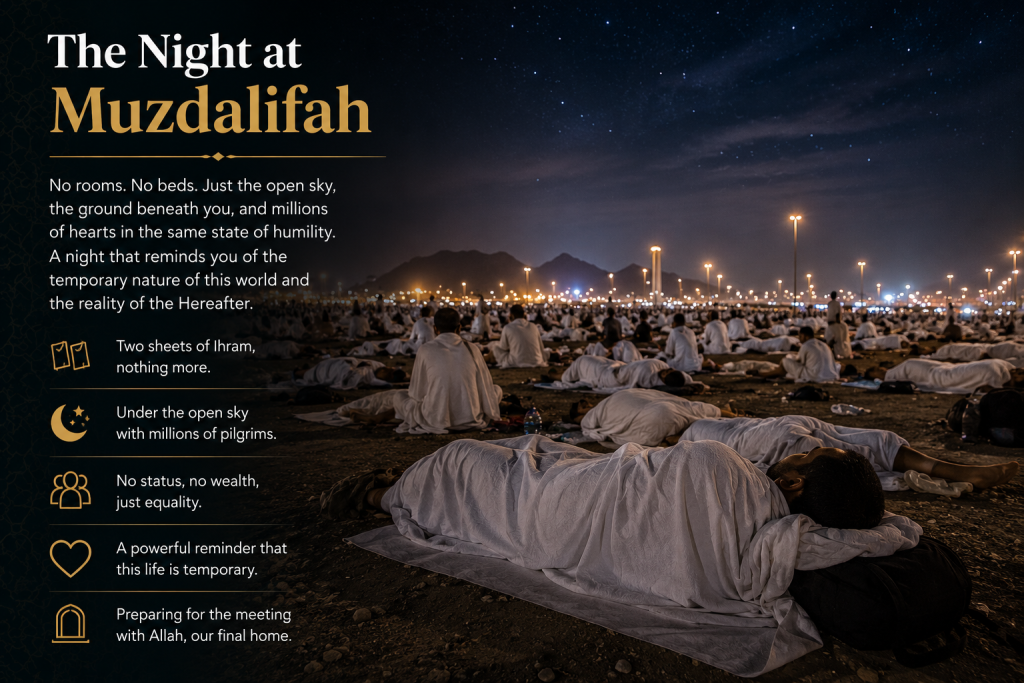
- The night at Muzdalifah is unlike any other night you will ever experience. There are no hotel rooms or comfortable beds. Instead, you sleep—or sometimes don’t sleep at all—under the open sky, on the ground, whether it is sand, dirt, pavement, or a roadside, wearing only the two simple, unstitched white sheets of Ihram. Surrounded by millions of fellow pilgrims, every comfort and status symbol of everyday life disappears.
For me, that night was one of the most thought-provoking moments of Hajj. Lying on the bare ground with nothing but my Ihram and the stars above, I couldn’t help but reflect on the temporary nature of this world. As Muslims, we believe this life is only a journey and that one day we will all return to Allah. Muzdalifah gave me a glimpse of that reality. It reminded me that wealth, luxury, and worldly possessions have little value in the end. What truly matters is our faith, our deeds, and preparing for the Hereafter (Akhirah).
Even today, when I think about that night, I don’t remember the discomfort. I remember the lessons it taught me—humility, simplicity, gratitude, and the real purpose of life. Those few hours under the open sky became one of the most unforgettable parts of my Hajj journey. - Caution: Dehydration is a real and serious danger. The heat is dry and constant. You don’t always feel thirsty until it’s too late. Drink continuously.
- The crowd at the Jamarat can feel genuinely overwhelming. The pushing is not aggressive — it is simply millions of bodies in a confined space. It can be frightening.
What actually helps
Broken-in footwear. Blister plasters bought in bulk before you go. Oral rehydration sachets mixed into your Zamzam water throughout the day, not just when you feel thirsty. Compression socks for the long flights and the long walks. And accepting, truly accepting, that some days your body will hurt and you will keep going anyway.
“The body’s limits are not a failure of faith. They are part of the offering.”
The Truth About Crowds at Hajj
Two million people is not an abstract number. It is a physical fact you will feel in your body.
I had seen the aerial photographs. I had watched the drone footage. I thought I understood what a crowd of two million people looked like. I did not, until I was inside one.
The crowd at Hajj is unlike any crowd you have experienced. A football stadium holds 80,000. Glastonbury holds 200,000. Hajj holds 2,000,000 — all in relatively contained spaces, all moving through the same rituals on the same timeline. The scale is genuinely incomprehensible until you are standing in it.
What nobody tells you is that the crowd has its own physics. It moves in waves. Sometimes you are walking freely; five minutes later you are pressed on all sides, not because anything has changed, but because the wave has shifted. The experienced pilgrims learn to read this. They walk near the edges of paths where possible, they avoid peak ritual times for optional elements, and they never, ever panic.
Important safety knowledge: If you feel the crowd getting very dense and you begin to feel frightened, do not push against it — this worsens crowd pressure and is what causes tragedy in crush situations. Instead, move diagonally towards the edge, keep your arms in front of your chest to protect your ribs and maintain space to breathe, and stay calm. Your group leader should have given you instruction on this; if they haven’t, ask.
Personal experience: The first time I entered the Masjid al-Haram for Tawaf after Zuhr prayer, the crowd was so dense I could not have lifted my arms above my waist. I was moving, but I was not choosing to move — the crowd was moving and I was inside it. It lasted about eight minutes before I found a clearer path. Afterwards, I sat down and my hands were shaking. Not from danger — I was never in danger — but from the sheer intensity of the experience. That eight minutes taught me more about surrender than any book.
When to go for key rituals to avoid the worst crowds
Tawaf is far less crowded in the very late night hours — after Isha and before Fajr. Many experienced pilgrims and scholars recommend this. The energy is different at that hour too: quieter, more contemplative, and the sight of the Ka’bah under the night sky is one of the most extraordinary things I have ever witnessed.
The Reality of Time Delays
Your schedule will not survive contact with Hajj. Make peace with this early.
If you are someone who runs on punctuality — who gets anxious when buses are late or plans change — Hajj will challenge you at a level you are not prepared for.
Buses don’t run to schedule. They can’t. The sheer logistical scale of moving millions of pilgrims means delays are not the exception; they are the norm. A bus that was meant to leave at 9am might leave at 11.30am. You will be told it is coming. You will wait. It will come eventually.
- Catering delays are common, especially during the days in Mina. Meals may arrive late or at unexpected times. Carry snacks — dates, nuts, energy bars.
- The move to Arafat on the 9th of Dhul Hijjah often takes much longer than expected due to road congestion. Some groups wait three or four hours on buses.
- Return flights are frequently delayed. The post-Hajj airport experience at Jeddah or Madinah is notoriously chaotic. Add hours to your expected wait time.
- Hotel check-in processes in Makkah can take a very long time, especially if your group is large. You may arrive exhausted from a long flight only to wait another two hours before you can access your room.
Personal experience: We waited four and a half hours on a coach outside our Mina camp before it moved. Four and a half hours in heat that was already climbing past 40°C, with no way to know when we’d move. I watched people handle this in completely different ways. Some prayed. Some slept. Some got increasingly upset. One man spent the entire time reciting Quran quietly to himself. When we finally moved, he was the calmest person on the bus. I learned something from that too.
How to survive the delays
Accept them as part of the journey before you go. Bring a pocket Quran, downloaded lectures, dhikr, and dates. Use waiting time as worship time. The delay isn’t wasted time — it’s time you have been given that you didn’t expect. The people who struggle most with Hajj delays are those who arrived with a rigid internal timetable.
The Mental Strength Hajj Demands
This is not a holiday. It is not even simply worship. It is a test of who you are.
I have heard Hajj described as a dress rehearsal for death. I think there is something truthful in that. You strip away your identity markers — your clothes, your job title, your social status, your nationality for a brief spiritual period — and you stand as a person, just a person, among millions of other people, equal before God.
That stripping away is not comfortable. Identity is comfortable. Anonymity is unsettling, even when it’s sacred.
The mental demands of Hajj are compounded by the physical exhaustion. After four nights of broken sleep, a body that aches in unfamiliar places, and an emotional intensity that has been running for days — your mental resilience is working harder than it ever does in ordinary life.
Triggers you might not expect
The standing at Arafat is the emotional peak of Hajj. For many people, it is the first time they have stood somewhere and truly believed, in their bones, that they are being heard. That experience can surface things: grief that wasn’t fully grieved, mistakes that weren’t fully forgiven, prayers for people who are no longer alive.
A woman in our group broke down completely at Arafat. She had lost her daughter two years before. She had been carrying that grief as quietly as she could for two years. At Arafat, she put it down. Properly. She said afterwards that she felt lighter leaving that plain than she had felt walking onto it. I think Hajj creates conditions for a kind of release that is very difficult to access otherwise.
Personal experience: I went to Hajj with a specific dua list. Names of people I wanted to pray for, things I wanted to ask for. I also, without realising it, went with a weight I had been carrying — some guilt, some regret, some unfinished internal business I hadn’t consciously named. At Arafat, I wasn’t thinking about my list. I was just — present, in a way I rarely am. And afterwards something was different. I cannot prove it or explain it. But I came back lighter too.
“Hajj doesn’t ask if you are ready. It asks if you are willing.”
The Personal Lessons That Change You
What you bring back isn’t always what you went looking for.
I went to Hajj hoping to come back feeling spiritually renewed. I did. But I also came back with a set of lessons I hadn’t gone looking for — lessons about patience, about ego, about my relationship with other people, and about what actually matters.
You learn that ego is heavy
The ihram removes the visual signals of status. In those two white cloths, you cannot tell a doctor from a cleaner, a wealthy businessman from someone who saved for fifteen years for this journey. That visual equality is extraordinary. And you begin to realise how much of ordinary life is organised around reinforcing status distinctions that, here, mean nothing at all.
You learn what patience actually means
Not the performance of patience — smiling through gritted teeth. Real patience. The kind where you genuinely stop needing things to be different from how they are. I watched an 80-year-old man navigate the Jamarat with a walking frame, surrounded by thousands of people, at his own pace, completely unbothered by anyone moving faster. He wasn’t slow. He was exactly where he needed to be, doing exactly what he needed to do.
You learn that humanity is enormous and also one thing
There is a moment during Tawaf, particularly at night, when you become aware of the extraordinary diversity of the people around you. Tall Somali men in white. Indonesian women in bright batik. Turkish families with small children. Pakistani grandmothers who have been saving for this since before you were born. Every continent, every language, every skin tone. All moving together, all saying the same words, all facing the same direction.
I cried at this too. I cried because it was the most beautiful thing I had ever seen, and because it made me feel that something true was happening in the world, even when the news makes you doubt it.
What most people come back knowing
That they are smaller than they thought. That other people are larger than they appeared. That the things they worried about before they left are not as large as they seemed. And that they want, very much, to go back.
Honest Advice for First-Time Pilgrims
What I would tell myself if I could go back to the person I was before I left.
- Lower your expectations for the mystical, raise them for the mundane. The spiritual highs are real, but they happen between coach delays and heat exhaustion and queues for the bathroom. Prepare for the ordinary; the extraordinary arrives uninvited.
- Your body will need attention. Drink water constantly. Eat even when you don’t feel hungry. Sleep in every gap you find. This is not indulgence — it is stewardship of what God gave you to complete this journey.
- Be kind to your group. You will be with the same people, under pressure, for weeks. The ones who came home with friendships intact are the ones who decided patience with each other was also ibadah.
- Do not spend all of Hajj on your phone. Be present. The images you’ll capture in your memory are more valuable than any photograph.
- Prepare your duas properly. Write them down. Be specific. Think about them in advance. At Arafat, when the moment arrives, you’ll be grateful that you already know what you want to say.
- Don’t compare your experience to others’. Some people weep from the moment they arrive. Some feel spiritually flat for the first week and then have a single transformative moment. There is no correct version of this experience.
- The journey home is part of Hajj too. The post-Hajj airport experience is famously difficult — hot, delayed, overcrowded. Stay in your ihram of patience a little longer. It will end.
- Give yourself time after you return. Re-entry to ordinary life after Hajj can feel disorienting. The noise and pace of normal life can feel jarring. Give yourself space to integrate what you’ve experienced before you’re fully back in the routine.
The single most useful thing someone told me before I went: “When it’s hard — and it will be hard — remember that you chose this. Nobody forced you here. You are here because you love Allah and you answered a call. Hold onto that when everything else is difficult.” I repeated that to myself many times during Hajj. It always helped.
Questions People Really Ask About Hajj
Honest answers to the things people search for but don’t always find straight answers to.
Is Hajj really as life-changing as people say?
In my experience and in the experience of nearly every pilgrim I have spoken to – yes. But not always in the way you expect. For some people it is a dramatic, emotional transformation. For others it is quieter: a settling, a clarity, a shift in perspective that becomes apparent gradually. What almost everyone agrees on is that something changes. You do not come back the same person who left. That change may take weeks or months to fully understand.
Is it safe to perform Hajj? What are the real risks?
The Saudi authorities have invested enormously in safety infrastructure, and Hajj is in most ways a very well-managed operation. The primary risks are heat-related illness and dehydration, which are preventable with preparation. Crowd-related incidents can occur but are rare and concentrated around specific times and places. For anyone with serious health conditions — heart disease, diabetes, respiratory conditions — a thorough conversation with your GP is essential before going. Travel insurance with comprehensive medical cover is non-negotiable.
What do people most regret about how they prepared for Hajj?
The most common regrets I’ve heard are: not preparing physically (underestimating the walking distances and heat), not preparing their duas in advance (arriving at Arafat with no specific prayers ready), spending too much time on their phones during key moments, and not investing enough time in learning the fiqh of the rituals so they felt confident performing them. Very few people regret packing too little. Many regret packing too much.
How do people cope emotionally when they return from Hajj?
Re-entry is genuinely difficult for many pilgrims. You have been in an extraordinary environment, stripped of normal routine, and then you return to the exact life you left — with the same problems, the same pressures, the same noise. Many people feel low or flat in the weeks after returning. Scholars call this the post-Hajj adjustment period. The advice is to maintain the habits of prayer and dhikr you built during Hajj, to spend time with people who understand what you’ve experienced, and to be patient with the adjustment. The experience settles slowly into who you are.
Is the Hajj experience different for women?+
In some practical ways, yes. Women must be part of an organised group under current Saudi regulations. The physical demands are the same, but women performing Hajj during menstruation face specific fiqh considerations — particularly around Tawaf — which is worth consulting a scholar about before departure. Many women find the experience of Hajj, particularly the equality of the ihram state, profoundly powerful. The crowd dynamics at the Jamarat and during Tawaf require particular awareness for women travelling without close family alongside them.
What should you do if you feel spiritually disconnected during Hajj?
This is more common than people admit. The exhaustion and sensory overwhelm can create a feeling of flatness even in holy spaces. Scholars and experienced pilgrims advise: don’t chase the feeling. Return to the basics — salah at their proper times, consistent dhikr, quiet contemplation, recitation of Quran. Sometimes the spiritual experience of Hajj is not a dramatic feeling but a slow, quiet reorientation. Trust the process. The feeling is not the point; the presence and the intention are.
What’s the hardest part of Hajj that nobody talks about?
Coming home and finding that ordinary life doesn’t automatically feel different — even though you do. You return having had this profound experience and the world around you has continued exactly as it was. The supermarket is the same. The traffic is the same. The office is the same. The work of Hajj is partly the pilgrimage itself, and partly the long, quiet work of integrating it into a life that doesn’t pause for your transformation.
How physically demanding is Hajj, really?
More demanding than almost any pilgrim fully anticipates. The combination of heat (regularly 42–47°C during peak Hajj season), distance (15–25km walking on some days), disrupted sleep (some nights effectively sleeping outdoors or not at all), and continuous ritual activity over five intensive days means that even physically fit people find themselves at their limits. Anyone with a chronic health condition, joint problems, or significant cardiovascular history needs detailed medical advice before committing to go. The Saudi medical services are excellent, but prevention is far better.
Why do so many people want to go back to Hajj even after their obligatory pilgrimage?
This is perhaps the most surprising thing about Hajj — you spend the whole journey exhausted, tested, and pushed to your limits, and yet almost universally, people want to return. The explanation I find most compelling is that Hajj is one of the rare experiences where you feel truly, completely alive — where everything is stripped away and what remains is just you, your faith, and two million fellow pilgrims. That feeling is difficult to replicate elsewhere. Makkah has a gravity of its own.
Does Hajj really erase past sins as Islamic tradition teaches?
The hadith of the Prophet Muhammad ﷺ (reported in Bukhari and Muslim) states that whoever performs Hajj without committing obscenity or wrongdoing returns as the day their mother bore them — free of sin. This is a matter of faith and sincerity, not a formula that operates automatically. The scholars note that what makes this possible is the combination of sincere intention, correct performance of the rituals, and genuine repentance. Many pilgrims describe an overwhelming sense of spiritual renewal and relief at Hajj — not just as a belief but as a felt experience.