A Practical Guide for Hajj & Umrah Pilgrims about Money Exchange in Saudi Arabia
Planning your Hajj or Umrah involves plenty of big decisions: flights, hotels, visas, Ihram, transport and what to pack. Money tends to feel like the easy part.
You might think, I’ll just take my bank card and withdraw some cash when I get there. And, in many cases, you can. Saudi Arabia has a modern payment system, ATMs are widely available, and card payments are common. But I would still advise every pilgrim to understand how money works before travelling. The last thing you want during Hajj or Umrah is to be standing outside a shop, restaurant or taxi trying to work out why your card isn’t working.
The best approach is not cash or card. It is a sensible combination of both.
This Miqat money exchange guide explains Saudi currency, where to exchange pounds and other foreign currencies, using UK bank cards, ATM withdrawals, travel cards, how much cash to carry, and some simple mistakes that can quietly make your pilgrimage more expensive.
Miqat Tip: Don’t spend days chasing the absolute best exchange rate to save a few pounds. Prepare sensibly, understand the fees, keep more than one payment method and concentrate on the reason you are travelling.
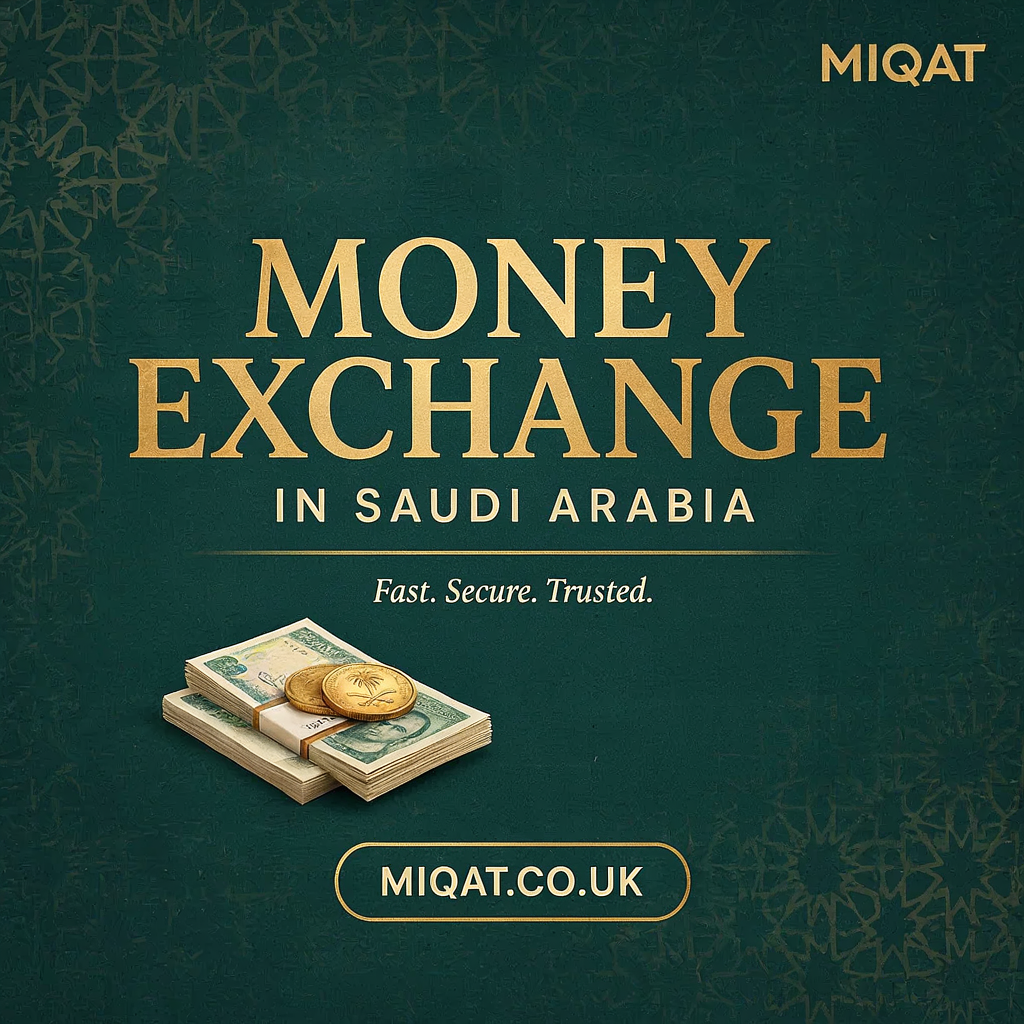
Money Exchange in Saudi Arabia
What Currency Is Used in Saudi Arabia?
The official currency of Saudi Arabia is the Saudi Riyal, commonly abbreviated as SAR or written as ﷼.
One Saudi Riyal is divided into 100 halalas.
When you are shopping, booking transport or eating out, prices will normally be displayed in Saudi Riyals.
If you are travelling from Britain, you will therefore be converting:
British Pounds (GBP) → Saudi Riyals (SAR)
The GBP/SAR exchange rate moves over time, so rather than putting a fixed exchange rate in this guide, check the live rate shortly before travelling.
Why I Don’t Recommend Memorising an Exchange Rate
It is tempting to think:
£1 = X Saudi Riyals.
The problem is that exchange rates move.
More importantly, the rate you see on Google is not necessarily the amount you will receive from:
- a currency exchange
- your bank
- an ATM
- your credit card
- a travel-money provider
There may be a spread, commission, foreign transaction charge or ATM fee involved.
For that reason, use the live market rate as a reference point, not a guarantee of what you will receive.
Should You Take Cash to Saudi Arabia?
Yes—I would.
But I would not recommend carrying your entire Hajj or Umrah budget in cash.
Saudi Arabia has developed a strong digital-payment infrastructure, and electronic payments are widely used. Nevertheless, carrying some Saudi Riyals is extremely useful.
Cash can help with:
- Small purchases
- Street shops
- Snacks and drinks
- Tips
- Small gifts
- Unexpected transport
- Markets
- Situations where your card temporarily fails
- Emergency backup
Think of cash as part of your backup system rather than your only payment method.
For most pilgrims, the safest setup is:
Saudi Riyal cash + main payment card + backup card
If one fails, you still have two alternatives.
Should I Exchange Pounds Before Travelling?
There is no single correct answer.
Personally, for a first-time pilgrim, I think having some Saudi Riyals before leaving home makes sense.
You do not need to arrive carrying your entire spending budget in Riyals. You simply want enough money that you are not immediately dependent on finding an ATM or currency exchange after a long journey.
You may arrive tired.
Your phone may not yet have internet.
Your transfer arrangements could change.
You may want food or drink.
Having some local currency removes one unnecessary worry.
A sensible approach
Instead of exchanging everything at once:
Before departure:
Take a modest amount of Saudi Riyals.
During the journey:
Use a suitable card for normal purchases.
When needed:
Withdraw additional Riyals from an ATM or exchange money through an authorised exchange centre.
This spreads your risk.
Where Can You Exchange Money in Saudi Arabia?
Pilgrims and tourists can exchange foreign currency through authorised exchange centres. Saudi Central Bank rules specifically recognise pilgrims, Umrah performers and tourists as customers who can use authorised money-exchange services.
You will commonly find exchange facilities around:
Jeddah
Jeddah is a major arrival point for pilgrims travelling onwards to Makkah.
Exchange facilities and ATMs are available around the airport and throughout the city.
Madinah
Madinah has banks, ATMs and exchange facilities, particularly around commercial areas and locations serving visitors.
Makkah
There are numerous ATMs, banks and money-exchange businesses around Makkah.
Areas surrounding Masjid al-Haram are heavily commercial, so accessing money is generally straightforward.
Airports
Airports are convenient because you can obtain Riyals shortly after landing.
However, convenience does not automatically mean the best exchange rate.
Compare the rate and fees before exchanging a large amount.
Use Authorised Money Exchange Centres
This point is important.
Do not exchange money informally with strangers simply because somebody offers you a slightly better rate.
Currency exchange is a regulated activity in Saudi Arabia. Pilgrims and tourists should use authorised money exchange centres or banks.
You may also be asked for identification.
Saudi regulations require valid identification for customers using money-exchange centres, and passport information can be required for visiting pilgrims and tourists.
So when exchanging a significant amount of money, take your passport or appropriate identification with you.
And keep the receipt.
Cash vs Debit Card vs Credit Card vs Travel Card
There isn’t one perfect payment method.
Each has advantages.
| Payment Method | Best Used For | Main Advantage | Watch Out For |
|---|---|---|---|
| Saudi Riyal Cash | Small purchases & backup | Works without technology | Loss/theft |
| UK Debit Card | Everyday purchases | Convenient | Foreign transaction fees |
| Credit Card | Hotels & larger purchases | Convenience/security | FX and cash-withdrawal charges |
| Travel Card | Everyday spending | Often designed for foreign currency | Provider-specific fees |
| ATM Withdrawal | Getting additional cash | Convenient | ATM + bank charges |
| Mobile Wallet | Contactless purchases | Fast and convenient | Requires compatible card/device |
The important thing is redundancy.
Do not travel with only one method of accessing money.
Using Your UK Debit or Credit Card in Saudi Arabia
International payment cards are widely useful in Saudi Arabia, particularly in:
- Hotels
- Restaurants
- Shopping centres
- Supermarkets
- Pharmacies
- Larger shops
- Transport apps
- Online bookings
Before travelling, check your bank’s foreign-use policy.
Look specifically for:
Foreign transaction fee
Some UK banks charge a percentage every time you spend abroad.
A £100 purchase could therefore cost more than £100 once the fee is added.
ATM withdrawal fee
Your bank may charge separately for withdrawing cash overseas.
Exchange-rate markup
Some providers build additional cost into the currency conversion.
Cash advance charges
Withdrawing cash using a credit card can be particularly expensive because interest and cash-advance charges may apply.
Check these things before you travel rather than discovering them on your statement after returning home.
The Most Important Card-Payment Rule: Pay in Saudi Riyals
This is one of the simplest travel-money lessons to remember.
Sometimes an ATM or payment terminal may ask whether you want the transaction converted into British Pounds.
For example:
Pay £21.40
or
Pay SAR 100
Your instinct might be to choose pounds because the amount feels familiar.
Be careful.
This type of conversion can involve a service known as Dynamic Currency Conversion (DCC), where the merchant or ATM operator performs the conversion rather than your card provider.
The exchange rate offered may be less favourable.
In many situations, choosing to pay in the local currency—Saudi Riyals (SAR) and allowing your own card provider to handle the conversion can be better.
Always check your particular card’s terms, but remember:
When asked which currency you want to pay in, don’t automatically choose pounds simply because you recognise the amount.
Using ATMs in Saudi Arabia
ATMs are widely available, especially in Makkah, Madinah, Jeddah, airports, shopping centres and around major hotels.
They can be one of the easiest ways to obtain Saudi Riyals.
However, before pressing “withdraw,” pay attention to the screen.
You may encounter:
- ATM operator fees
- Your own bank’s overseas withdrawal fee
- Currency conversion offers
- Daily withdrawal limits
The total cost matters more than simply finding an ATM.
Miqat ATM Tips
Use ATMs attached to recognised banks where possible.
Avoid making lots of tiny withdrawals if your bank charges a fixed fee each time.
Cover the keypad when entering your PIN.
Take your card before walking away.
Keep your cash discreetly stored.
If offered conversion into GBP, read the exchange rate carefully before accepting.
Should You Use a Travel Money Card?
For many pilgrims, a fee-friendly travel debit or prepaid card can be useful.
These cards may offer competitive currency conversion and lower overseas transaction fees than some traditional bank accounts.
But don’t assume every travel card is free.
Check:
- Foreign exchange markup
- ATM allowance
- ATM fees after the allowance
- Weekend exchange-rate adjustments
- Replacement-card procedure
- Saudi Arabia availability
- Daily spending limits
A travel card is best viewed as one part of your payment setup.
I would still take another bank card separately.
Keep Your Backup Card Somewhere Else
This sounds simple, but it can save your journey.
If your wallet contains:
- all your cash
- debit card
- credit card
- travel card
…and you lose that wallet, you have lost everything at once.
Instead:
Wallet:
Small amount of cash + main card.
Hotel safe / secure luggage:
Backup card + additional cash.
If travelling with your spouse or family, consider dividing emergency funds between responsible adults.
One lost wallet should not become a financial emergency.
How Much Cash Should You Carry for Umrah?
There isn’t a universal amount.
It depends heavily on whether:
- Your hotel is prepaid
- Breakfast or meals are included
- Airport transfers are included
- You intend to use taxis
- You plan to buy gifts
- You are travelling alone or as a family
- You are staying for five days or three weeks
Rather than asking:
“How much cash should I take?”
Ask:
“Which parts of my trip have I already paid for?”
Then build your spending budget around what remains.
A Simple Pilgrim Budget
Create categories before travelling.
| Expense | Already Paid? | Expected SAR | Actual SAR |
|---|---|---|---|
| Flights | ✓ | — | — |
| Hotel | ✓ / ✗ | ||
| Airport transfer | ✓ / ✗ | ||
| Makkah–Madinah transport | ✓ / ✗ | ||
| Food | |||
| Local taxis | |||
| SIM / eSIM | |||
| Laundry | |||
| Gifts | |||
| Ziyarah / excursions | |||
| Emergency fund |
This simple exercise gives you a much better answer than somebody on social media saying:
“Take £500.”
Their journey may be completely different from yours.
Don’t Forget Saudi VAT
Saudi Arabia has a standard VAT rate of 15% where applicable.
For pilgrims, this is worth remembering when budgeting for shopping, services and other purchases.
Sometimes the displayed or quoted price may already include VAT; in other contexts you should make sure you understand the final amount payable.
When budgeting, leave some flexibility rather than calculating everything down to the last Riyal.
Money During Hajj Is Different From Normal Umrah Travel
During Umrah, you may spend most of your time between your hotel, Masjid al-Haram, restaurants and shops.
Hajj is different.
During the days involving:
- Mina
- Arafat
- Muzdalifah
- Jamarat
your normal routine changes considerably.
This is not the time to depend entirely on finding an ATM whenever you need one.
Prepare beforehand.
Carry:
- A modest amount of cash
- Your main payment card
- Your phone
- A charged power bank
But keep valuables to a minimum.
During Hajj, simplicity is a blessing.
A Spiritual Lesson About Money During Hajj and Umrah
There is something interesting about travelling for pilgrimage.
Before leaving home, we spend weeks thinking about money.
How much will the flights cost?
How expensive is the hotel?
How many Riyals should I take?
How much will food cost?
Then you enter Masjid al-Haram.
You see people from every part of the world standing together.
Rich and poor.
Business owners and labourers.
Doctors and drivers.
Different languages, nationalities and backgrounds.
During Hajj, men enter Ihram dressed in the same simple white cloth.
Many of the things we use to measure status in everyday life suddenly become almost meaningless.
That does not mean money is unimportant. We have responsibilities, families and expenses, and Islam teaches us to manage them properly.
But Hajj and Umrah can quietly change our relationship with possessions.
You begin to remember that money is something we use during the journey.
It isn’t the purpose of the journey.
Take enough money to make your pilgrimage comfortable and safe—but don’t allow shopping, prices and possessions to become the memories that define your time in Makkah and Madinah.
Common Money Mistakes Pilgrims Should Avoid
Carrying all your money in cash
Unnecessary and risky.
Depending on only one bank card
Cards can be lost, blocked or damaged.
Not checking foreign transaction fees
A convenient card at home may be expensive abroad.
Automatically paying in GBP
Always examine the SAR option and the exchange rate offered.
5. Exchanging large amounts without comparing rates
Convenience can carry a price.
Using unofficial currency exchangers
Use authorised services.
Keeping everything in one wallet
Split your money and cards.
Carrying too much cash into crowded areas
Take what you reasonably need.
Forgetting an emergency fund
Keep money available for unexpected transport, medical needs, changed flights or other problems.
Spending too much time shopping
Makkah and Madinah have wonderful shopping opportunities, and bringing gifts home is part of many families’ traditions.
But remember why you travelled thousands of miles to be there.
The shops will still exist after Salah.
Your time in the Haram is limited.
FAQs
What currency should I take to Saudi Arabia for Umrah?
The local currency is the Saudi Riyal (SAR). Having some Riyals when you arrive is useful for small purchases, transport and emergencies.
You do not necessarily need to convert your entire spending budget before travelling. A combination of local cash and suitable payment cards gives you greater flexibility.
Check the current exchange rate and your bank’s international fees before departure.
Is it better to exchange money before going to Saudi Arabia?
Exchanging a small amount before travelling can make your arrival easier.
You can then compare exchange rates or withdraw additional Riyals once you are in Saudi Arabia.
The “best” option depends on the exchange rate available to you and the charges imposed by your bank or travel-money provider.
Can I use British Pounds in Makkah and Madinah?
You should plan to make everyday purchases in Saudi Riyals rather than relying on shops accepting British Pounds.
GBP can be exchanged through authorised exchange services, but restaurants, supermarkets, taxis and ordinary shops generally operate in SAR.
Think of pounds as currency to exchange, not your everyday spending currency in Saudi Arabia.
Are debit cards widely accepted in Saudi Arabia?
Card and digital payments are widely used across Saudi Arabia, particularly in hotels, shopping centres, restaurants, supermarkets and larger retailers.
Still, carry some cash.
Technology fails, cards can be declined, and small cash purchases remain useful.
Can I withdraw Saudi Riyals from an ATM?
Yes. ATMs are widely available throughout major Saudi cities and pilgrimage areas.
Your UK bank may charge an overseas ATM fee, and the ATM operator may also impose charges.
Check the transaction screen carefully before accepting the withdrawal.
Should I take cash or card for Umrah?
Take both.
Cash provides flexibility for small purchases and emergencies, while cards reduce the need to carry large amounts of money.
A main card, backup card and modest amount of Saudi Riyal cash is a sensible combination.
How much spending money do I need for Umrah?
There is no reliable single figure.
Someone travelling on a fully inclusive package will need far less spending money than a family paying separately for food, taxis and intercity transport.
Calculate your expected daily costs and add an emergency reserve.
Is it safe to carry cash in Makkah?
Millions of pilgrims visit Makkah, and normal travel precautions still apply.
Avoid displaying large amounts of money. Carry only what you reasonably expect to spend and leave additional funds securely stored.
Crowded environments require particular awareness of wallets, phones and personal belongings.
Should I use my credit card to withdraw cash?
Usually this deserves caution.
Credit-card cash withdrawals can trigger cash-advance fees and interest in addition to foreign exchange or ATM charges.
Check your card provider’s exact terms before using a credit card at an ATM.
Do I need my passport to exchange money in Saudi Arabia?
Authorised exchange centres are required to identify customers, including visitors and pilgrims. Depending on the transaction, passport information and additional documentation may be recorded.
Carry suitable identification when visiting an exchange centre, particularly for larger transactions.
Miqat’s Recommended Money Setup for Pilgrims
Keep it simple:
Before leaving home
✓ Check the GBP/SAR exchange rate
✓ Check your bank’s overseas fees
✓ Obtain some Saudi Riyals
✓ Take two payment cards if possible
✓ Tell your bank you’re travelling if required
✓ Save your bank’s lost-card number
✓ Create a basic spending budget
During your pilgrimage
✓ Pay in SAR
✓ Use authorised ATMs and exchange centres
✓ Carry only modest cash
✓ Keep your backup card separately
✓ Check transactions occasionally
✓ Keep an emergency reserve
Before returning home
✓ Avoid withdrawing excessive cash during your final days
✓ Spend or exchange unwanted Riyals sensibly
✓ Keep a small amount if you hope to return
And, Insha’Allah, perhaps keeping a few Riyals will give you another reason to say:
“I’ll need these when Allah calls me back.”
Final Reflection
Money is an important part of preparing for Hajj and Umrah, but it should remain exactly that—a part of the preparation.
Prepare enough that you don’t spend your pilgrimage worrying about exchange rates, declined cards or whether you have enough cash for tomorrow.
Then put the financial planning behind you.
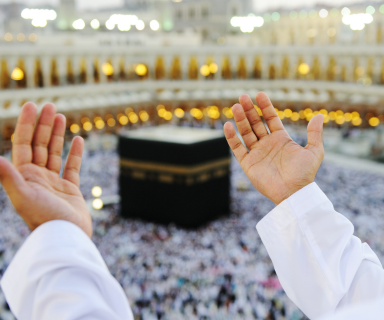
When you enter Masjid al-Haram and your eyes fall upon the Ka’bah, the exchange rate will probably be one of the last things on your mind.
You have travelled for something far more valuable.
May Allah provide for everyone longing to visit His House, make the financial path easy for those saving for Hajj and Umrah, place barakah in their wealth and their journey, and invite all of us back to Makkah and Madinah again and again.
Ameen.