You have paid for your flights. Your hotel is booked. Transport has been arranged. You have worked out roughly how much you will spend on food. Then somebody asks:
“How much money are you taking for shopping?”
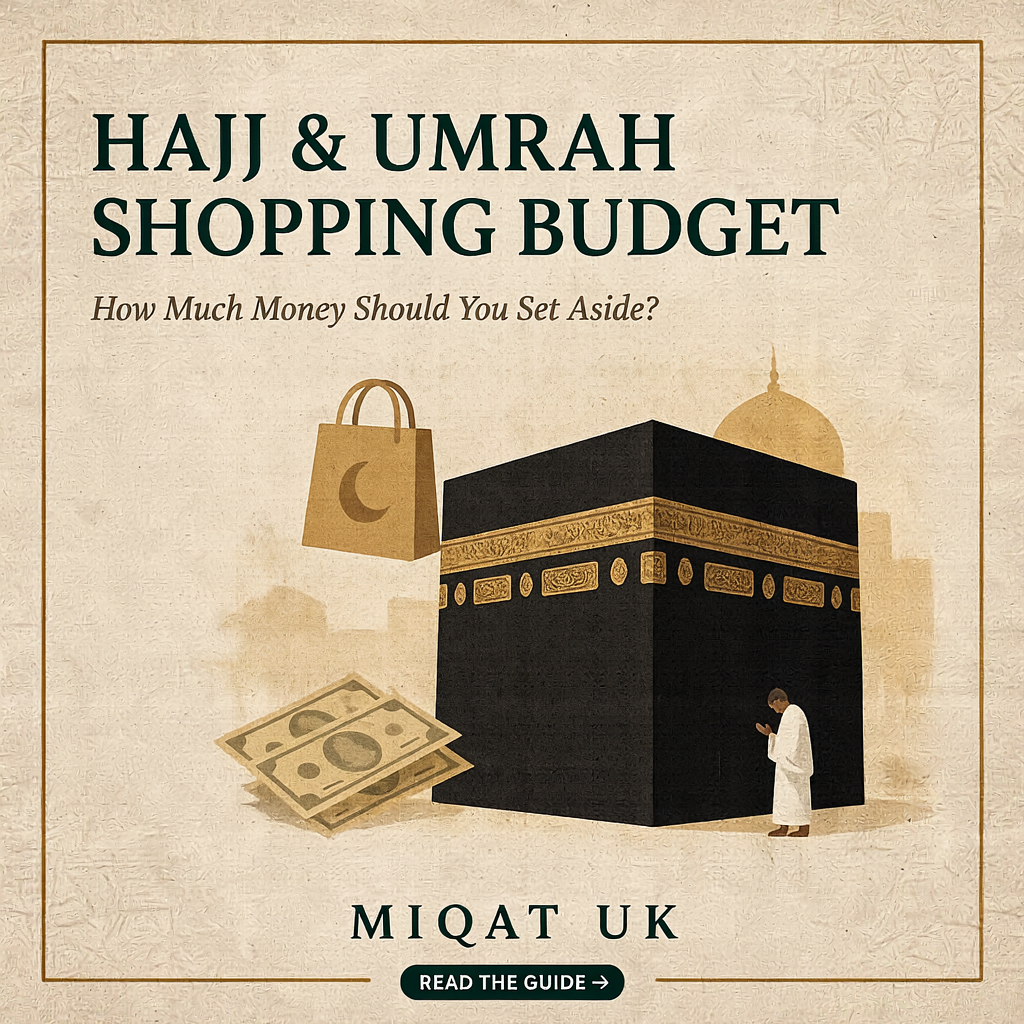
And suddenly another part of the Hajj or Umrah budget appears. Shopping isn’t the purpose of pilgrimage, but for most pilgrims it becomes part of the journey. You may want to bring dates home for family. Someone has asked for a prayer mat. You see a beautiful tasbih in Madinah. Your children want gifts. You may need another thobe or abaya. Perhaps you want attar, Islamic books or something small to remember the journey. One purchase isn’t necessarily expensive.
The problem is that small purchases multiply very quickly.
Hajj & Umrah Shopping Budget
This guide will help you create a realistic Hajj or Umrah shopping budget without allowing shopping to take over either your finances or your pilgrimage.
How Much Should You Budget for Shopping During Hajj or Umrah?
There is no single correct shopping budget.
One pilgrim may spend almost nothing beyond a few gifts.
Another may be buying for parents, children, siblings, friends and extended family.
Instead of asking:
“How much does everyone spend?”
Ask:
“Who am I actually buying for, and what do I intend to buy?”
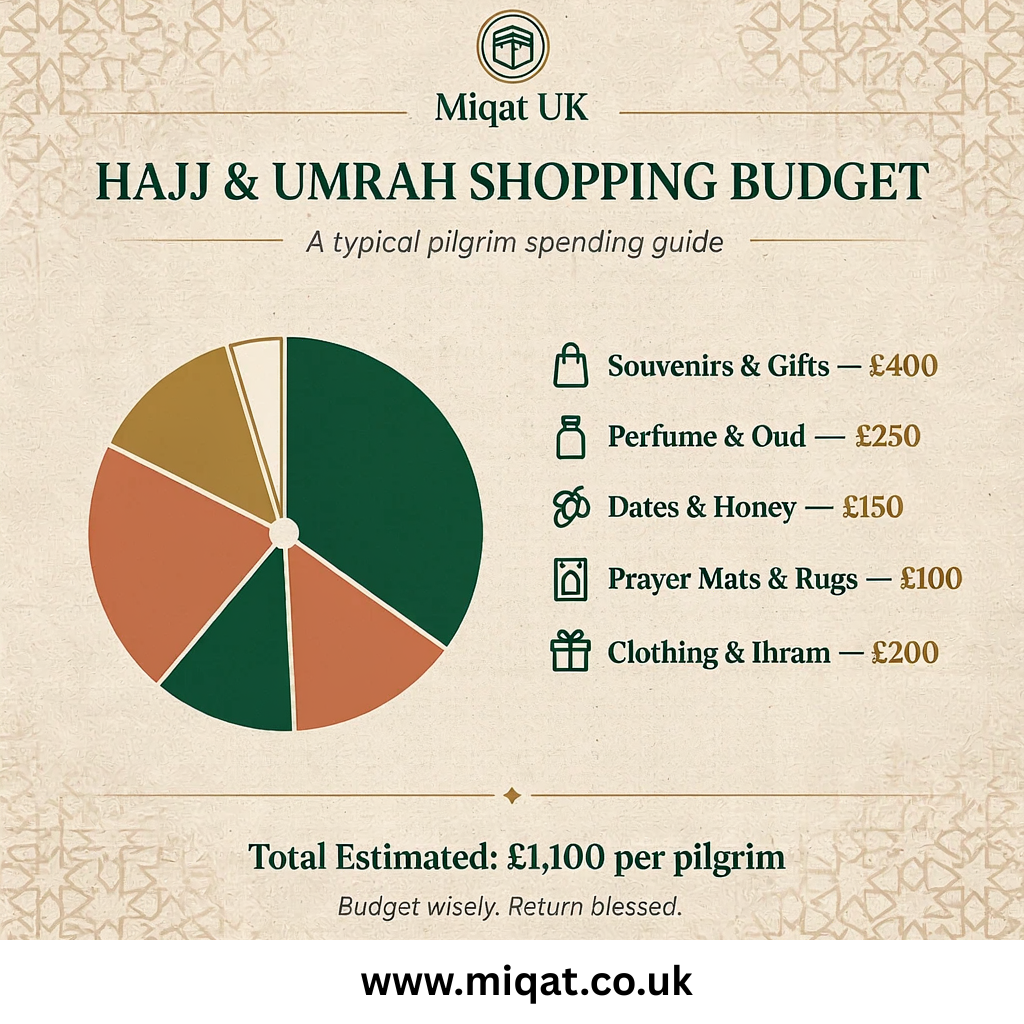
As a simple planning framework rather than a fixed price guide, you could think in terms of:
| Shopping style | Example planning allowance |
|---|---|
| Very limited shopping | £50–£100 |
| Moderate personal + family shopping | £100–£250 |
| Gifts for a larger family | £250–£500 |
| Extensive shopping | £500+ |
These aren’t required amounts and aren’t claims about what goods currently cost in Saudi Arabia. They’re simply useful limits you can set before travelling.
Your actual spending will depend on what you buy, quality, quantity, where you shop and current exchange rates.
Separate Your Shopping Money From Your Pilgrimage Budget
This is probably the most important budgeting principle in this article.
Don’t combine everything into:
“I have £1,000 spending money.”
Break it down.
For example:
Food: £___
Local transport: £___
SIM/data: £___
Emergency money: £___
Shopping: £___
Shopping should come after essential expenses, not compete with them.
Miqat’s How Much Does Food Cost in Makkah and Madinah? guide can help you estimate your food allowance separately.
And before deciding how many Saudi riyals your pounds will provide, read our Money Exchange in Saudi Arabia guide.
Once essentials are covered, you know what you can comfortably allocate to shopping.
Make Your Shopping List Before You Leave Home
This sounds almost too organised for souvenir shopping, but it works.
Create three groups.
People I Definitely Want to Buy For
Perhaps:
- Parents
- Spouse
- Children
- Siblings
- Close family
People I Would Like to Buy For
Perhaps:
- Friends
- Neighbours
- Colleagues
- Extended family
General Gifts
These are small items you can distribute without buying something individually selected for every person.
This simple exercise can prevent the classic situation where you start buying gifts in the final two days and suddenly realise:
“I forgot somebody.”
Then you buy five more things.
Then remember another person.
Then buy another ten.
Your suitcase and budget both suffer.
What Do Pilgrims Commonly Buy in Makkah and Madinah?
Shopping habits vary enormously, but common purchases include:
- Dates
- Prayer mats
- Tasbih
- Attar and perfume
- Abayas
- Thobes
- Hijabs and scarves
- Ihram clothing
- Qur’ans and Islamic books
- Miswak
- Islamic gifts
- Children’s gifts
- Decorative souvenirs
The important budgeting question isn’t simply the price of one item.
It is quantity.
A prayer mat for yourself is one purchase.
Prayer mats for twelve relatives are a budget category.
Dates Can Become a Significant Purchase
Dates are among the most popular gifts pilgrims bring home, particularly from Madinah.
It is very easy to think:
“I’ll just buy a few boxes.”
Then you see different varieties.
Different grades.
Different packaging.
Family asks for Ajwa.
Someone wants another variety.
Suddenly you are carrying several kilograms.
So dates should have their own line in your shopping budget.
For example:
Dates budget: £_____
Think about luggage weight at the same time.
A bargain stops looking like such a bargain if excess baggage becomes involved.
Miqat should eventually have a dedicated Buying Dates in Madinah: Ajwa, Varieties, Prices and Shopping Tips guide beneath the Madinah cluster.
Prayer Mats, Tasbih and Small Gifts
These are attractive gifts because they are useful and easy to associate with the pilgrimage.
But again, quantity matters.
Suppose you think:
“That’s inexpensive. I’ll take ten.”
Then you repeat the same thought with another product.
Small amounts quickly become a substantial total.
One strategy is to set a general gifts budget rather than deciding item by item.
For example:
General gifts: £80 maximum
Once that allowance has been spent, you’re done.
It removes much of the temptation to keep adding “just one more thing.”
Attar and Perfume
Attar can range from relatively inexpensive everyday fragrances to much more expensive products.
If perfume is something you enjoy, give it a separate budget.
Otherwise it is very easy to justify a purchase because:
“I’m already in Saudi Arabia.”
That sentence can become expensive.
Decide before travelling whether fragrance is:
a planned purchase
or
something you will only consider if money remains.
There is a big difference.
Abayas, Thobes and Clothing
Clothing is another category where budgets vary enormously.
Some pilgrims may buy one abaya or thobe.
Others may be shopping for several family members.
Before buying large quantities, consider:
- Actual need
- Size
- Quality
- Fabric
- Luggage space
- Whether the person will actually wear it
A gift isn’t automatically better because it came from Makkah or Madinah.
Buy things people will use.
Makkah vs Madinah Shopping
Both cities offer plenty of shopping opportunities, but your experience can be different depending on where you stay and where you shop.
Around the major mosque areas, convenience is a significant advantage.
You can leave your hotel and find shops almost immediately.
But convenience can also make spontaneous buying easier.
You walk out after salah.
See something.
Buy it.
Repeat that several times each day and your shopping budget disappears without ever having a dedicated “shopping trip.”
That’s why I prefer allocating one or two specific shopping periods.
Spend the rest of the journey doing what you travelled there to do.
Don’t Shop Every Day
This is partly financial advice and partly pilgrimage advice.
If you’re in Makkah for seven days, you don’t need seven shopping days.
The same applies in Madinah.
You could decide:
First days: worship, orientation and settling in.
One designated period: main shopping.
Final day: only anything genuinely forgotten.
This prevents shopping from becoming the background activity of the entire pilgrimage.
Cash or Card for Shopping?
You don’t necessarily need to carry your whole shopping budget as cash.
Depending on the merchant and current payment options, you may use cards or other electronic payment methods, while cash can still be useful in some situations.
The more important issue is knowing what your bank is charging you.
A purchase can involve:
- Exchange-rate conversion
- Foreign transaction fees
- ATM charges
- Merchant conversion choices
Our dedicated Money Exchange in Saudi Arabia guide explains the wider money-planning side of the journey.
Whatever payment method you choose, I would still maintain a written or phone-based shopping limit in GBP and SAR so that converting currencies doesn’t make spending feel unreal.
Be Careful With Currency Psychology
This happens easily when travelling.
At home, you instinctively understand what £10, £50 or £100 feels like.
In another currency, those instincts can become weaker.
A number in Saudi riyals can feel like “holiday money.”
It isn’t.
It is still your money.
When considering a larger purchase, mentally convert it back into pounds.
Then ask:
Would I still buy this at home for approximately that amount?
Sometimes the answer changes immediately.
Budget for Food Before Gifts
If your overall travel budget is limited, prioritise essential spending.
You still need to eat.
You may need taxis.
You may need mobile data.
You may encounter an unexpected expense.
That is why your shopping budget should be calculated after your basic pilgrimage costs.
Use Miqat’s How Much Does Food Cost in Makkah and Madinah? article to estimate your meal spending.
For connectivity, our SIM Cards in Saudi Arabia guide covers the options available to pilgrims.
Those are practical expenses.
Souvenirs are optional.
Keep Emergency Money Completely Separate
If you remember only one financial rule from this guide, make it this:
Emergency money is not shopping money.
If you have put aside £200 for emergencies, don’t look at your final-day wallet and think:
“We didn’t use this. Let’s spend it.”
Keep it available until the journey is effectively complete.
Unexpected costs can occur late in a trip too.
Airport transport.
Baggage.
Food.
Medication.
A changed arrangement.
Emergency funds have a purpose even when you are fortunate enough not to use them.
Shopping With a Family
Family shopping can grow quickly because several people are buying at once.
One person buys dates.
Another buys clothing.
Someone else buys gifts.
Nobody is keeping track of the total.
If you’re travelling as a family, consider agreeing beforehand:
Our total family shopping budget is £_____.
Individual family members can still have personal allowances, but at least you understand the overall exposure.
When five of us travelled together for Hajj, ordinary group decisions naturally became different from travelling alone. With several people, even small purchases or changes of plan multiply.
A little coordination helps.
Give Children Their Own Allowance
If you’re travelling with older children, giving them a small fixed shopping allowance can be useful.
Instead of repeatedly asking:
“Can I have this?”
they begin making choices.
If they spend the allowance immediately, that’s their decision.
If they save it for something they really want, they learn something useful.
It also protects the family budget from dozens of small impulse purchases.
Beware of the Final-Day Shopping Panic
This is probably when budgets are most vulnerable.
You realise you are leaving tomorrow.
Suddenly:
We need more dates.
Did we buy something for Uncle?
What about the neighbours?
We should take something for work.
Maybe another prayer mat.
Because time is short, you stop comparing and start buying.
The solution is simple:
Complete your main shopping before your final day.
Use the final day only for genuine omissions.
Think About Your Luggage Budget Too
Shopping has two costs:
the purchase price
and
the space/weight required to take it home.
Dates are heavy.
Books can be heavy.
Perfume bottles add weight.
Clothing occupies space.
Prayer mats can become bulky.
Before your main shopping trip, know your airline’s baggage allowance.
If possible, leave some empty suitcase capacity when travelling out.
Packing every suitcase to its limit before departure and then planning to buy gifts is asking for trouble.
Don’t Buy Something Simply Because It Says “Makkah” or “Madinah”
Pilgrimage naturally gives objects emotional value.
That’s understandable.
But pause before buying.
Ask:
Will I use this?
Will the person receiving it use it?
Is the quality reasonable?
Do I already have something similar?
Am I buying it because I genuinely want it or because I feel I should buy something?
Memories don’t have to be purchased.
Some of the most valuable things you bring home won’t be inside your suitcase.
Don’t Let Shopping Become the Pilgrimage
There is nothing inherently wrong with shopping.
You may genuinely enjoy choosing gifts for your parents or children.
There can be pleasure in bringing home dates for people you love.
But time in Makkah and Madinah is limited.
Imagine travelling thousands of miles and then spending hours every day browsing shops for things you could have bought elsewhere.
There needs to be balance.
I would rather return thinking:
“I didn’t buy everything I could have.”
than:
“I wish I had spent more time in the Haram.”
A Simple Shopping Budget Example
Suppose a pilgrim decides they can comfortably spend £200 on shopping.
They might divide it like this:
| Category | Example budget |
|---|---|
| Dates | £50 |
| Parents/immediate family gifts | £60 |
| Prayer mats/tasbih/general gifts | £40 |
| Personal purchase | £30 |
| Unplanned/forgotten gifts | £20 |
| Total | £200 |
This is only an example of how to structure a limit, not a recommendation that £200 is the correct amount.
Someone with a £50 budget can use exactly the same method.
So can someone with £500.
The principle matters more than the number:
decide the total first, then divide it.
£100 Shopping Budget Example
A smaller budget might look like:
| Category | Example allowance |
|---|---|
| Dates | £25 |
| Close family | £35 |
| General small gifts | £20 |
| Personal item | £10 |
| Reserve | £10 |
| Total | £100 |
You don’t need to buy something for everybody you know.
Most reasonable people understand that Hajj and Umrah aren’t shopping trips.
£500 Shopping Budget Example
For a larger family or somebody intentionally planning significant purchases:
| Category | Example allowance |
|---|---|
| Dates | £100 |
| Immediate family | £150 |
| Clothing | £100 |
| General gifts | £75 |
| Personal purchases | £50 |
| Reserve | £25 |
| Total | £500 |
Again, this is budgeting mathematics rather than a Saudi price list.
You decide what fits your finances.
Should You Borrow Money for Pilgrimage Shopping?
Optional gifts and souvenirs should not become a reason to create unnecessary financial pressure.
If your budget is limited, reduce the shopping.
People who genuinely care about you would rather you return safely than bring them an expensive gift.
A small bag of dates given sincerely can mean more than an elaborate present.
Keep a Simple Spending Record
You don’t need an accounting spreadsheet while performing Umrah.
A note on your phone is enough.
For example:
Shopping budget: £200
Dates – £42
Gifts – £55
Clothing – £30
Personal – £18
Remaining: £55
This takes seconds and stops the common problem of having no idea how much you’ve spent until checking the bank account.
What Should You Buy From Makkah or Madinah?
There is no compulsory shopping list.
Buy according to your needs and budget.
If I were simplifying it for a first-time pilgrim, I would think in this order:
1. Something meaningful for immediate family
2. Dates or another easy shared gift
3. Anything genuinely useful for yourself
4. Small general gifts only if the budget allows
Then stop.
You don’t need to return with a suitcase that looks like you opened a souvenir shop.
A Better Way to Think About Your Shopping Budget
Instead of asking:
“How much money should I take for shopping?”
ask four questions:
Who am I buying for?
What am I planning to buy?
What is my maximum total?
How much luggage space do I have?
Once those four answers are clear, shopping becomes much easier.
Frequently Asked Questions
How much should I budget for shopping during Umrah?
There is no standard amount. A pilgrim buying only a few gifts may need very little, while someone buying dates, clothing and gifts for a large family may spend considerably more.
Set a maximum amount according to your own finances after budgeting for essentials such as food and transport.
Is £100 enough for Umrah shopping?
It can be if your shopping plans are modest.
The important thing is to decide who you are buying for and prioritise purchases rather than expecting £100 to cover an undefined list.
Is £200 enough for Umrah shopping?
For some pilgrims, £200 can provide a reasonable discretionary shopping allowance. For others, particularly those buying for large families, it may not.
Treat the figure as a personal spending limit rather than a target.
How much money should I take to Saudi Arabia for Umrah?
Your overall spending money should cover much more than shopping, including food, local transport, connectivity and contingency expenses.
Calculate those categories separately before deciding your shopping allowance.
What are the most common gifts from Makkah and Madinah?
Dates, prayer mats, tasbih, attar, Islamic books, abayas, thobes and small Islamic gifts are commonly associated with pilgrimage shopping.
There is no requirement to buy any of them.
Should I buy dates in Makkah or Madinah?
Both cities offer dates, although Madinah is particularly associated with varieties such as Ajwa. Compare quality, quantity, packaging and price rather than buying solely because a shop is close to a major mosque.
Should I use cash or card when shopping in Saudi Arabia?
Having payment flexibility is useful. Your personal bank/card fees and exchange rates matter, so check these before travelling and see Miqat’s Money Exchange in Saudi Arabia guide for broader planning.
How can I stop overspending during Umrah?
Set your total shopping budget before travelling, make a gift list, allocate amounts by category, keep emergency money separate and record purchases as you make them.
Should I buy gifts for everyone after Hajj or Umrah?
No. There is no requirement to bring a gift for everyone you know.
Work within your means and don’t allow social expectations to create financial pressure.
When should I do my shopping?
I would avoid leaving all your shopping until the final day. Choose one or two dedicated periods during the trip and leave the final day for anything genuinely forgotten.
Plan the Money, Then Forget About It
A good budget isn’t there to make your pilgrimage feel restrictive.
It does the opposite.
Once you have decided:
This is my food money.
This is my transport money.
This is my emergency money.
And this is what I can comfortably spend on shopping.
you don’t need to keep worrying about every purchase.
You already know the boundary.
Buy the dates.
Choose something meaningful for your parents.
Bring a small gift for your children.
Perhaps buy something that will remind you of the journey.
Then stop.
Because years later, you probably won’t remember every shop you entered.
You may not remember what every gift cost.
But you may remember seeing the Ka’bah for the first time.
You may remember sitting inside Masjid an-Nabawi.
You may remember a dua.
A conversation with your family.
A difficult moment that taught you patience.
Those memories don’t take any luggage allowance.
And they don’t cost a single riyal.
May Allah put barakah in your wealth, protect you from waste and excess, make your Hajj or Umrah journey easy, and allow you to return home carrying something far more valuable than anything you could buy in a shop.
Ameen.