Before a pilgrim can set eyes on the Ka’bah, Islam appoints a boundary that must not be crossed in an ordinary state. That boundary is called the Miqat – and for millions of pilgrims travelling from the northeast, it is Dhat Irq.
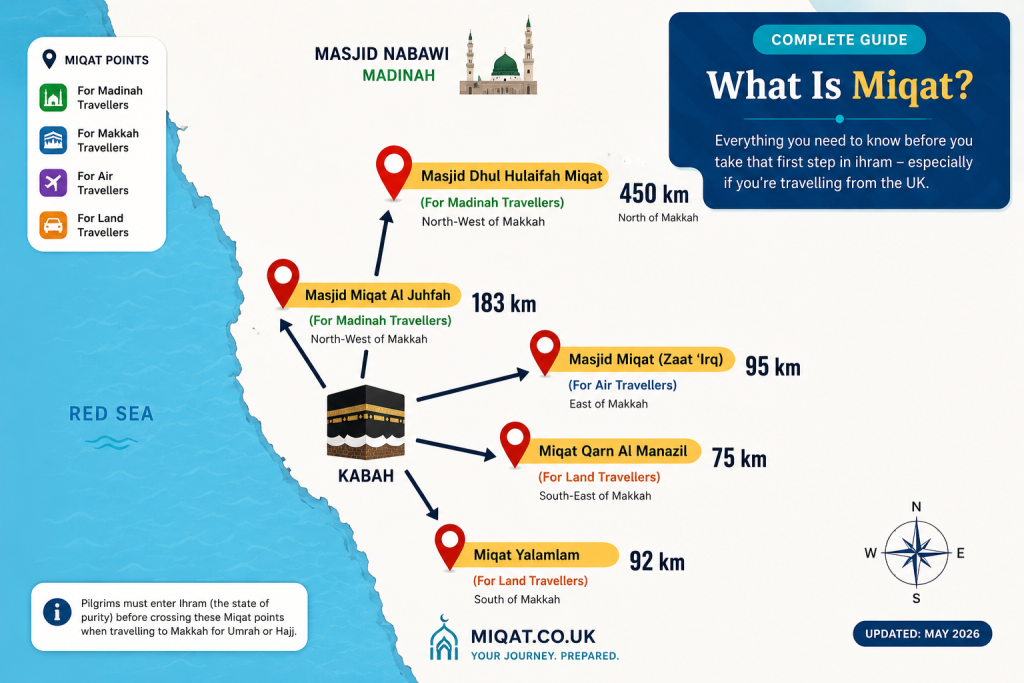
Dhat Irq (Arabic: ذات عرق) is one of the five designated Mawaqit (مواقيت) — the sacred boundary points that encircle Makkah, from which every pilgrim intending Hajj or Umrah must enter the state of ihram before proceeding to the Holy City. Each of the five Mawaqit serves a different direction of approach. Dhat Irq serves the northeast: the great corridor through which pilgrims from Iraq, Iran, and the lands beyond have been travelling for over fourteen centuries.
Dhat Irq
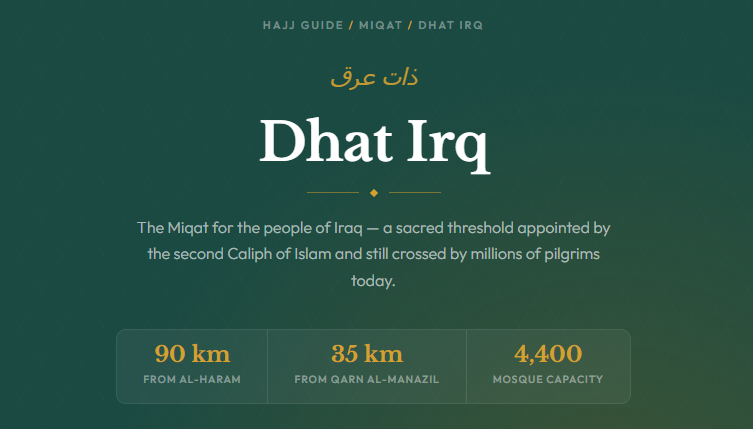
Its name carries a geographical memory. “Dhat Irq” means roughly “the place of the vein” — a reference to a prominent mountain in the region, whose ridgelines were said to trace the earth like veins beneath skin. It sits 90 kilometres northeast of Masjid al-Haram, and 35 kilometres from its neighbouring Miqat, Qarn al-Manazil (al-Sayl al-Kabeer).
| Arabic Name | ذات عرق (Dhat Irq) |
| Direction | Northeast of Makkah |
| Distance from Haram | 90 km (56 miles) |
| Nearby Miqat | 35 km from Qarn al-Manazil |
| Named After | A large mountain in the region |
| Appointed By | Umar ibn al-Khattab (رضي الله عنه), second Caliph of Islam |
Who Is Dhat Irq For?
Dhat Irq is the Miqat for pilgrims approaching Makkah from the direction of Iraq and the broader northeastern corridor. This includes travellers originating from or passing through Iraq, Iran, China, Russia, and other countries that lie in the general northeast of the Arabian Peninsula.
The Islamic ruling on the Mawaqit is clear and beautifully simple: a pilgrim uses whichever Miqat they first encounter — or pass in line with — on their route towards Makkah. For those whose journey brings them from the northeast, Dhat Irq is that threshold. Crossing it without entering ihram — for anyone intending Hajj or Umrah — renders a dam (penalty sacrifice) obligatory according to the majority of scholars.
“Whoever passes by one of these Mawaqit intending Hajj or Umrah must put on ihram there. Whoever lives within these boundaries must put on ihram from where he sets out.”
Narrated by Ibn Abbas (رضي الله عنه) — Sahih Bukhari & Muslim
For pilgrims flying to Jeddah or Madinah whose flight path passes over or near Dhat Irq, the same ruling applies in the air. Most Hajj operators and airline crews will announce when the aircraft is approaching the Miqat boundary. Many pilgrims choose to board their flights already in ihram to avoid any risk of crossing the boundary unprepared — this is entirely permissible and widely practised.
The History Behind Dhat Irq
Dhat Irq holds a distinction that sets it apart from the other four Mawaqit: it was not appointed directly by the Prophet Muhammad ﷺ. Instead, it was established during the reign of the second Caliph of Islam, Umar ibn al-Khattab (رضي الله عنه) — and the story behind its designation is a window into early Islamic governance at its most thoughtful.
During the Prophet’s ﷺ lifetime, the great Iraqi cities of Basra and Kufa did not yet exist as Muslim settlements. The Mawaqit designated by the Prophet served the directions from which pilgrims were already travelling — Madinah, Syria, Yemen, and Najd. The northeastern route from Iraq simply hadn’t yet produced a stream of pilgrims that required a formal threshold.
Within years of the Prophet’s ﷺ passing, that changed dramatically. Under Umar ibn al-Khattab’s caliphate, Basra and Kufa were founded and rapidly grew into two of the most important cities in the early Islamic world — centres of scholarship, governance, and a swelling Muslim population with their hearts turned towards Makkah for Hajj. These new pilgrims needed a Miqat.
Umar, in consultation with the scholars around him, designated Dhat Irq — positioning it so that it aligned proportionally with the other Mawaqit in its distance from Makkah and its relationship to the direction of travel. This decision is considered a prime example of sound scholarly ijtihad (independent legal reasoning) exercised by the Companions, and it is accepted across all major schools of Islamic law.
“In appointing Dhat Irq, Umar ibn al-Khattab showed that the Shari’ah grows to meet the ummah — that the framework left by the Prophet ﷺ was designed to expand, not merely to be preserved.”
Masjid Dhat Irq
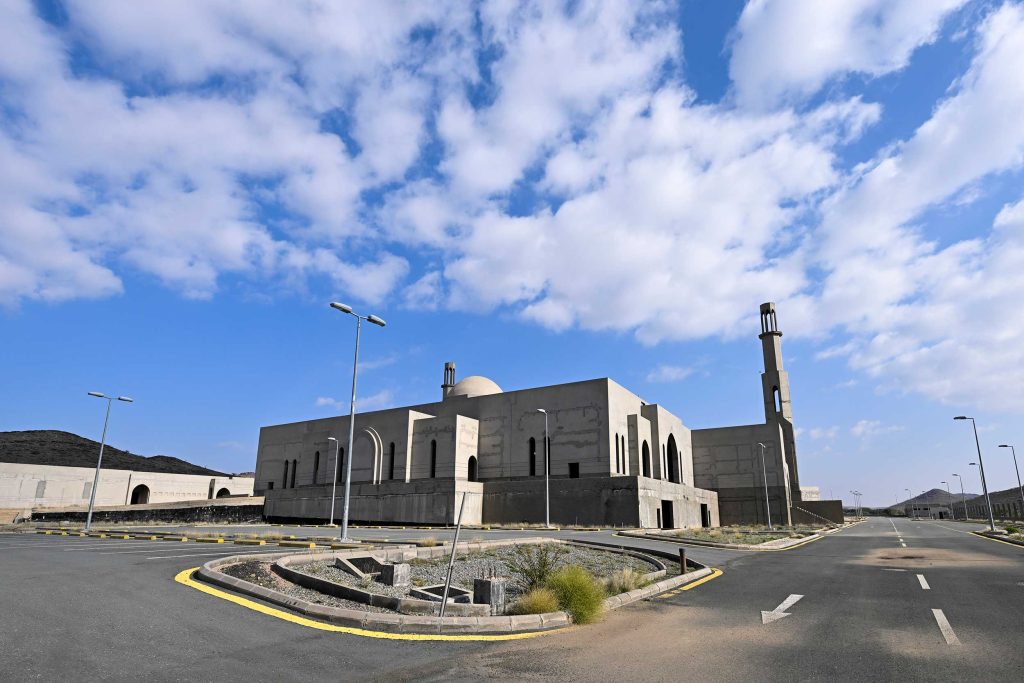
At the site of Dhat Irq stands Masjid Dhat Irq (Arabic: مسجد ذات عرق) — the mosque that serves as the practical heart of this Miqat for arriving pilgrims. Like the mosques at other Mawaqit, it exists to give pilgrims a dignified, dedicated space to perform the rites of entering ihram: washing, changing, praying two rak’ahs, making their intention (niyyah), and lifting their voices in the Talbiyah for the first time.
The mosque is currently undergoing construction and expansion. When complete, the men’s prayer hall — measuring 2,775 square metres — will accommodate approximately 3,500 worshippers. The women’s prayer area, at 750 square metres, will hold around 900 worshippers, giving the mosque a combined capacity of roughly 4,400 pilgrims at one time.
For the pilgrim arriving at Dhat Irq, the mosque is far more than architecture. It is the place of transition — the last ordinary moment before the sacred state begins. Men change into the two unstitched white cloths of ihram; women ensure their modest covering is in place. The niyyah is made in the heart. And then, for the first time on the journey, the Talbiyah rises:
“Labbayk Allahumma labbayk. Labbayk laa shareeka laka labbayk. Innal hamda wan-ni’mata laka wal-mulk. Laa shareeka lak.”
Here I am, O Allah, here I am. Here I am — You have no partner — here I am. Verily all praise, blessings, and sovereignty belong to You. You have no partner.
The Talbiyah — recited upon entering ihram
What Pilgrims Need to Know
For pilgrims whose Hajj or Umrah route passes through the direction of Dhat Irq, the practical obligations are the same as at any Miqat: enter ihram before the boundary, make the intention, and do not cross in an ordinary state.
If a pilgrim intending Hajj or Umrah crosses any Miqat — including Dhat Irq — without entering ihram, the majority of scholars hold that a dam (penalty) is due: a sacrifice offered in Makkah. If it is possible to return to the Miqat and enter ihram from there, that is the preferred remedy. Prevention, as always, is far easier than the cure.
Dhat Irq may be less visited by British pilgrims than some of the other Mawaqit, but for the millions of pilgrims who travel from Iraq, Iran, and beyond, it is the sacred gateway their feet have crossed for centuries — and will continue to cross, God willing, for centuries more.
Explore More Miqat Guides
Dhu al-Hulayfah — The Miqat of Madinah
Al-Juhfah — The Miqat of Syria and the Northwest
Qarn al-Manazil — The Miqat of Najd