Should you take cash to Saudi Arabia for Hajj or Umrah, or simply use your bank card? For a first-time pilgrim, this can become surprisingly confusing. You may hear one person say:
“Don’t bother taking much cash. I used my card everywhere.”
Then somebody else tells you:
“Make sure you have Saudi riyals with you.”
Both can have a point. Saudi Arabia has a highly developed electronic payments system, and cards are widely useful. But that doesn’t mean I would travel for Hajj or Umrah with no cash at all. For most pilgrims, the sensible approach is not cash OR card.
It is: cash + card + backup.
Cash vs Card in Saudi Arabia
That gives you flexibility when paying for food, taxis, shopping, transport and everyday expenses while also protecting you if one payment method temporarily doesn’t work. This guide explains how I would approach money for a Hajj or Umrah journey, including using ATMs, avoiding unnecessary fees and deciding how much Saudi cash to carry.
What Currency Is Used in Saudi Arabia?
Saudi Arabia uses the Saudi riyal, abbreviated as SAR.
You’ll see prices displayed in riyals throughout Makkah, Madinah and elsewhere in Saudi Arabia.
If you’re travelling from the UK, you’ll naturally be thinking in pounds.
That can take a little adjustment.
During the first few days, you may find yourself repeatedly calculating:
“How much is that in pounds?”
That’s sensible, particularly with larger purchases.
Exchange rates move, so rather than memorising a conversion months before travelling, check the current GBP/SAR rate shortly before departure and during your journey when necessary.
For a fuller explanation of exchanging pounds and managing currency, see Miqat’s:
Money Exchange in Saudi Arabia
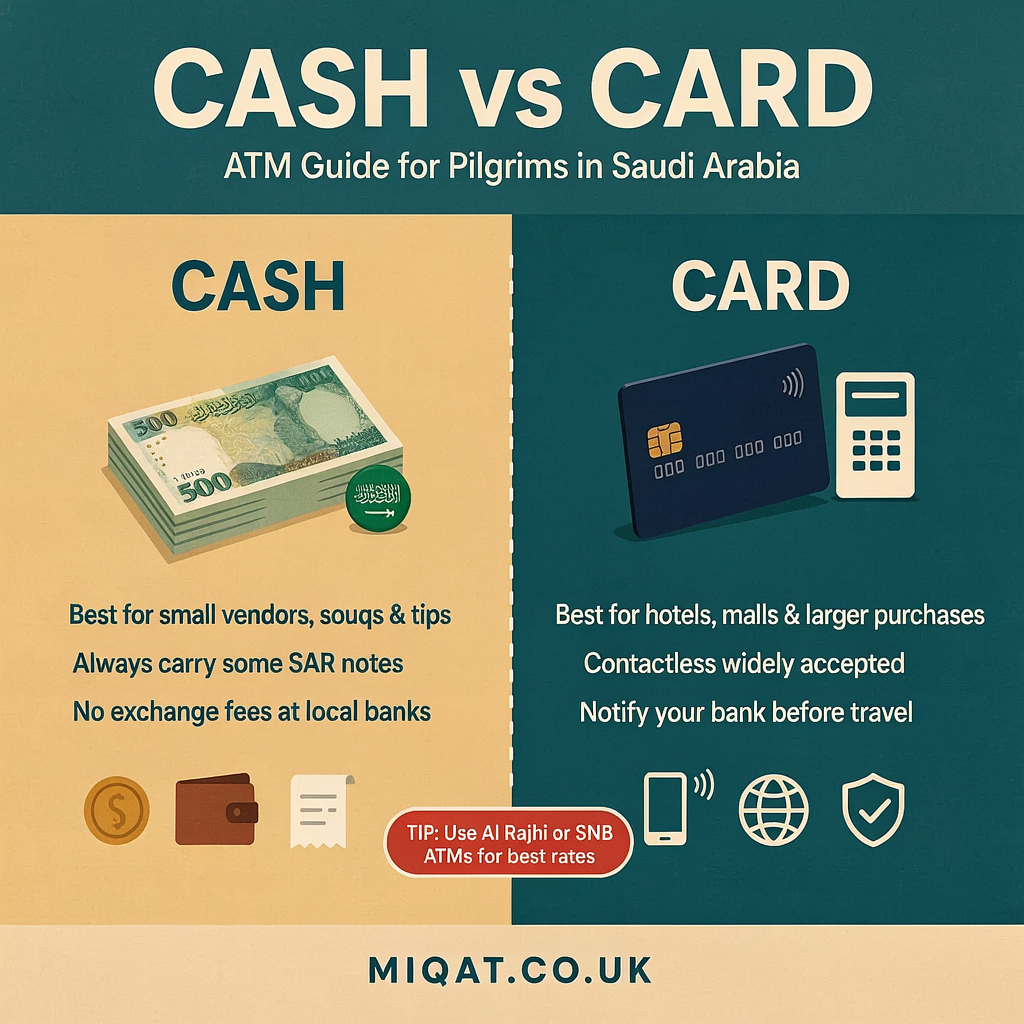
Cash or Card: Which Is Better in Saudi Arabia?
For most pilgrims, both.
Cards offer convenience.
Cash offers a backup.
Here’s the simple comparison:
| Payment method | Advantages | Things to consider |
|---|---|---|
| Cash | Simple, useful as backup, no card terminal required | Can be lost or stolen; you need to exchange/withdraw it |
| Debit card | Convenient and widely useful | Your bank may charge foreign transaction or ATM fees |
| Credit card | Convenient and useful as backup | Foreign transaction, cash withdrawal and interest charges may apply |
| Travel/multi-currency card | Can offer useful exchange features | Fees and terms depend on provider |
| Mobile wallet | Very convenient where accepted | Depends on your phone, battery and compatible card |
I wouldn’t rely completely on any single option.
Are Cards Widely Accepted in Saudi Arabia?
Electronic payments are common across Saudi Arabia, particularly at established businesses.
For a pilgrim, you may find card payment convenient at places such as:
- Hotels
- Restaurants
- Supermarkets
- Pharmacies
- Shopping centres
- Larger retail stores
- Cafés
- Established transport services
But circumstances vary by merchant, terminal and location.
And technology sometimes fails.
That is why I would still keep a modest amount of Saudi riyals available.
Why You Should Still Carry Some Cash
Imagine you’ve just arrived.
You’re tired.
Your phone battery is low.
You want to pay for something small, and for whatever reason your normal payment method isn’t working.
That isn’t the moment you want to start solving an international banking problem.
Cash gives you another option.
It can also be useful for smaller everyday transactions depending on where you’re buying.
You don’t necessarily need a wallet full of notes.
Just enough that a temporary card problem doesn’t become an immediate travel problem.
How Much Cash Should You Carry?
There isn’t a universal amount because every pilgrim’s arrangements are different.
A person travelling on a package where accommodation, transfers and many meals are already covered may need less day-to-day cash than someone arranging everything independently.
Instead of asking:
“What exact amount should I carry?”
think about what you might reasonably need before your next opportunity to access money.
That could include:
- Food and drinks
- Small purchases
- Taxi or transport
- Pharmacy items
- Tips or incidental expenses where appropriate
- Emergency needs
I prefer the principle of carrying enough for convenience, but not carrying your entire travel budget in cash.
Don’t Carry All Your Money in One Place
This is one of the simplest travel-money habits.
Suppose you have several hundred riyals in cash.
Don’t necessarily keep every note in the same wallet.
You could have:
Daily spending cash in your wallet.
A small backup amount securely stored elsewhere.
And your main travel funds accessible through your card/account.
The same principle applies to cards.
If you’re carrying two usable cards, keeping them in exactly the same wallet reduces the value of having a backup.
If the wallet disappears, both disappear.
Take More Than One Payment Method
For an international pilgrimage, I would avoid depending entirely on one debit card.
Ideally, have an alternative.
That could mean:
- Main debit/travel card
- Backup card
- Some Saudi riyals
If your main card is blocked, lost, damaged or temporarily rejected, you still have another way to access money.
This becomes even more important when travelling with family.
Tell Your Bank You’re Travelling – If Necessary
Bank procedures vary.
Some banks no longer require customers to provide travel notifications, while others may have different fraud-prevention systems.
Before leaving the UK, check your own bank’s guidance.
Also make sure you know:
- Your card PIN
- How to temporarily freeze/unfreeze the card
- How to contact your bank
- Whether international transactions are enabled
- Your daily cash withdrawal limit
- Your foreign transaction fees
Do this at home.
Don’t discover your card settings while standing beside an ATM in Makkah.
Using ATMs in Saudi Arabia
ATMs are widely available in Saudi cities, including Makkah and Madinah.
You’ll commonly find them around commercial areas, shopping centres and bank locations.
Using an ATM can be a convenient way of obtaining Saudi riyals rather than carrying all your spending cash from the UK.
But before inserting your card, understand that there can potentially be more than one layer of cost.
What Fees Can Apply at a Saudi ATM?
Depending on your card, bank and ATM, possible costs can include:
- Your UK bank’s foreign cash withdrawal fee
- Foreign transaction/conversion fees
- ATM operator charges where applicable
- Exchange-rate differences
- Credit-card cash advance fees if using a credit card
The exact charges depend on your provider.
This is why two pilgrims can withdraw the same amount from an ATM and effectively pay different amounts.
One person’s card might be designed for overseas use.
Another person’s ordinary bank card may add charges.
Check your card before travelling.
That ten-minute check can potentially save you repeated fees throughout the trip.
Avoid Making Lots of Tiny ATM Withdrawals
Suppose your card provider charges you every time you withdraw cash abroad.
Withdrawing a small amount today, another small amount tomorrow and another two days later can mean repeatedly paying fees.
Where safe and appropriate, fewer planned withdrawals can sometimes make more sense than constant small withdrawals.
But don’t go to the opposite extreme and withdraw your entire holiday budget simply to avoid another ATM visit.
You still need to think about security.
The goal is balance.
Always Read the ATM Screen
Don’t rush through ATM screens just because people are waiting behind you.
Check:
- Withdrawal amount
- Currency
- Any displayed fee
- Conversion options
- Final amount before confirming
If something doesn’t look right, cancel the transaction.
There is nothing embarrassing about taking an extra few seconds when dealing with your money.
Be Careful With Currency Conversion at ATMs
When using a foreign card, you may sometimes be offered a choice about how the transaction is converted.
You might see an offer to show or charge the withdrawal in your home currency rather than leaving the conversion to your card provider.
This type of conversion is commonly known as dynamic currency conversion (DCC).
Don’t automatically press the most familiar-looking currency.
Read the exchange information carefully.
In many travel situations, allowing your own card provider/network to perform the currency conversion can be preferable to accepting a merchant or ATM’s offered home-currency conversion, but the actual cost depends on the rates and fees involved.
The useful rule is:
Don’t accept a conversion without understanding what rate you’re being offered.
Should You Use a Credit Card to Withdraw Cash?
Generally, I would treat a credit card as a poor first choice for ordinary ATM withdrawals unless you understand exactly how your particular card handles cash advances.
Cash withdrawals on credit cards can involve:
- Cash advance fees
- Interest
- Foreign transaction charges
- ATM-related charges
Your own provider’s terms determine the actual cost.
A credit card can still be valuable as a backup payment method, but paying for a purchase and withdrawing cash are not necessarily treated the same way.
Check before travelling.
Debit Card vs Travel Card
Many UK travellers now use cards specifically designed for overseas spending or multi-currency use.
Whether one is worthwhile for you depends on:
- Exchange rates
- Foreign transaction fees
- ATM allowance
- Withdrawal fees
- Spending limits
- Weekend or out-of-hours conversion policies
- Replacement arrangements
Don’t choose a travel card because someone on social media said it is “free abroad.”
Read the current fee schedule.
Financial products change.
What was a great travel card two years ago may have different terms by the time you travel.
What About Contactless Payments?
Contactless payments can make everyday spending very easy.
Sometimes too easy.
Tap.
Tap.
Tap.
By the evening, you have spent far more than you realised.
If you’re using card or contactless payment throughout your pilgrimage, keep an eye on your banking app or maintain a simple daily spending note.
This is particularly useful if you have set separate budgets for:
Food
Transport
Shopping
Other spending
For shopping specifically, Miqat has a separate guide:
Hajj & Umrah Shopping Budget: How Much Money Should You Set Aside?
That article should be internally linked here once published.
Can You Use Your Phone to Pay?
Mobile wallets can be convenient where your card and the merchant support them.
But I wouldn’t make my phone my only payment method.
Your phone can:
run out of battery,
lose internet access,
be misplaced,
or develop a problem.
Your pilgrimage already depends heavily on your phone for maps, communication, bookings and apps.
Don’t make every financial transaction depend on it too.
For mobile connectivity planning, see:
SIM Cards in Saudi Arabia: The Complete Guide for Hajj & Umrah
Cash Is Useful – But Too Much Cash Creates Another Problem
Some travellers feel safer carrying cash because there is no risk of a card being declined.
But cash has its own risks.
If you lose a bank card, you may be able to freeze it.
If you lose cash, it is usually simply gone.
So I wouldn’t carry your entire Hajj or Umrah spending budget around Makkah in your pocket.
Take what you reasonably need and keep the rest secure.
Keep Emergency Money Separate
This is especially important.
Your emergency money is not:
shopping money.
It isn’t:
“money left over for gifts.”
It is there for something unexpected.
Perhaps:
- Emergency transport
- Medication
- Replacement essentials
- Baggage issue
- Unexpected meal
- Travel disruption
- Another genuine need
Keep a financial buffer until you are safely towards the end of your journey.
If you never use it, excellent.
That means the emergency fund did its job without being needed.
Paying for Food in Makkah and Madinah
Food is one of the main variable expenses during pilgrimage.
Depending on your hotel/package, breakfast or other meals may already be included.
At other times, you might eat at restaurants, food courts, cafés or buy food from supermarkets.
Instead of guessing your food budget, we’ve already created a separate guide:
How Much Does Food Cost in Makkah and Madinah?
Work out your approximate food requirement first.
Then calculate shopping and other discretionary spending separately.
This makes the overall budget much easier to control.
Paying for Taxis and Transport
Your transport arrangements can vary considerably depending on your itinerary.
You may use:
- Pre-booked transfers
- Ride-hailing services
- Taxis
- Trains
- Buses
- Hotel transport
- Organised Hajj transport
Don’t assume the same payment method will be ideal for every situation.
Having both card access and some cash gives you flexibility.
Our main travel pillar covers the wider transport and arrival side of the journey:
Saudi Arabia Travel Guide for Hajj & Umrah Pilgrims
A Simple Money Setup for a UK Pilgrim
Rather than giving you a fixed amount — which would be meaningless without knowing your trip — here is a structure I would consider.
1. Main spending card
Use this for ordinary purchases where appropriate.
Before travelling, check its overseas charges.
2. Backup card
Ideally kept separately from your primary card.
Only use it if necessary.
3. Saudi riyals
Keep a reasonable amount for smaller spending and situations where cash is more convenient.
4. Emergency reserve
Keep this separate from everyday spending.
5. Phone access
Make sure you can access your banking app and know how to contact your provider if your card is lost or blocked.
That gives you several layers rather than one point of failure.
Travelling With Family? Don’t Give One Person Everything
If you’re travelling with your spouse, parents, siblings or a larger family group, don’t necessarily make one person the only person capable of paying for anything.
During Hajj especially, groups can become separated.
Someone may return to the hotel while another person stays at the Haram.
One person may need transport unexpectedly.
When I travelled for Hajj with my family, there were five of us. Group travel quickly teaches you the value of simple backup arrangements.
Depending on your family circumstances, it can be useful for more than one responsible adult to have access to money.
Keep Your Bank App Working
Before leaving the UK, log in and make sure everything works.
This sounds obvious.
But consider what happens if:
- Your banking app logs you out
- It requires SMS verification
- Your UK number isn’t working
- You have forgotten a password
- Your bank sends a security prompt
Sort out access while you’re still at home.
If you’re planning to use a Saudi SIM or eSIM, think carefully about maintaining access to the UK number associated with banking authentication.
Don’t Use Public Wi-Fi Carelessly for Banking
Hotels, airports and public spaces may offer Wi-Fi.
For sensitive financial activity, be cautious about unfamiliar or unsecured networks.
Where possible, use a trusted connection and your bank’s official app.
And never give PINs, passwords or verification codes to somebody claiming they need them to “help” with a transaction.
ATM Safety in Makkah and Madinah
Use the same common-sense precautions you would use anywhere else.
Prefer ATMs in sensible, established locations.
Before using one:
- Look at the machine
- Protect your PIN
- Don’t accept unnecessary help from strangers
- Put your cash away before walking off
- Take your card
- Check your banking notification or transaction history
If an ATM behaves strangely or appears tampered with, use another one.
There is rarely a reason to force the transaction.
What If Your Card Is Declined?
First, don’t panic.
A declined transaction doesn’t necessarily mean there is no money in your account.
Possible reasons can include security checks, payment-terminal issues, limits or temporary technical problems.
Try to determine the problem calmly.
This is where your backup plan becomes useful.
You may have:
another card
or
cash
while you contact your bank.
That is much easier than standing at a checkout with one card, no cash and no alternative.
What If You Lose Your Bank Card?
Before travelling, know how to freeze or report your card.
Many banking apps allow customers to temporarily freeze cards, although features vary by provider.
If a card genuinely appears lost or stolen:
- Secure/freeze it using your provider’s available method.
- Check recent transactions.
- Contact your provider where necessary.
- Switch to your backup payment method.
- Keep monitoring the account.
Don’t store your backup card beside the lost card in the first place.
Keep Your Spending Money Separate From Your Shopping Budget
This helped form our previous Travel cluster article.
Imagine you have £600 available for discretionary spending.
Don’t think:
“I’ve got £600 to spend.”
Instead:
Food: £___
Transport: £___
Mobile/data: £___
Shopping: £___
Emergency: £___
Now you know what the money is for.
This is particularly useful in Makkah and Madinah because small purchases can accumulate very quickly.
Don’t Exchange All Your Money at the Airport Without Comparing
Airports are convenient.
Convenience and the best exchange value aren’t always the same thing.
If you need some Saudi riyals immediately, convenience may matter more than squeezing out the best possible rate.
But there is no reason to assume you must convert your entire travel budget at the first exchange counter you see.
Compare your options.
Our dedicated:
Money Exchange in Saudi Arabia
guide should remain the main Miqat resource for that topic.
This article is specifically about how to use cash, cards and ATMs once you’re travelling.
Don’t Become Obsessed With Finding the Perfect Exchange Rate
There is another extreme.
A pilgrim spends an hour walking around trying to save the equivalent of a few pounds on currency exchange.
Your time in Makkah and Madinah has value too.
Compare sensible options.
Avoid obviously poor deals.
Understand fees.
Then move on.
You travelled for Hajj or Umrah, not to become a foreign-exchange trader.
A Practical Example
Imagine a pilgrim has already paid for:
- Flights
- Hotel
- Major transfers
- Visa/package costs
They now need money for day-to-day expenses.
Instead of carrying the entire amount as cash, they might decide:
“I’ll carry enough Saudi riyals for immediate spending, use my main card for larger purchases, keep another card separately and leave part of my available money untouched for emergencies.”
Notice that there is no fixed amount in that example.
That’s intentional.
A solo traveller staying five days and a family of five staying three weeks shouldn’t follow the same number.
The system matters more than somebody else’s budget.
Common Money Mistakes Pilgrims Can Avoid
A little preparation prevents most of the obvious problems.
Try to avoid:
- Depending on one bank card
- Carrying all your cash together
- Keeping both cards in the same wallet
- Not checking overseas card fees
- Making repeated small ATM withdrawals without understanding charges
- Accepting currency conversion automatically
- Using a credit card for cash without checking cash-advance terms
- Forgetting your PIN
- Having no access to your banking app
- Spending emergency money on shopping
- Leaving money planning until you arrive
- Treating Saudi riyals as though they aren’t real money
The last one sounds silly.
It happens.
Cash vs Card: My Recommended Approach
For a first-time Hajj or Umrah pilgrim, I would keep it simple.
Take some Saudi riyals.
Not necessarily your whole budget.
Use a suitable card for ordinary spending.
But understand its fees.
Carry a backup payment method.
Preferably separately.
Know how you’ll access more cash if necessary.
Check your card’s ATM terms before travelling.
Protect an emergency reserve.
Don’t spend it because you found a nice perfume on your final evening.
That is really all the system needs to be.
Frequently Asked Questions
Is it better to use cash or card in Saudi Arabia?
For most pilgrims, using a combination is practical. Cards are convenient for many purchases, while some cash gives you flexibility and a backup if electronic payment isn’t available or your card has a problem.
Are cards accepted in Makkah?
Cards are commonly useful at established businesses such as hotels, supermarkets, restaurants and shops. Acceptance can still vary, so carrying some cash is sensible.
Are cards accepted in Madinah?
Electronic payments are common in Madinah as well, particularly at established businesses. Again, I wouldn’t rely on one payment method for the entire trip.
Can I withdraw Saudi riyals from an ATM?
International cards can commonly be used to withdraw local currency where the card/network and ATM are compatible. Your own bank and the ATM may have relevant limits or fees, so check before confirming a withdrawal.
Do Saudi ATMs charge UK cards?
Charges depend on the ATM and your own card provider. Your UK bank may also impose overseas cash withdrawal or foreign transaction fees.
Always check your specific card terms before travelling.
Should I take Saudi riyals from the UK?
Having some local currency available when you arrive can be convenient.
Whether you obtain it in the UK or withdraw/exchange money after arrival depends on the exchange rates, fees and convenience available to you.
How much cash should I carry for Umrah?
There is no universal amount.
Carry enough for your reasonable short-term needs and backup, rather than carrying your entire pilgrimage budget in cash.
Can I use my UK debit card in Saudi Arabia?
Many UK debit cards support international transactions, but this depends on your provider and card.
Check overseas usage, fees, limits and any relevant settings before travelling.
Can I use a credit card in Saudi Arabia?
Credit cards can be useful for purchases where accepted, but check your provider’s foreign transaction terms.
Be especially careful about using credit cards for ATM withdrawals because cash-advance fees and interest may apply.
Should I exchange pounds for riyals before Umrah?
You don’t necessarily need to exchange your entire budget before travelling.
Compare the exchange rate and fees available through cash exchange, your card and ATM withdrawals, then choose the combination that suits you.
What happens if my bank card stops working during Umrah?
This is exactly why I recommend carrying some cash and a separate backup card.
Contact your bank using its official support channel while using your alternative payment method in the meantime.
Should I carry cash during Hajj?
Some cash can be useful, but avoid carrying more than you reasonably need at one time.
Hajj involves crowds, movement and changing locations, so keeping your money organised and divided can be especially helpful.
Money Should Make the Journey Easier, Not Become Another Worry
Before travelling, money can feel like one of a hundred things you need to organise.
But the system doesn’t need to be complicated.
Have some cash.
Have a suitable card.
Have a backup.
Understand your fees.
Keep emergency money separate.
Then concentrate on the reason you travelled.
During Hajj, there were moments when ordinary concerns suddenly felt very small. Standing in front of the Ka’bah or resting simply at Muzdalifah has a way of changing what feels important.
Money is necessary.
Planning it properly matters.
But once you have taken sensible precautions, don’t allow yourself to spend the pilgrimage constantly checking exchange rates, bank balances and ATM fees.
Organise the practical side before you travel so that, when you reach Makkah and Madinah, more of your attention can be given to something far more valuable.
May Allah put barakah in your wealth, protect you and your family throughout your journey, make your finances easy to manage, and accept your Hajj or Umrah.
Ameen.