“How much spending money should I take for Umrah?” It sounds like a simple question. You might expect an answer such as:
£500.
Or perhaps:
£1,000.
But neither figure means very much without knowing what your pilgrimage package already includes. One person may have flights, hotels, breakfast, airport transfers and transport between Makkah and Madinah already paid for. Another pilgrim may have booked only flights and accommodation and plans to arrange almost everything else independently. A solo traveller staying for seven days will spend differently from a family of five staying for three weeks.
Hajj is different again. So rather than giving you one magic number, this guide will help you calculate how much spending money you personally need for Umrah or Hajj. And the calculation is actually quite simple:
Food + local transport + mobile/data + personal expenses + shopping + emergency reserve = your spending-money budget.
Let’s work through it.
How Much Spending Money for Umrah
First: What Do We Mean by “Spending Money”?
This article assumes your major pilgrimage costs have already been paid or budgeted separately.
That might include:
- Flights
- Visa or package costs
- Main accommodation
- Hajj package
- Pre-booked transfers
- Other major travel arrangements
We’re talking about the money you will actually need while you are in Saudi Arabia.
Think:
coffee,
meals,
taxi,
SIM card,
laundry,
dates,
gifts,
pharmacy,
and those small expenses you never thought about before leaving home.
Individually, many of them don’t seem significant.
Together, they can become a substantial part of the trip.
How Much Spending Money Should You Take for Umrah?
For a UK pilgrim whose flights and accommodation are already paid, I would use the following as a planning framework, not a fixed prediction of what your trip will cost.
| Travel style | 7 days | 10 days | 14 days |
|---|---|---|---|
| Careful / budget | £200–£350 | £300–£450 | £400–£600 |
| Comfortable | £350–£550 | £450–£700 | £600–£900 |
| Higher spending / shopping | £550+ | £700+ | £900+ |
These figures are illustrative budgeting allowances, not current Saudi price quotations.
Your actual requirement can be considerably lower or higher depending on meals, hotel inclusions, transport, shopping and family size.
For example, someone whose hotel includes breakfast and who doesn’t plan much shopping may spend much less than somebody eating in restaurants three times a day and buying gifts for twenty relatives.
Don’t Use Someone Else’s £500 as Your Budget
This happens all the time.
You ask a friend:
“How much money did you take for Umrah?”
They say:
“£500 was plenty.”
But perhaps:
their breakfast was included,
they travelled as a couple,
their airport transfers were prepaid,
they didn’t shop much,
and they stayed eight days.
Your circumstances may be completely different.
Instead, calculate your own budget category by category.
1. Start With Your Food Budget
Food is usually one of the largest everyday expenses.
Ask what your hotel/package includes.
Do you have:
Breakfast included?
Half board?
Full meals?
Nothing?
If breakfast is already included, you may only need to budget for lunch, dinner, drinks and snacks.
If nothing is included, your food allowance needs to cover the full day.
Your choices matter too.
A pilgrim buying simple meals and supermarket items will spend differently from somebody eating regularly in hotel restaurants or international chains.
We’ve covered this separately in:
How Much Does Food Cost in Makkah and Madinah?
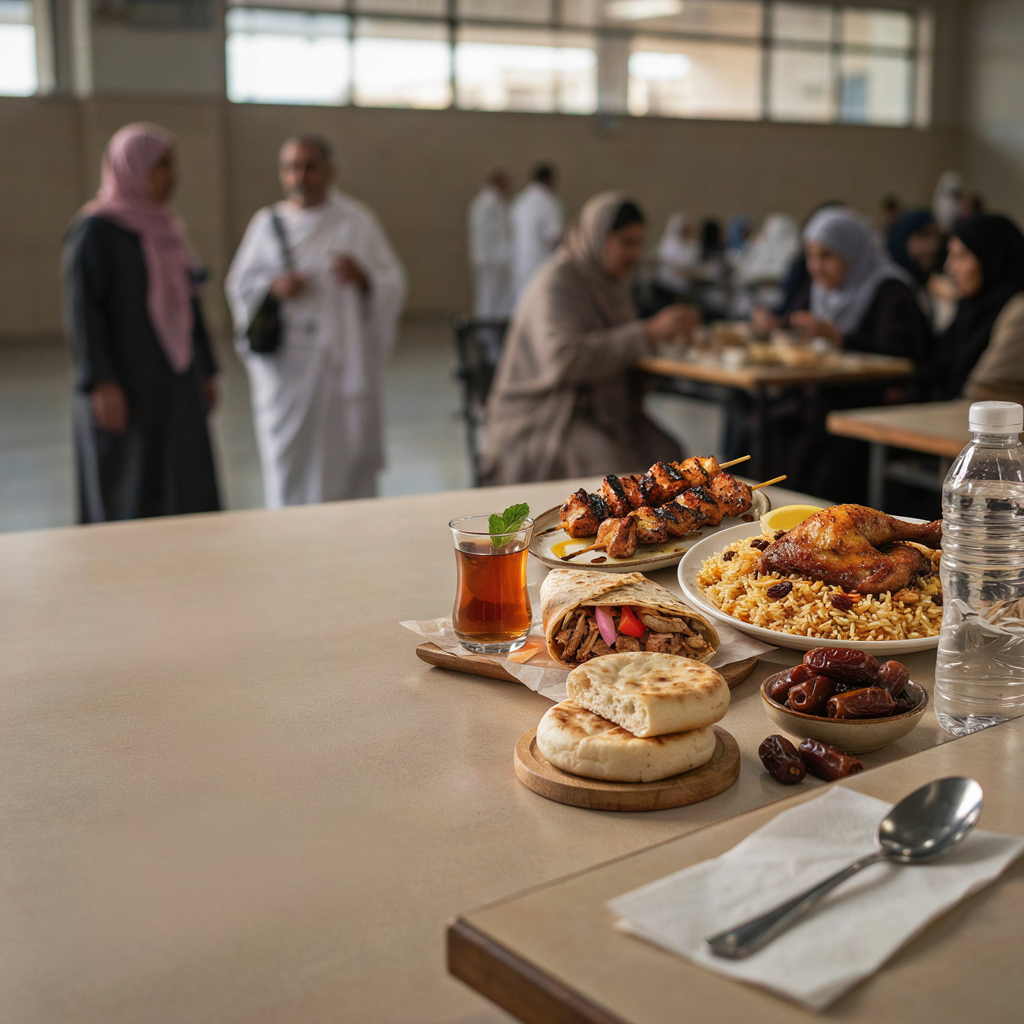
Use that article to estimate a daily food figure, then multiply it by the number of days.
For example:
Daily food allowance × number of days = estimated food budget.
Simple.
2. Add Local Transport
Next, think about movement.
Your package may already cover:
- Airport → hotel
- Makkah → Madinah
- Madinah → airport
- Hajj transport
If so, your additional transport costs may be relatively small.
But you might still use taxis or ride-hailing services for:
- Ziyarat
- Shopping
- Restaurants
- Train stations
- Visiting places away from your hotel
- Unexpected journeys
Don’t budget as though you will walk everywhere simply because your hotel looks close to the Haram on a map.
Some days you may be tired.
If you’re travelling with elderly parents or children, you may use transport more frequently.
Give transport its own allowance.
3. Budget for Your SIM or eSIM
This is usually a small part of the overall pilgrimage budget, but it is worth including.
Mobile data is extremely useful in Saudi Arabia.
You may need it for:
- Maps
- Ride-hailing
- Nusuk
- Airline information
- Hotel communication
- Banking
- Translation
- Staying in touch with your group
Don’t just switch on UK roaming without understanding what your provider will charge.
Compare roaming, physical SIM and eSIM options.
Miqat’s dedicated guide covers this:
SIM Cards in Saudi Arabia: The Complete Guide for Hajj & Umrah
Once you know which option you prefer, add it to the budget.
4. Add Everyday Personal Expenses
This is the category people often forget.
Not every expense fits neatly into “food” or “transport.”
You may spend money on:
- Laundry
- Toiletries
- Water or drinks
- Snacks
- Pharmacy items
- Replacement footwear
- Personal-care products
- Small hotel expenses
- Luggage-related items
- Other unexpected essentials
You don’t need to predict every purchase.
Just give yourself a reasonable personal/miscellaneous allowance.
5. Decide Your Shopping Budget Separately
Shopping can completely change the answer to:
“How much money do I need for Umrah?”
A pilgrim who doesn’t shop much may need hundreds of pounds less than somebody buying for a large extended family.
Common purchases include:
- Dates
- Prayer mats
- Tasbih
- Attar
- Abayas
- Thobes
- Hijabs
- Islamic books
- Children’s gifts
- Souvenirs
Don’t allow these purchases to disappear into your general spending money.
Set a separate limit.
For example:
My maximum shopping budget: £______
Then work within it.
Our dedicated Hajj & Umrah Shopping Budget guide goes deeper into how to calculate this without allowing gifts and souvenirs to consume your pilgrimage budget.
6. Add an Emergency Reserve
Now add money you don’t intend to spend.
That distinction matters.
An emergency fund could help with:
- Unexpected transport
- Medication
- Lost/replacement items
- Travel changes
- Extra baggage
- An unplanned hotel issue
- Family emergency
- Other genuine problems
If you reach the last day without using it, don’t automatically think:
“Great, that’s another £200 for shopping.”
The journey isn’t over until you’re safely home.
Keep your reserve available.
A Simple 10-Day Umrah Budget Example
Let’s imagine a solo UK pilgrim travelling for 10 days.
Flights, accommodation and major transfers have already been paid.
They create the following spending plan:
| Category | Illustrative allowance |
|---|---|
| Food & drinks | £200 |
| Local transport | £70 |
| SIM/data | £30 |
| Personal/miscellaneous | £50 |
| Shopping & gifts | £150 |
| Emergency reserve | £150 |
| Total available | £650 |
This does not mean you need £650 for a 10-day Umrah.
It demonstrates how a £650 spending allowance could be organised.
Another pilgrim might comfortably manage on £350.
Someone travelling with different expectations could spend £1,000.
The value is in knowing where the money is supposed to go.
What About a 14-Day Umrah?
A longer stay doesn’t necessarily mean every category doubles.
Your SIM may cost roughly the same.
You don’t need twice as many gifts because you stayed twice as long.
But food and everyday expenses naturally continue.
For example, a 14-day budget might look something like:
| Category | Illustrative allowance |
|---|---|
| Food & drinks | £280 |
| Local transport | £100 |
| SIM/data | £30 |
| Personal expenses | £70 |
| Shopping | £200 |
| Emergency reserve | £170 |
| Total available | £850 |
Again, this is a budgeting example, not a statement of current prices.
Adjust every category to your own circumstances.
How Much Spending Money for Hajj?
Hajj needs to be considered differently.
Your Hajj package may already include substantial parts of the journey, such as accommodation, certain meals and transport arrangements.
But Hajj is also longer and more complex than a short Umrah trip.
You may have spending before Hajj, during the main Hajj period and afterwards.
Your personal spending may include:
- Additional food
- Drinks/snacks
- SIM/data
- Laundry
- Medication
- Taxis
- Personal essentials
- Shopping
- Gifts
- Dates
- Unexpected costs
For a UK pilgrim whose main Hajj package and major travel arrangements are already paid, you could use a broad planning framework like:
| Spending style | Illustrative personal allowance |
|---|---|
| Careful spending | £500–£750 |
| Comfortable allowance | £750–£1,200 |
| Significant shopping / higher discretionary spending | £1,200+ |
Again, these are planning allowances, not claims about what Hajj currently costs.
Your Hajj package inclusions matter enormously.
Hajj Package Price Is Not the Same as Spending Money
This distinction is important.
Suppose your Hajj package is expensive.
That doesn’t automatically mean you need huge amounts of additional spending money.
If the package already includes:
flights,
hotels,
Hajj accommodation,
transport,
and many meals,
then much of the expensive part has already been paid.
Your spending-money calculation should cover what isn’t included.
Read your package details.
Don’t guess.
Make a “Paid / Not Paid” List
This is one of the easiest ways to calculate your budget.
Before travelling, make two columns.
Already Paid
Perhaps:
- Flights
- Hotel
- Visa/package
- Airport transfer
- Makkah–Madinah train
- Breakfast
- Hajj transport
Still Need to Pay
Perhaps:
- Other meals
- Taxi
- SIM
- Laundry
- Shopping
- Gifts
- Personal expenses
Now your spending-money requirement becomes much clearer.
Solo Traveller vs Couple vs Family
Family size obviously changes the calculation.
But don’t simply multiply everything by the number of travellers.
Some expenses are shared.
For example:
Taxi: potentially shared.
Hotel: probably already paid.
SIM: each adult may or may not need one.
Food: generally increases per person.
Shopping: depends on the family, not necessarily the number travelling.
Emergency reserve: should increase, but doesn’t necessarily need to multiply exactly.
So if a solo pilgrim budgets £600, that doesn’t automatically mean a couple needs £1,200.
Build the categories.
Travelling With Children
Children create their own spending patterns.
Food.
Snacks.
Drinks.
Small purchases.
Unexpected necessities.
Perhaps children’s gifts or activities.
You may also use taxis more frequently rather than walking longer distances.
Add a little flexibility rather than constructing a budget where every pound has already been allocated.
Travelling With Elderly Parents
If you’re accompanying elderly parents, I would be particularly generous with the transport and emergency categories.
A journey that you could comfortably walk may not be appropriate for your parents.
You might need:
- More taxis
- Additional rest stops
- Pharmacy purchases
- Mobility-related expenses
- Different meal arrangements
Your budget should serve the people you’re travelling with.
Don’t force your parents through unnecessary difficulty just to protect a very tight spending target.
How Much Saudi Cash Should You Carry?
Your total spending budget and the amount of cash in your pocket are two different things.
If you budget £800, you don’t need £800 in banknotes.
A combination of:
some Saudi riyals + main card + backup card
is usually more flexible than carrying everything in cash.
We cover this properly in:
Cash vs Card in Saudi Arabia: ATM & Money Guide for Hajj and Umrah
That article should be one of the strongest internal links from this page.
Exchange Your Money Carefully
If you are travelling from the UK, the amount of Saudi riyals you receive for your pounds depends on the exchange rate and any associated charges.
You have several possible approaches depending on your circumstances:
- Exchange some money before travelling
- Exchange cash in Saudi Arabia
- Withdraw Saudi riyals from an ATM
- Pay directly by card
- Use a travel/multi-currency card
There isn’t necessarily one method that is best for everybody.
The important thing is to understand the real cost, including fees.
For more detail:
Money Exchange in Saudi Arabia
Don’t Forget Bank Fees
This is technically spending too.
Suppose you carefully calculate your budget but then repeatedly pay:
foreign transaction fees,
ATM fees,
currency conversion charges,
or credit-card cash advance fees.
Those costs eat into your allowance.
Before leaving home, check:
- Foreign purchase fee
- ATM withdrawal fee
- Exchange-rate policy
- Daily withdrawal limit
- Overseas card settings
Small preparation here can make your budget more efficient.
Use a Daily Budget — But Don’t Become Obsessed With It
A daily spending allowance can be useful.
Suppose you’ve allocated £300 for food and everyday personal spending over 10 days.
You now know you’re roughly working with:
£30 per day.
That doesn’t mean you must spend exactly £30 every day.
Perhaps one day costs £18.
Another costs £38.
The daily figure is simply a guide.
You don’t need to sit outside Masjid al-Haram updating a spreadsheet after buying a bottle of water.
Keep Shopping Outside the Daily Budget
This is something I particularly recommend.
If your everyday budget is £30 and then you buy £70 of dates, the system suddenly looks broken.
Instead:
Daily living allowance: £___
Shopping allowance: £___
Keep them separate.
Then you can enjoy buying gifts without wondering whether you’ve just spent tomorrow’s lunch money.
Should You Take £500 for Umrah?
For some pilgrims, yes.
For others, no.
If your major travel costs are already paid, £500 may provide a useful spending allowance for a shorter pilgrimage with moderate personal spending.
But ask:
- How long are you staying?
- Are meals included?
- How much transport is prepaid?
- Are you shopping?
- Are you travelling alone?
- Do you have an emergency reserve?
Those answers matter more than the £500 figure itself.
Is £1,000 Enough for Umrah?
If flights and accommodation are already paid, £1,000 can represent a substantial discretionary allowance for many individual pilgrims.
But again, family size, duration and shopping can change the situation considerably.
Don’t take £1,000 because somebody on TikTok said:
“That’s what you need.”
Calculate your trip.
You might discover you comfortably need less.
Or that your circumstances justify more.
Should I Take £1,000 for Hajj?
The same principle applies.
Your Hajj package inclusions and length of stay determine how much additional spending money is sensible.
A pilgrim with meals and transport largely included will have different requirements from somebody paying for more things separately.
Instead of choosing a round number first, calculate the categories and see what total they produce.
Budget in Pounds, Spend in Riyals
For UK pilgrims, I think it helps to build your overall budget in GBP.
That’s the currency your income, savings and household expenses are probably measured in.
Then while travelling, understand approximately what those amounts represent in Saudi riyals.
For example:
My shopping budget is £150.
rather than:
I’ll just see how many riyals I spend.
The first creates a boundary.
The second can quietly expand.
A Simple Budget Template
Before leaving, copy this into your phone and fill it in:
Hajj / Umrah Spending Money
Duration: ___ days
Food: £_____
Local transport: £_____
SIM/data: £_____
Laundry/personal: £_____
Shopping/gifts: £_____
Other: £_____
Emergency reserve: £_____
Total spending allowance: £_____
Already have Saudi cash: £_____ equivalent
Available by card: £_____
Backup funds: £_____
That’s enough.
You don’t need complicated financial software.
Track Your Spending Occasionally
Check every few days.
Not every few minutes.
If you planned £700 and halfway through the journey you’ve already spent £600, something needs adjusting.
If you’ve spent £250, you’re probably comfortable.
A simple note works:
Starting budget: £700
Approx. spent: £280
Remaining: £420
You aren’t trying to produce company accounts.
You’re simply avoiding surprises.
Common Spending-Money Mistakes
Most problems aren’t caused by one enormous purchase. They come from poor planning.
Common mistakes include:
- Copying somebody else’s budget
- Forgetting what the package already includes
- Not budgeting for food
- Underestimating taxis
- Mixing shopping money with essential money
- Carrying the entire budget as cash
- Having only one bank card
- Ignoring foreign transaction fees
- Spending emergency money
- Buying too many gifts
- Forgetting luggage costs
- Not tracking spending at all
The solution isn’t to become miserly.
It is simply to know where your money is going.
Don’t Let Budgeting Make You Miserable
There is also such a thing as over-budgeting.
You don’t need to feel guilty every time you buy tea.
If you can afford a nice meal with your family, enjoy it.
If you want to buy dates for your parents, buy them.
If something meaningful catches your eye and it fits comfortably within your budget, there is nothing wrong with that.
The purpose of a budget isn’t:
“Spend as little as humanly possible.”
It is:
“Spend without creating unnecessary financial stress.”
Remember Why You Are There
Shopping centres in Makkah can be impressive.
Restaurants are everywhere.
There are gifts to buy and places to visit.
But your time is limited.
One thing Hajj taught me is how quickly many ordinary concerns become small when placed beside the purpose of the journey.
You have travelled a long way to worship Allah.
Manage your money properly so that it supports that journey rather than distracting you from it.
Frequently Asked Questions
How much spending money should I take for Umrah from the UK?
There is no single correct figure. For planning purposes, a solo pilgrim whose flights, accommodation and major transfers are already paid might consider several hundred pounds depending on trip length, food, transport, shopping and personal spending.
Build your own total from individual categories rather than copying somebody else’s figure.
Is £500 enough spending money for Umrah?
It can be for some pilgrims, particularly where major costs are prepaid and shopping is moderate.
Trip duration, meals, transport and family size can make £500 either more than enough or insufficient.
Is £1,000 enough for Umrah?
For many solo travellers with major travel costs already paid, £1,000 would represent a relatively generous discretionary allowance. However, this isn’t a guarantee or recommendation because individual circumstances differ considerably.
How much spending money do I need for a 7-day Umrah?
As an illustrative planning range, someone with flights and accommodation already paid might begin around £200–£550+, depending heavily on food, transport and shopping.
Calculate the categories individually before deciding your final amount.
How much spending money do I need for a 14-day Umrah?
A broad illustrative range might begin around £400–£900+ where major travel costs are already paid.
A pilgrim doing extensive shopping or paying more transport/food expenses could spend more.
How much spending money should I take for Hajj?
Hajj spending requirements depend heavily on what your package includes.
A broad personal planning allowance after the main package is paid could range from several hundred pounds upward depending on trip duration, food, shopping and additional expenses.
Do I need cash for Umrah?
Some Saudi riyals are useful, but you don’t necessarily need to carry your entire spending budget as cash.
A combination of cash, a suitable payment card and a backup payment method provides greater flexibility.
How much money should I budget for food?
This depends on whether your hotel provides meals and where you prefer to eat.
Use Miqat’s dedicated food-cost guide to calculate a daily allowance rather than combining food with shopping money.
How much should I budget for shopping?
Shopping is entirely personal.
Set a maximum amount based on who you plan to buy for and what you intend to purchase. Keep that allowance separate from food, transport and emergency funds.
Should I carry emergency money?
Yes, I recommend maintaining an emergency reserve separate from normal spending.
The exact amount depends on your circumstances, particularly whether you’re travelling alone or responsible for a family.
Can I use my UK bank card in Saudi Arabia?
Many UK cards support overseas transactions, but fees, limits and features vary by provider.
Check your own bank’s current terms before travelling.
So, How Much Should You Actually Take?
If you’re still looking for one number, resist that temptation for another five minutes.
Open the calculator on your phone.
Work out:
Food
plus
Transport
plus
SIM/data
plus
Personal expenses
plus
Shopping
plus
Emergency reserve.
That number is far more useful than whatever a stranger says they took to Umrah.
Then add a little flexibility.
Make sure you have more than one way to access your money.
And stop worrying about it.
Pilgrimage preparation involves passports, flights, hotels, money, packing and a hundred other practical details. We deal with those things because being prepared allows us to concentrate better when we arrive.
The budget is not the journey.
It simply supports the journey.
Years after Hajj, I don’t expect the amount I spent on a meal or taxi to be among the memories that remain with me.
I remember seeing the Ka’bah.
I remember being there with my family.
I remember Muzdalifah and how little you suddenly realise you actually need.
Prepare enough money to make the journey manageable.
Protect yourself against emergencies.
Spend responsibly.
Then give your attention to the reason you travelled in the first place.
May Allah put barakah in your wealth, make your Hajj or Umrah affordable and easy, protect you from financial difficulty and waste, and accept your pilgrimage.
Ameen.