West of Makkah, where the coastal plains of the Hijaz meet the shimmer of the Red Sea, there is a boundary that has marked the beginning of pilgrimage for more than fourteen centuries. That boundary is miqat Al-Juhfah and for British Muslims, it is almost certainly the Miqat of their Hajj.
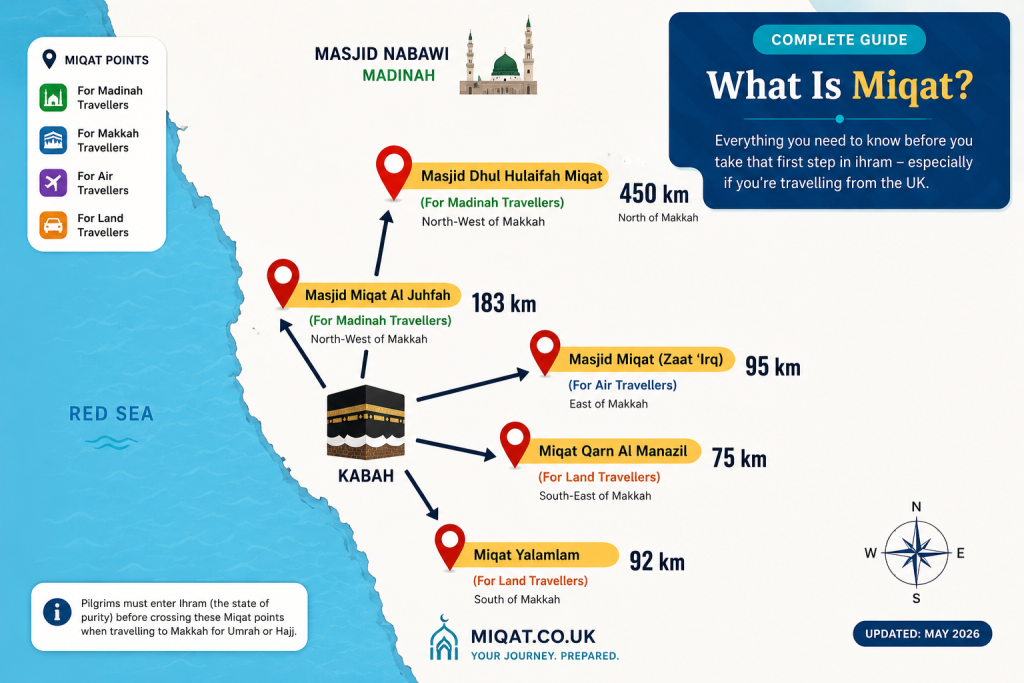
Al-Juhfah (Arabic: الجحفة) is one of the five designated Mawaqit of Islam — the sacred boundary points encircling Makkah from which every pilgrim intending Hajj or Umrah must enter the state of ihram before approaching the Holy City. While each of the five Mawaqit serves a different compass direction, al-Juhfah serves the northwest and west: the approach from Syria, Egypt, the North African coast, Europe, and the Americas.
Al-Juhfah
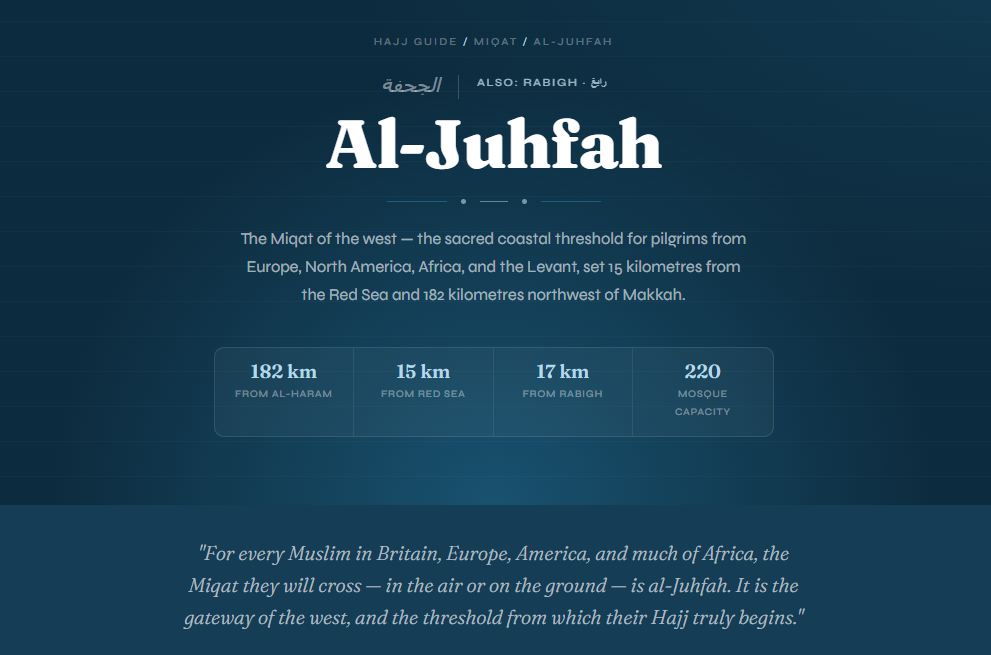
For anyone flying to Jeddah or Madinah from London, Manchester, or Birmingham — from Paris, New York, Lagos, or Cairo — al-Juhfah is almost certainly the Miqat boundary your flight will cross. Understanding where it sits, what it means, and what you must do when you approach it is one of the most practically important pieces of knowledge a pilgrim from the West can carry.
| Arabic Name | الجحفة (Al-Juhfah) |
| Direction | Northwest of Makkah — Syria, Egypt, Europe, North America, West Africa |
| Distance from Makkah | 182 km (113 miles) |
| Distance from Rabigh | 17 km (10.5 miles) — Rabigh lies to the north |
| Distance from Red Sea | 15 km (9 miles) east |
| Appointed By | The Prophet Muhammad ﷺ — narrated in Sahih Bukhari & Muslim |
| Alternative Point | Rabigh (رابغ) — on roughly the same latitude; permissible for ihram |
| Mosque | Masjid Miqat al-Juhfah — 900 m², 220 worshippers |
Where Is Al-Juhfah?
Location
Al-Juhfah is located 182 kilometres northwest of Makkah, positioned in the coastal strip of the Hijaz — the narrow lowland between the Red Sea mountains and the sea itself. It sits 15 kilometres east of the Red Sea shoreline, making it one of the most seaward of all the Mawaqit, and it lies 17 kilometres southeast of Rabigh, the coastal town to its north that also serves as an alternative ihram point for pilgrims from the same direction.
This coastal position is historically significant. For centuries, the primary pilgrimage route from Syria, Egypt, and the Levant ran southward along the Red Sea coast — a road that caravans travelled for weeks, keeping the sea to their right and the mountains to their left. Al-Juhfah was exactly where this coastal road reached the latitude designated by the Prophet ﷺ as the boundary for the western approach. Pilgrims would arrive here already physically close to the end of their overland journey, but spiritually at the beginning of something much greater.
Today, al-Juhfah is not on any major pilgrim route by road — most pilgrims arrive in Jeddah or Madinah by air. But the Miqat boundary it represents remains exactly where the Prophet ﷺ drew it, and pilgrims flying from the northwest cross it somewhere over the Hijaz mountains, typically during the approach to Jeddah.
Who Uses Al-Juhfah?
For Pilgrims
Al-Juhfah serves the widest geographic catchment of all five Mawaqit — a vast arc of the globe that sweeps from Turkey and Syria westward through North Africa, across the Atlantic to the Americas, and northward through all of Europe. Any pilgrim whose journey to Makkah approaches from this northwestern direction is bound by al-Juhfah as their threshold.
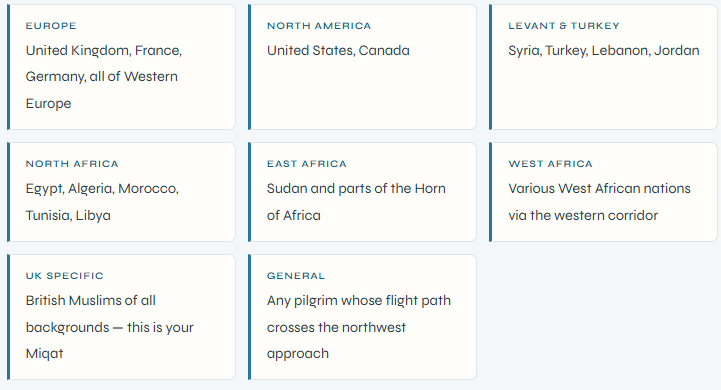
EuropeUnited Kingdom, France, Germany, all of Western Europe
North AmericaUnited States, Canada
Levant & TurkeySyria, Turkey, Lebanon, Jordan
North AfricaEgypt, Algeria, Morocco, Tunisia, Libya
East AfricaSudan and parts of the Horn of Africa
West AfricaVarious West African nations via the western corridor
UK SpecificBritish Muslims of all backgrounds — this is your Miqat
GeneralAny pilgrim whose flight path crosses the northwest approach
For British Muslims specifically — whether flying direct to Jeddah, routing via a hub in the Middle East, or arriving in Madinah first — al-Juhfah is almost always the relevant Miqat. However, there is an important nuance for those flying via Middle Eastern hubs: if your connecting flight from Dubai or Doha approaches Makkah from the east rather than the northwest, a different Miqat (such as Qarn al-Manazil) may technically apply to that final leg. Always confirm with your Hajj operator or a qualified scholar based on your exact itinerary.
“The Prophet ﷺ fixed Dhu al-Hulayfah as the Miqat for the people of Madinah, al-Juhfah for the people of Syria, Qarn al-Manazil for the people of Najd, and Yalamlam for the people of Yemen. These are for those people and for all who come through those regions intending Hajj or Umrah.”
Narrated by Ibn Abbas (رضي الله عنه) — Sahih Bukhari & Muslim
The History of Al-Juhfah
History
Al-Juhfah was appointed directly by the Prophet Muhammad ﷺ as one of the original five Mawaqit — its designation is narrated in the most authenticated collections of hadith, and it has been the recognised western Miqat since the earliest years of Islam.
The site itself has a history that predates Islam. Al-Juhfah was, in ancient times, a significant settlement on the coastal Hijaz road — a place where travellers rested, traded, and resupplied before the final stretch southward to Makkah. By the time the Prophet ﷺ designated it as a Miqat, it was already a place of geographical significance to those who knew the road.
In the centuries that followed, as the great Islamic caravan routes from Egypt and Syria developed into formal annual Hajj processions, al-Juhfah became one of the most traversed of all the Mawaqit. Tens of thousands of pilgrims from the Levant and North Africa would converge on it each year, the coastal road alive with the sound of the Talbiyah rising from every direction. Many scholars and notable figures of Islamic history — travelling from their institutions in Damascus, Cairo, and the Maghreb — entered their ihram at al-Juhfah before proceeding to Makkah.
“Every British pilgrim who boards a flight to Jeddah crosses the same boundary as the scholars of ancient Damascus, the caravans of old Egypt, and the pilgrims of the first Islamic century. The threshold has not moved.”
In time, the original settlement of al-Juhfah fell into decline and is no longer inhabited as it once was. Today, the Miqat is formally marked by the mosque built at the site, and the nearby town of Rabigh has become the practical focal point for road travellers approaching from the north along the coastal highway.
Rabigh: The Alternative Ihram Point
Alternative
Alternative Ihram Point
رابغ
Rabigh
Rabigh is a coastal town 17 kilometres north of al-Juhfah, sitting slightly higher in latitude on the Red Sea coast. Because it lies on roughly the same east-west plane as al-Juhfah, Islamic scholars have confirmed that pilgrims may enter into ihram at Rabigh as an alternative to al-Juhfah itself. This is particularly practical for pilgrims travelling by road along the coastal highway from the north, for whom Rabigh is a more accessible and better-served stop than al-Juhfah’s more remote location.
The permissibility of using Rabigh is widely accepted across the major schools of Islamic law, based on the principle that a pilgrim may enter ihram anywhere at or before the Miqat boundary — including at a point slightly further from Makkah, as Rabigh’s slightly higher latitude places it just outside the Miqat line. Entering ihram early is always permissible; crossing the Miqat without ihram is not.
Masjid Miqat Al-Juhfah
The Mosque
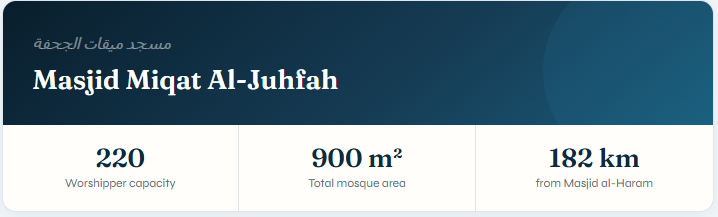
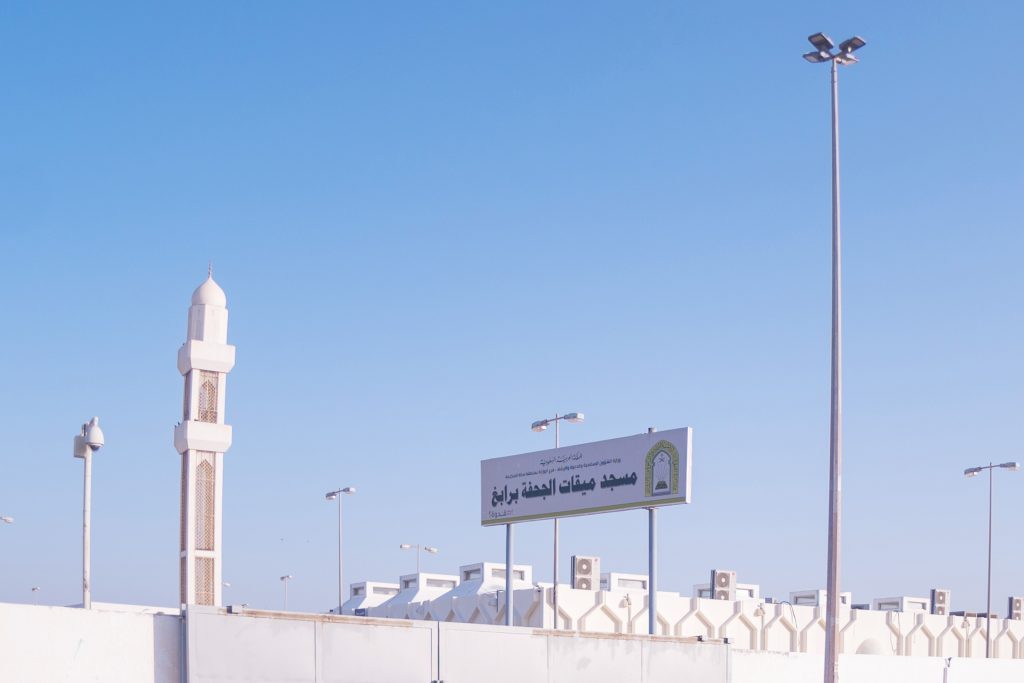
At the site of al-Juhfah stands Masjid Miqat al-Juhfah (Arabic: مسجد ميقات الجحفة) — the mosque that formally marks the Miqat boundary and serves pilgrims who arrive at this point to enter ihram. Like the mosques at each of the five Mawaqit, it provides the facilities for ghusl, the space for the two rak’ahs of ihram prayer, and the sacred atmosphere in which the niyyah and Talbiyah can be made with proper intention and presence of heart.
مسجد ميقات الجحفة
Masjid Miqat Al-Juhfah
220
Worshipper capacity
900 m²
Total mosque area
182 km
from Masjid al-Haram
It is worth noting that Masjid Miqat al-Juhfah is considerably more modest in capacity than the mosques at some other Mawaqit — accommodating approximately 220 worshippers across its 900 square metre total area. This reflects the reality that most pilgrims from the west who use this Miqat do so at altitude, entering ihram on their aircraft before crossing the boundary, rather than stopping at the mosque itself. Road travellers passing the al-Juhfah site or the nearby town of Rabigh will find facilities there, but the scale of the mosque is smaller than those serving the busier road-based Mawaqit.
Practical Guidance for UK Pilgrims
Practical Advice
For British pilgrims, al-Juhfah is the Miqat that matters most — and the most important practical question is not where the mosque is, but when your aircraft crosses the boundary and what you must do before it does.
The safest approach for UK air travellers: Board your flight to Jeddah or Madinah already in ihram. Perform ghusl at home or at the airport, change into your ihram cloths before boarding, pray your two rak’ahs at the airport if possible, and make your niyyah and begin your Talbiyah when you are airborne and approaching the Miqat boundary. This removes any uncertainty about the exact moment of crossing and allows your sacred journey to begin from your doorstep.
Important: If you are flying via a Middle Eastern hub — Dubai, Doha, Istanbul — the second leg of your journey may approach Makkah from a different direction, which could place a different Miqat boundary on your route. Speak to your Hajj operator or a scholar before travelling to confirm which Miqat applies to your full itinerary.
Al-Juhfah was placed by the Prophet ﷺ at precisely the right point on the western horizon — far enough from Makkah to give the pilgrim time to prepare, close enough that the Sacred City already feels within reach. For every Muslim who has ever boarded a flight from a Western country and felt that mixture of anticipation and solemnity as the coastline of Arabia came into view below — that feeling marks, more or less precisely, the moment al-Juhfah is crossed. It is the moment the Hajj truly begins.
Explore More Miqat Guides
Dhu al-Hulayfah — The Miqat of Madinah
Al-Juhfah — The Miqat of Syria and the Northwest
Qarn al-Manazil — The Miqat of Najd