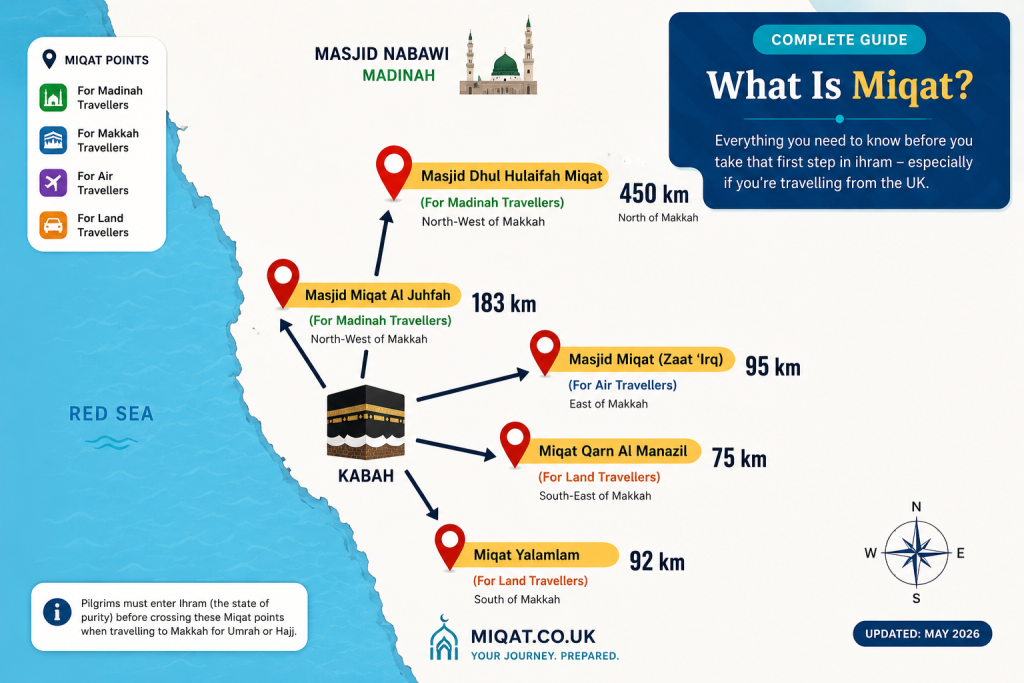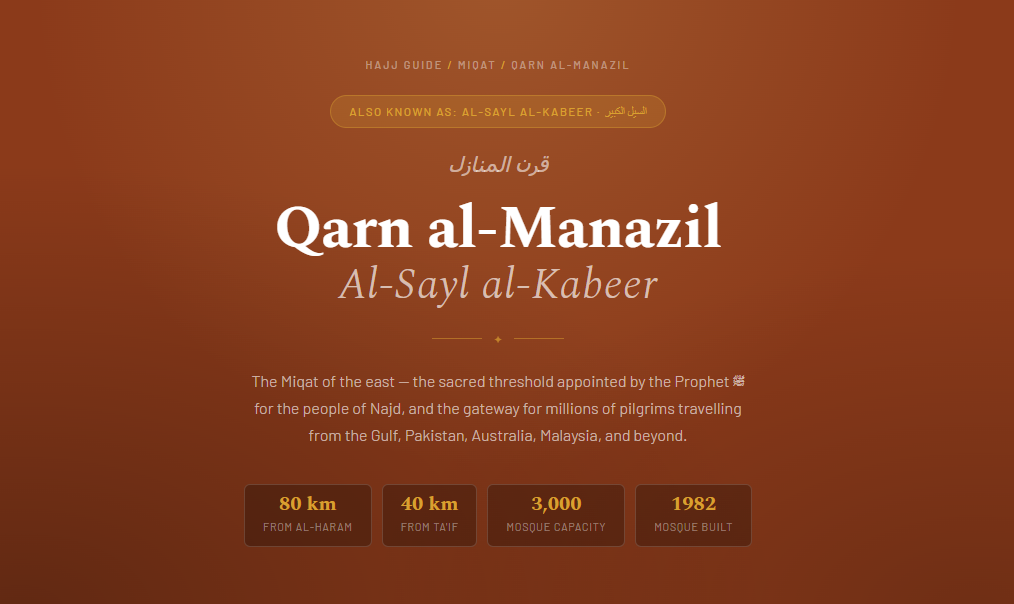
Of the five Mawaqit encircling Makkah, Qarn al-Manazil guards the eastern approach — the threshold from which the vast plateaus of Najd, the Gulf states, and the distant lands of Asia give way to the sacred precincts of the Holy City.
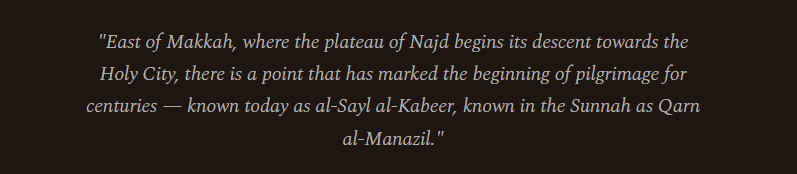
Qarn al-Manazil
Qarn al-Manazil (Arabic: قرن المنازل), also widely known today as al-Sayl al-Kabeer (Arabic: السيل الكبير), is one of the five designated Mawaqit of Islam — the sacred boundary points from which every pilgrim intending Hajj or Umrah must enter the state of ihram before approaching Makkah. Each Miqat serves a direction. Qarn al-Manazil serves the east and northeast, standing as the threshold for the people of Najd and for a vast, diverse community of pilgrims from across the Arabian Peninsula and far beyond.
The two names are worth understanding from the outset. Qarn al-Manazil is the historical name found in the hadith of the Prophet Muhammad ﷺ — the name by which this Miqat has been known across fourteen centuries of Islamic scholarship. Al-Sayl al-Kabeer is the name of the modern settlement that has grown up near the Miqat site, and it is the name most commonly used today on road signs, maps, and by pilgrims arriving by road or air. Both names refer to the same boundary, the same sacred threshold.
| Historic Name | Qarn al-Manazil (قرن المنازل) |
| Modern Name | Al-Sayl al-Kabeer (السيل الكبير) |
| Direction | Northeast of Makkah — Najd, the Gulf, and the east |
| Distance from Haram | 80 km (50 miles) |
| Distance from Ta’if | 40 km (25 miles) |
| Appointed By | The Prophet Muhammad ﷺ — narrated in Sahih Bukhari & Muslim |
| Mosque | Masjid al-Sayl al-Kabeer — built 1982 (1402 AH) |
Where Is Qarn al-Manazil?
Location
The Miqat is located 80 kilometres northeast of Masjid al-Haram, and 40 kilometres from the city of Ta’if — the elevated city in the mountains east of Makkah that has been a summer retreat and agricultural heartland for the region since before Islam. This proximity to Ta’if is significant: Ta’if has historically been one of the nearest major population centres to this Miqat, and the people of Ta’if and its surrounding valleys have long used Qarn al-Manazil as their point of entry into ihram.
The setting is the broad, sun-baked terrain of the Hijaz plateau — a landscape of ancient rock, sparse vegetation, and dry mountain air that gives way, as the pilgrim descends towards Makkah, to the more populated valleys of the Hijaz. For anyone who has driven this road, the Miqat feels exactly as it should: a natural pause point, a threshold, a place where the journey changes character.
Masjid al-Sayl al-Kabeer, the mosque marking the Miqat today, sits just north of the al-Sayl al-Kabeer settlement — positioned so that pilgrims arriving by road from the east can pull in, perform ghusl and their ihram prayer, and continue towards Makkah without retracing their route.For Pilgrims
Who Uses Qarn al-Manazil?
Qarn al-Manazil serves one of the widest and most diverse catchments of any Miqat. It is the designated threshold for the people of Najd — the great central plateau of Arabia — and for all those whose route to Makkah approaches from the eastern or northeastern direction. In practice, this encompasses a remarkable range of communities.
Arabian PeninsulaRiyadh, Najd, and the Saudi interior
Arabian PeninsulaTa’if and surrounding mountain communities
Gulf StatesUnited Arab Emirates, Qatar, Bahrain, Kuwait
Gulf StatesOman and parts of the Arabian Gulf coast
South AsiaPakistan — one of the largest Hajj-sending nations
OceaniaAustralia and New Zealand
Southeast AsiaMalaysia, Singapore, Indonesia (some routes)
GeneralAny pilgrim whose flight path crosses the eastern approach
For many British pilgrims of Pakistani heritage, it is worth noting that if your flight to Jeddah or Madinah follows a routing that passes over or near Qarn al-Manazil before crossing the other Mawaqit, this is your Miqat. However, most direct UK-to-Jeddah routes pass closer to other Mawaqit boundaries — always confirm with your Hajj operator or a qualified scholar which Miqat applies to your specific flight path.
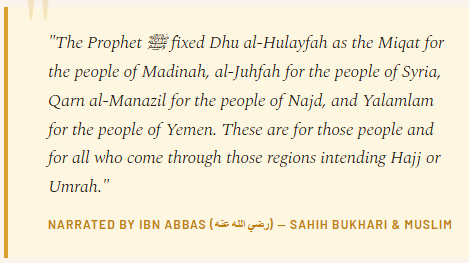
“The Prophet ﷺ fixed Dhu al-Hulayfah as the Miqat for the people of Madinah, al-Juhfah for the people of Syria, Qarn al-Manazil for the people of Najd, and Yalamlam for the people of Yemen. These are for those people and for all who come through those regions intending Hajj or Umrah.”
Narrated by Ibn Abbas (رضي الله عنه) — Sahih Bukhari & Muslim
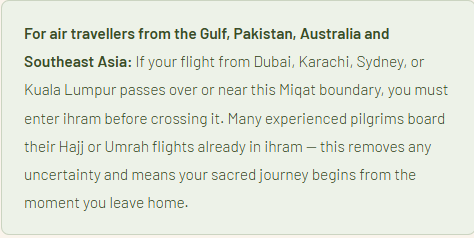
For air travellers from the Gulf, Pakistan, Australia and Southeast Asia: If your flight from Dubai, Karachi, Sydney, or Kuala Lumpur passes over or near this Miqat boundary, you must enter ihram before crossing it. Many experienced pilgrims board their Hajj or Umrah flights already in ihram — this removes any uncertainty and means your sacred journey begins from the moment you leave home.History
The History of Qarn al-Manazil
Qarn al-Manazil was appointed directly by the Prophet Muhammad ﷺ as one of the original five Mawaqit — a designation recorded in some of the most widely transmitted and authenticated hadith in the Sunnah. Its place in Islamic law has never been disputed, and it has been the recognised Miqat of the eastern approach to Makkah since the earliest years of the community.
The name “Qarn al-Manazil” carries some geographical poetry. “Qarn” in Arabic refers to a horn or peak — a ridge of elevated ground — while “al-Manazil” speaks to a place of resting or alighting, suggesting that this was historically a stopping point on the caravan routes from Najd to Makkah. Travellers who had crossed the vast interior of Arabia would reach this ridge, rest, and begin their preparations for the Holy City ahead.
Over the centuries, the settlement that grew up around this Miqat became known as al-Sayl al-Kabeer — “the great flood valley” — a name that reflects the seasonal watercourses that carve through the region. Today, al-Sayl al-Kabeer is a recognisable town on the Taif-Makkah road, and the name most pilgrims will encounter when navigating to the Miqat by road or GPS.
“Qarn al-Manazil has been the threshold of Najd’s pilgrims since the Prophet ﷺ himself drew the boundary. Fourteen centuries of footsteps have crossed it, and millions more will follow.”
One note of historical interest: the great Islamic scholar and Mujaddid of his era, Ibn Taymiyyah (رحمه الله), is reported to have been a pilgrim who entered ihram from this Miqat on his own journeys to Makkah, being from the Najdi tradition. While scholars should always be cited with care, it is a reminder that these Mawaqit are not merely geographical markers — they are lived places, crossed by the greatest and the most humble pilgrims alike.The Mosque
Masjid al-Sayl al-Kabeer
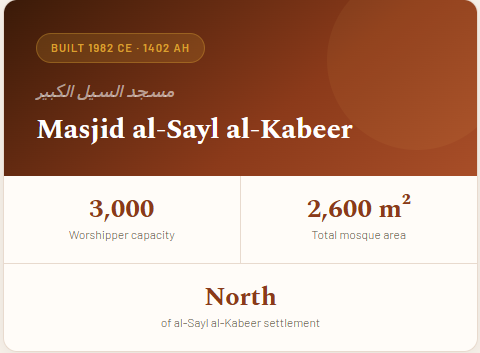
The mosque marking the Miqat of Qarn al-Manazil today is Masjid al-Sayl al-Kabeer (Arabic: مسجد السيل الكبير) — built in 1982 CE, corresponding to 1402 in the Hijri calendar, and situated just north of the al-Sayl al-Kabeer settlement where the main road from Ta’if meets the approach to Makkah.
Built 1982 CE · 1402 AH
مسجد السيل الكبير
Masjid al-Sayl al-Kabeer
3,000
Worshipper capacity
2,600 m²
Total mosque area
North
of al-Sayl al-Kabeer settlement
The mosque has a total area of 2,600 square metres and can accommodate approximately 3,000 worshippers — making it one of the more substantial Miqat mosques in terms of capacity. It sits just north of the settlement, accessible from the main Ta’if–Makkah road, and serves the steady flow of pilgrims arriving by coach, private car, and organised group transport throughout the Hajj and Umrah seasons.
For the pilgrim arriving here, the mosque offers what every Miqat mosque must: a dignified space to perform ghusl, to pray two rak’ahs of the ihram Sunnah prayer, to make the niyyah with clarity and intention, and to recite the Talbiyah for the first time on this journey. The journey to Makkah will have begun long before — in some cases, from the other side of the planet — but it is here, at this mosque, that the sacred state formally begins.
لَبَّيْكَ اللَّهُمَّ لَبَّيْكَ، لَبَّيْكَ لَا شَرِيكَ لَكَ لَبَّيْكَ
“Here I am, O Allah, here I am. Here I am — You have no partner — here I am.”
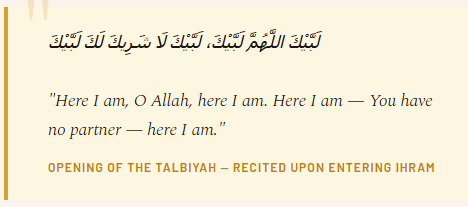
Opening of the Talbiyah — recited upon entering ihramPractical Guidance
What Pilgrims Need to Know
Whether you are driving from Riyadh, flying from Dubai, or arriving on a long-haul flight from Sydney or Karachi, the obligation at Qarn al-Manazil is the same as at any Miqat: the state of ihram must be entered before the boundary is crossed. For road travellers, the mosque at al-Sayl al-Kabeer provides a clear and well-signposted stop. For air travellers, the timing requires thought and preparation in advance.
It is worth remembering that the consequences of crossing any Miqat without ihram — even accidentally — are significant in Islamic law. The majority of scholars hold that a dam (penalty sacrifice) becomes obligatory. The remedy is to return to the Miqat if possible, or to offer the dam in Makkah if return is not possible. A few minutes of preparation before your journey costs nothing. The alternative is far more disruptive.
Qarn al-Manazil, like all the Mawaqit, is ultimately a gift: a clear, unambiguous point at which the pilgrim knows with certainty that the sacred has begun. The Prophet ﷺ gave us these boundaries precisely so that we would not approach the House of Allah carelessly. Cross this threshold with intention, with prayer, and with the Talbiyah on your lips — and the journey that follows will be everything it is meant to be.
Explore More Miqat Guides
Dhu al-Hulayfah — The Miqat of Madinah
Al-Juhfah — The Miqat of Syria and the Northwest
Qarn al-Manazil — The Miqat of Najd