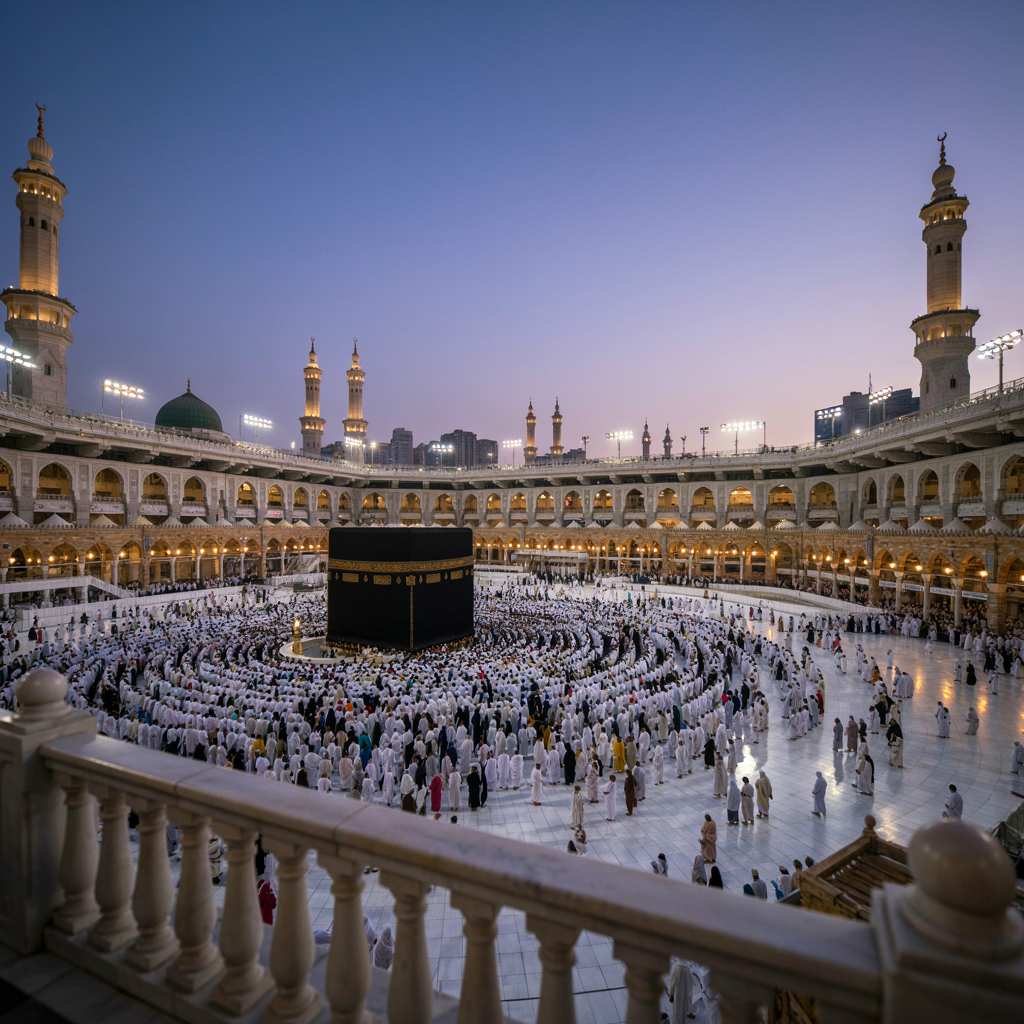
There are places you spend years seeing in photographs, videos and prayer mats, yet nothing really prepares you for standing there yourself.
Masjid al-Haram is one of those places. You may have watched the Ka’bah live on television hundreds of times. You may know what Tawaf looks like. You may have read about Maqam Ibrahim, Zamzam, Safa and Marwah and imagined what your first visit would feel like. And then you actually arrive.
For a first-time pilgrim, Masjid al-Haram can be spiritually overwhelming and practically confusing at exactly the same time. You are trying to take in the sight of the Ka’bah while thousands of people are moving around you. You are thinking about your Umrah, your duas, your family, which gate you entered through, where your shoes are and how you’re going to find your hotel again.
That combination is precisely why I wanted this guide on Miqat.
Masjid al-Haram
This isn’t only about what Masjid al-Haram is. It is about what it is actually like to arrive there as a pilgrim and the small things I wish every first-time visitor knew beforehand.
What Is Masjid al-Haram?
Masjid al-Haram, often called the Grand Mosque, is the sacred mosque in Makkah surrounding the Ka’bah.
For Muslims, there is nowhere quite like it. It is towards the Ka’bah that Muslims around the world face for Salah every day, and Masjid al-Haram is where pilgrims perform key rites including Tawaf and Sa’i during Umrah and Hajj.
Within or immediately associated with the sacred mosque are landmarks that many of us have known by name since childhood:
- The Ka’bah
- Hajar al-Aswad (the Black Stone)
- Maqam Ibrahim
- Hijr Ismail
- Multazam
- The Mataf
- Zamzam
- Safa
- Marwah
Each deserves proper explanation, and Miqat will cover them individually rather than trying to squeeze their history and significance into a few paragraphs here.
Think of this article as your orientation guide to Masjid al-Haram.
For the wider city—accommodation, food, transport, historical places and practical Makkah information—start with our main Makkah Guide for Hajj & Umrah Pilgrims.
My First Time Entering Masjid al-Haram
I don’t think I will ever be able to describe this properly.
I went for Hajj with four members of my family, so there were five of us travelling together. Some of my brothers from our group were also with me when we entered Masjid al-Haram.
It was the first time for us.
You spend your life knowing about the Ka’bah. You see it in photographs, on television, on your phone and during live broadcasts from Makkah.
But walking towards it yourself is different.
We came through the pillars near the gate area, and at first I could see only one corner of the Ka’bah.
That was enough.
I remember stopping.
For a few moments, it was as though the body simply didn’t know what to do.
There were tears in our eyes. Nobody really had words. You think beforehand that when you finally see the Ka’bah you will make all these duas you have prepared.
But when it happened to me, my mind didn’t produce a long list.
What came from my heart was very simple:
“Ya Allah, mujhe maaf kar dena.”
O Allah, forgive me.
I stood behind one of the pillars for a moment.
It felt as if something from the Ka’bah had reached straight into the soul. I don’t know how else to explain it. Your eyes are seeing it, but the feeling seems to affect your whole body.
Then reality returned in a very Makkah way.
A Saudi security officer was trying to keep people moving.
“Haji, Haji…”
And he motioned us forward.
Anyone who has been for Hajj may recognise the particular way the security staff call you Haji. Even that small sound became part of the memory for me.
We moved.
But that first sight stayed.
There are some experiences for which photographs are useful and words are helpful, but neither can reproduce the moment itself.
Seeing the Ka’bah for the first time was one of them.
May Allah allow everyone reading this who has not yet been there to see it with their own eyes one day. Ameen.
Before You Go to Masjid al-Haram
A little practical preparation makes the first visit much easier.
If you are heading there specifically to perform Umrah, make sure you understand the requirements before arriving at the mosque.
Saudi Arabia’s current Ministry of Hajj and Umrah guidance says an official Umrah permit is obtained through the Nusuk app before heading to Masjid al-Haram to perform Umrah. Regulations and operational arrangements can change, so check the official guidance close to your travel date rather than relying on an old screenshot, YouTube video or blog post. Hajj Ministry
If you’re performing Umrah, you must also understand Ihram and Miqat before travelling towards Makkah. Ihram is not something to sort out after reaching the Ka’bah.
Prepare these matters before the emotional side of the journey takes over.
Getting to Masjid al-Haram
How you reach the Haram will depend largely on where you are staying.
Many pilgrims staying within the central area walk from their hotels. Others use buses, taxis, ride-hailing services or hotel transport.
Official Saudi guidance lists public buses, official taxis and ride-hailing services among the transport options for reaching the Grand Mosque. It also notes that transport may stop outside the central area to reduce congestion, meaning pilgrims can have some walking left before reaching the mosque itself. Hajj Ministry
That last point is worth remembering.
A taxi dropping you “at the Haram” doesn’t necessarily mean stepping out of the car immediately beside the Ka’bah.
During busy periods, road restrictions and crowd controls can affect how close vehicles can get.
We will cover this separately in our upcoming Getting Around Makkah: Complete Transport Guide for Hajj & Umrah Pilgrims.
Your First Visit: Don’t Rush It
If circumstances allow, give yourself time.
You don’t need your first experience of Masjid al-Haram to become:
hotel → taxi → gate → Tawaf → Sa’i → back to hotel.
Look around.
Understand your surroundings.
Notice which direction you came from.
Take note of your gate.
Find a sensible meeting point with your family.
Then concentrate on your worship.
Masjid al-Haram is enormous, and when you combine its scale with crowds, multiple levels and the emotion of your first visit, it is surprisingly easy to lose your sense of direction.
Understanding the Main Areas of Masjid al-Haram
You don’t need to memorise a map before travelling, but knowing the basic terminology helps enormously.
The Ka’bah
The Ka’bah stands at the centre of Masjid al-Haram and is the direction of prayer—the Qiblah—for Muslims throughout the world.
During Umrah and Hajj, pilgrims perform Tawaf around it.
We’ll cover its history, features and practical orientation separately in our Ka’bah: A Pilgrim’s Guide to the Heart of Masjid al-Haram.
The Mataf
The open area immediately surrounding the Ka’bah where Tawaf takes place is commonly referred to as the Mataf.
This is one of the areas where crowd conditions can vary dramatically.
Sometimes movement feels relatively comfortable.
At busy times it can become extremely crowded.
Don’t assume the experience you saw in somebody’s quiet early-morning video represents what you’ll encounter.
Hajar al-Aswad
Hajar al-Aswad—the Black Stone—is positioned in a corner of the Ka’bah and marks the starting and ending point of each circuit of Tawaf.
First-time pilgrims sometimes become overly focused on physically reaching or touching it.
Don’t turn your worship into a struggle with other pilgrims.
We will discuss its significance and practical etiquette properly in a separate guide.
Maqam Ibrahim
Maqam Ibrahim is associated with Prophet Ibrahim (peace be upon him) and stands near the Ka’bah.
Because this is a busy area, always be aware of the flow of pilgrims around you rather than stopping suddenly in moving crowds.
Hijr Ismail
The curved semi-circular area adjacent to the Ka’bah is known as Hijr Ismail, also commonly called the Hateem.
This is another area that deserves its own guide because pilgrims naturally have questions about praying there and its relationship to the Ka’bah.
Safa and Marwah
Safa and Marwah are where pilgrims perform Sa’i, walking between the two as part of Umrah and Hajj rites.
If this is your first Umrah, don’t underestimate the physical effort involved simply because the Sa’i area is indoors.
Tawaf followed by Sa’i involves considerable walking.
Comfortable footwear outside Ihram restrictions, hydration, pacing and understanding the ritual beforehand all help.
Zamzam Water at Masjid al-Haram
One of the beautiful conveniences inside the Haram is access to Zamzam.
For a first-time visitor, even drinking Zamzam there can feel completely different from drinking it from a bottle brought home by somebody else.
Take your time.
Drink.
Make dua.
But also remember that thousands of other pilgrims are using the same areas.
Avoid blocking walkways or gathering unnecessarily around dispensers.
A dedicated Zamzam Water Guide for Hajj & Umrah Pilgrims will form part of this Makkah series.
Learn Your Gate
This sounds like very ordinary advice.
It may save you a lot of stress.
Masjid al-Haram has numerous entrances and exits, and the surrounding streets can look completely different depending on where you emerge.
Don’t simply think:
“I’ll recognise this place.”
You may not.
Especially at night.
Especially after several hours inside.
Especially when thousands of people are leaving at the same time.
When you enter, take note of identifying information around your entrance.
You can also:
- Take a photograph of the gate/nearby landmark.
- Save your hotel on Google Maps.
- Share your location with family where appropriate.
- Agree on a meeting point.
- Keep your hotel’s name and address on your phone.
- Make sure elderly family members know the plan too.
The authorities also provide an interactive mapping service intended to help visitors locate facilities and services around the Two Holy Mosques. Al Haramain
We’ll cover the entrances in much greater detail in Masjid al-Haram Gates Explained: How to Find Your Way Around the Haram.
Agree on a Family Meeting Point Before You Need One
If you’re travelling as a family, do this on your first visit.
Don’t wait until someone goes missing.
Choose somewhere specific.
Not:
“We’ll meet near the Ka’bah.”
That is far too vague.
And not:
“Meet outside.”
Outside where?
Instead, choose something that everyone in the group can identify.
This becomes especially important during Hajj, Ramadan, after Salah and other crowded periods.
If your group includes elderly parents or somebody who doesn’t use smartphones confidently, make the system even simpler.
Miqat will have a dedicated guide on Where to Meet Your Family at Masjid al-Haram If You Get Separated, because this seemingly small issue can cause enormous anxiety.
What If You Get Lost?
First: don’t panic.
The size of Masjid al-Haram means losing your bearings does not mean you’ve done anything particularly foolish.
Stop somewhere safe without obstructing the movement of people.
Look for signs.
Use the official mapping/guidance resources where available.
Ask authorised staff for help.
Saudi authorities provide multilingual on-site guidance, with directional and cultural guidance available across many languages. Al Haramain
This is another reason I recommend knowing:
your hotel name, your gate and your agreed meeting point.
Three simple pieces of information.
What Should You Take Inside Masjid al-Haram?
Less than you think.
You don’t need to carry half your hotel room.
For an ordinary visit, consider essentials such as:
- Phone
- Small power bank
- Hotel key/card
- Small amount of money or payment card
- Identification where appropriate
- Small personal essentials
- Medication you genuinely need
- A small shoe bag
Keep everything compact.
The official Grand Mosque service information also lists luggage-storage facilities in designated courtyard locations, with restrictions on size, weight, duration and valuables. Al Haramain
For normal worship, though, travelling light is much easier.
What Should I Do With My Shoes?
This sounds like a minor subject until you can’t find them.
Then it becomes very important.
When you remove your footwear, don’t casually place it somewhere and assume you’ll remember.
After Salah, Tawaf or Sa’i, your surroundings may look completely different.
A small lightweight shoe bag is useful because you can keep your footwear with you where permitted rather than trying to remember a rack among hundreds of others.
The Grand Mosque authority currently lists a free shoe-bag service among its on-site services. Al Haramain
We will also create a short practical guide specifically about where to keep your shoes at Masjid al-Haram without losing them.
Toilets and Wudu Facilities
One thing first-time visitors should understand is that toilets aren’t simply beside the prayer space in the way you might expect at your local mosque.
Plan ahead.
If you need the toilet or need to renew your wudu, allow enough time—particularly before Salah when large numbers of people are moving.
If travelling with children or elderly relatives, this becomes even more important.
We’ll publish a dedicated Toilets and Wudu Facilities at Masjid al-Haram guide with practical orientation rather than overloading this article.
Wheelchairs and Mobility Assistance
If you’re travelling with elderly parents, somebody with reduced mobility or you personally have mobility needs, don’t assume Tawaf and Sa’i must be approached exactly as an able-bodied younger pilgrim would approach them.
Mobility assistance is available.
The Grand Mosque authority currently describes extensive manual and electric cart services and supervised cart pushers, including services intended to make Tawaf and Sa’i easier for elderly and disabled pilgrims. Al Haramain
Check the latest official arrangements when you travel because locations, access routes and operating arrangements can change.
And don’t feel embarrassed about using assistance when genuinely needed.
Hajj and Umrah are demanding journeys.
Protecting an elderly parent’s strength can be far more sensible than exhausting them unnecessarily.
Medical Help Inside Masjid al-Haram
Another useful thing to know before you need it: medical assistance is available.
The Grand Mosque authority lists emergency medical centres within the complex, providing round-the-clock emergency care. Current listed locations include areas around the King Fahd Expansion, the Saudi portico and Ajyad Bridge. Al Haramain
For minor personal needs, carry necessary medication with you.
For an emergency, seek staff assistance rather than trying to navigate everything yourself.
Managing the Crowds
Crowds are part of the experience, particularly during Hajj, Ramadan and busy Umrah periods.
Your mindset matters.
Everyone wants to get somewhere.
Everyone wants to worship.
Many people are tired.
Some are elderly.
Some don’t understand your language.
You may be pushed unintentionally.
Someone may stop in front of you.
A group may suddenly change direction.
Try not to let those moments steal your patience.
Practical things help too:
Avoid stopping suddenly in moving crowds.
Move to the side before checking your phone or waiting for family.
Don’t fight against crowd flow unnecessarily.
Sometimes walking slightly further is easier than forcing your way through people.
Protect elderly companions.
Stay aware of them rather than assuming they are still immediately behind you.
Don’t make touching a particular landmark a competition.
Worship should not become a reason to hurt or distress another pilgrim.
And if security staff direct you somewhere, remember they may be managing a crowd situation you cannot see from where you’re standing.
Finding a Place for Salah
Don’t assume you’ll always reach the exact place you imagined.
At busy times, sections can fill and staff may direct worshippers elsewhere.
Give yourself time before Salah.
During very busy periods, arriving only a few minutes before the prayer can mean spending those minutes navigating crowds rather than settling your heart for Salah.
For Jumu’ah in particular, plan ahead.
We’ll create a dedicated Jumu’ah at Masjid al-Haram: When to Arrive & What to Expect guide because the experience deserves more than a paragraph.
When Is Masjid al-Haram Less Crowded?
There is no permanently “quiet time.”
Makkah changes.
Hajj season is different from an ordinary Umrah month.
Ramadan is different again.
Prayer times, group movements, weather and seasonal visitor numbers all influence crowd levels.
Rather than promising readers a magic hour when the Mataf will be empty, Miqat’s advice is:
observe conditions during your own stay.
After a day or two, you’ll begin noticing patterns.
If you have flexibility and want to perform additional Tawaf, use what you’re seeing on the ground rather than relying completely on a blog post written months earlier.
Our separate Best Time to Perform Tawaf: Crowds, Heat & Practical Advice article will go deeper into this.
Your Phone Is Useful — But Don’t Experience the Haram Through a Screen
Take photographs.
Keep memories.
Call family if you want them to share your happiness.
But there is a balance.
You finally reached a place you may have prayed for years to visit.
Sometimes put the phone away.
Look at the Ka’bah.
Sit quietly.
Read Qur’an.
Make dua.
Watch pilgrims arriving from every corner of the world.
There are moments in Masjid al-Haram that don’t need to become content.
They can simply become memories.
First-Time Mistakes I Would Try to Avoid
If this is your first visit, these small changes can make things easier:
- Don’t arrive without knowing your Umrah steps. Learn before you travel.
- Don’t carry unnecessary luggage into the Haram.
- Don’t forget which entrance you used.
- Don’t use “near the Ka’bah” as your family meeting point.
- Don’t leave shoes somewhere random.
- Don’t underestimate how much walking you’ll do.
- Don’t force your way through crowds to touch something.
- Don’t expect elderly relatives to maintain your pace.
- Don’t wait until your phone reaches 2% battery before thinking about navigation.
- Don’t rush every visit.
That last one matters most to me.
Hajj and Umrah have rites to complete, schedules to follow and practical responsibilities.
But somewhere among all that movement, give yourself time simply to be there.
A Simple First-Visit Checklist
Before leaving your hotel:
- Know why you’re going to the Haram.
- Check current official access/permit requirements.
- Make sure your phone is charged.
- Save your hotel location.
- Carry only what you need.
- Agree on a family meeting point.
- Make sure elderly relatives have identification/contact details.
- Understand your Umrah rites if performing Umrah.
- Leave enough time.
- Take patience with you too.
The final item won’t fit in your bag, but you may need it more than anything else.
Frequently Asked Questions About Masjid al-Haram
Is Masjid al-Haram the same as the Ka’bah?
No.
The Ka’bah is the sacred structure towards which Muslims face in prayer. Masjid al-Haram is the vast mosque complex surrounding it.
The distinction becomes obvious when you arrive because the Grand Mosque contains prayer areas, multiple levels, courtyards and numerous facilities surrounding the central Mataf and Ka’bah.
Is Masjid al-Haram open all day?
The Grand Mosque serves worshippers around the clock, but access to particular areas, routes or facilities can be managed differently depending on crowd conditions, seasons and official operational arrangements.
Always follow current signs and staff directions rather than assuming a route you used yesterday will necessarily operate identically today.
Do I need a permit to enter Masjid al-Haram?
Entry arrangements and permits depend on what you are doing and current Saudi regulations. At the time of this update, the Saudi Ministry’s Umrah guidance states that an Umrah permit must be obtained through the Nusuk application before heading to Masjid al-Haram to perform Umrah. Hajj Ministry
Because Saudi procedures can change, particularly around Hajj and Ramadan, check official guidance shortly before travelling.
Can non-Muslims enter Masjid al-Haram?
Masjid al-Haram and the sacred precinct of Makkah are for Muslims. Travellers should respect Saudi regulations governing access to Makkah and the Holy Mosque.
Can I take a bag into Masjid al-Haram?
Small personal belongings are much easier to manage than large luggage. Security and operational restrictions may apply, particularly during busy periods.
The official authority also provides designated luggage-storage services subject to conditions. Al Haramain
Is Zamzam water available inside Masjid al-Haram?
Yes, Zamzam is provided for worshippers within the Grand Mosque.
Drink respectfully and avoid obstructing busy circulation areas while stopping.
Can elderly pilgrims use a wheelchair for Tawaf and Sa’i?
Mobility services are available for elderly people and pilgrims with disabilities, including manual and electric cart options. Current official information describes thousands of carts and trained pushers serving visitors. Al Haramain
Check current locations and arrangements when you arrive because operational details can change.
What happens if I get lost inside Masjid al-Haram?
Move away from the main flow of people where possible, stay calm and use signs, mapping resources or authorised staff.
The Grand Mosque provides multilingual guidance services and an interactive map designed to help visitors locate facilities and navigate the complex. Al Haramain
Can I take photographs inside Masjid al-Haram?
Rules and enforcement concerning photography, filming and equipment can change, and crowd/security instructions should always be respected.
Even where ordinary personal photography is possible, avoid obstructing worshippers or turning sacred moments into lengthy photo sessions.
How early should I arrive for Salah?
There isn’t one correct time because crowd levels change enormously by season and prayer.
During busy periods, allow substantially more time than you think you’ll need. Walking from your hotel, passing through the surrounding area, entering the mosque and finding a suitable prayer space can all take time.
What is the best gate to enter Masjid al-Haram?
There isn’t one gate that is universally “best.”
The most practical entrance depends on your hotel, where you are coming from, your destination within the mosque, current access controls and mobility requirements.
Rather than memorising somebody else’s favourite entrance, learn the gates most relevant to where you’re staying.
Masjid al-Haram Is Something You Learn
On your first visit, everything can feel enormous.
The buildings.
The crowds.
The entrances.
The Mataf.
The emotions.
Even finding your way back to the hotel can feel like an achievement.
But something changes after a few visits.
You begin recognising routes.
You remember your gate.
You know where your family waits.
You understand how long the walk takes.
The huge unfamiliar place slowly becomes somewhere you recognise.
Yet for me, one thing doesn’t become ordinary.
The Ka’bah.
That first moment remains difficult to put into words.
I had imagined it before Hajj, but imagination was nothing like standing there.
Perhaps that is how some parts of pilgrimage are supposed to be.
We can prepare you for the gates.
We can explain the maps.
We can tell you what to carry, where to meet your family and how to navigate the crowds.
But some experiences Allah leaves for you to discover yourself.
If you’re reading this while preparing for your first journey, I pray that when your moment comes, Allah allows you to reach Masjid al-Haram safely, see the Ka’bah with your own eyes, make the duas in your heart, and return home with something from Makkah that stays with you for the rest of your life.
May Allah invite us again and again, and accept the Hajj and Umrah of every pilgrim. Ameen.