There is something different about Madinah. Makkah overwhelms you with the majesty of the Ka’bah, the movement of Tawaf and the scale of Masjid al-Haram. Madinah often reaches you differently. It can feel calmer. You arrive knowing that this is the city that welcomed the Prophet Muhammad ﷺ after the Hijrah. This is where he lived, taught, led the Muslim community and eventually passed away.
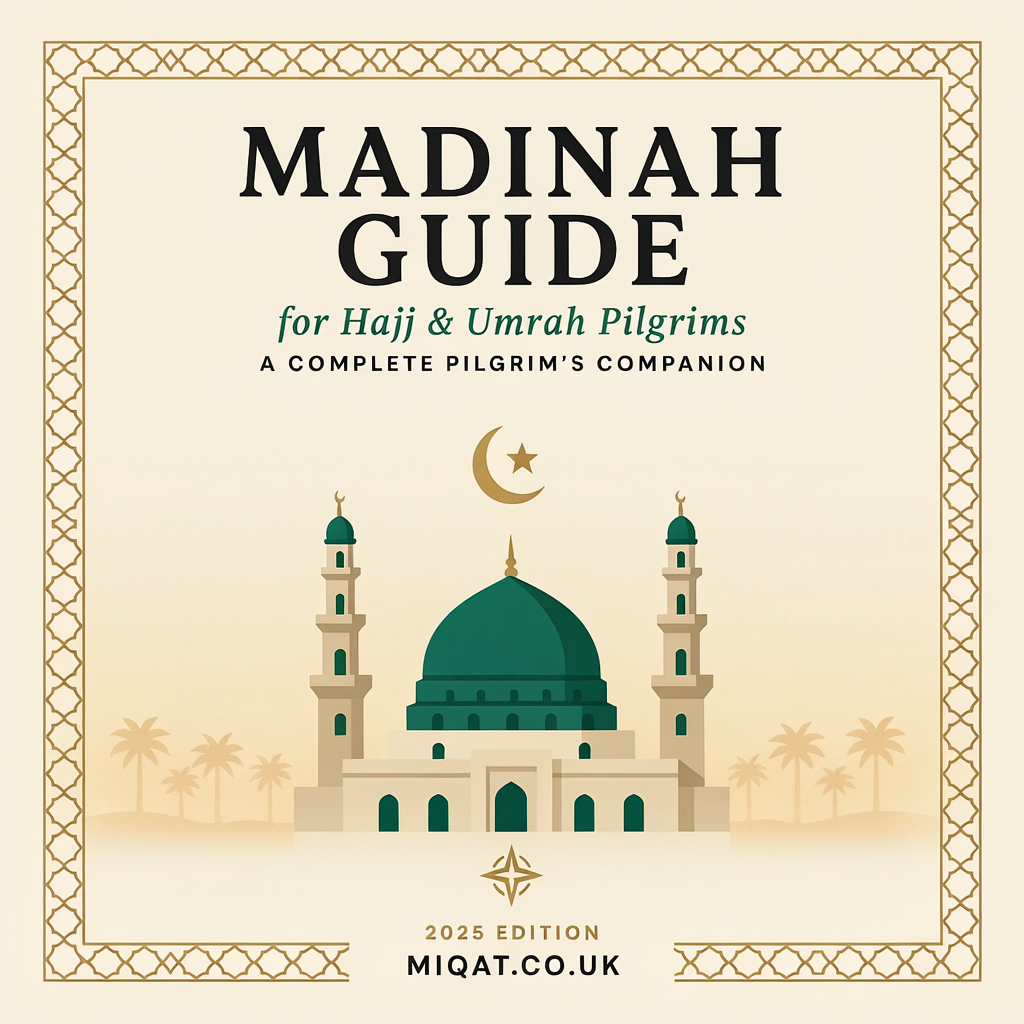
Madinah Guide
It is home to Al-Masjid an-Nabawi — the Prophet’s Mosque.
It is connected to Abu Bakr رضي الله عنه, Umar ibn al-Khattab رضي الله عنه, the Ansar, the Muhajirun and generations of Muslims whose stories we have heard throughout our lives.
For many Hajj and Umrah pilgrims, visiting Madinah becomes one of the most memorable parts of the entire journey.
But there is also a practical side.
Where should you stay?
How do you navigate Masjid an-Nabawi?
What is Rawdah?
How do Rawdah arrangements work?
What should you know about visiting and giving salam?
Which Islamic historical places are worth visiting?
How do you get around Madinah?
Where can you eat?
And if you’re travelling from Madinah to Makkah for Umrah, where do you enter Ihram?
This Madinah Guide is Miqat’s main starting point for answering those questions.
It isn’t intended to replace every detailed article we will publish about Madinah.
Instead, think of it as your doorway into the city.
Visit Madinah with knowledge, move through it with adab, and leave with a greater love for the Messenger of Allah ﷺ and his Sunnah.
Why Is Madinah Important in Islam?
Before the Hijrah, Madinah was known as Yathrib.
When persecution of the Muslims in Makkah intensified, the Prophet Muhammad ﷺ eventually migrated to Madinah.
The Hijrah wasn’t simply a change of location.
Madinah became the home of the developing Muslim community.
The Muhajirun who migrated from Makkah were welcomed by the Ansar of Madinah.
The Prophet ﷺ established his mosque.
Important events in the Seerah took place in and around the city.
The Battle of Uhud took place nearby.
Masjid Quba became closely connected to the story of the Hijrah.
And eventually the Prophet ﷺ passed away in Madinah.
When you understand these stories before arriving, the city becomes more than a collection of historical sites.
You begin to understand what happened here.
Is Visiting Madinah Part of Hajj or Umrah?
This is an important distinction.
Visiting Madinah is not a ritual or requirement of Hajj or Umrah.
Your Hajj or Umrah is not incomplete simply because you do not visit Madinah.
However, visiting Masjid an-Nabawi is highly virtuous, and many pilgrims understandably combine a visit to Madinah with their journey to Saudi Arabia.
This distinction matters because Miqat should always separate:
what is part of the pilgrimage ritual
from
what is a recommended or beneficial visit.
That prevents travel customs from gradually being presented as requirements of Hajj or Umrah.
Should You Visit Madinah Before or After Umrah?
Both options are common.
Some pilgrims:
Madinah → Makkah → Umrah
Others:
Makkah → Umrah → Madinah
There isn’t one itinerary that is automatically right for everyone.
Starting in Madinah can be particularly appealing for first-time travellers.
After your flight, you can settle into Saudi Arabia, recover, visit Masjid an-Nabawi and spend some quieter days in Madinah before entering Ihram and travelling towards Makkah.
Other pilgrims prefer performing Umrah first and visiting Madinah afterwards.
Consider:
- Flight prices
- Airport
- Hotel bookings
- Length of trip
- Family needs
- Elderly travellers
- Transport
- Your overall itinerary
Our Saudi Arabia Travel Guide for Hajj and Umrah Pilgrims should eventually connect all of these transport decisions.
Arriving in Madinah
Pilgrims may reach Madinah by air, rail or road depending on their itinerary.
If you’re arriving for the first time, don’t feel that you need to begin sightseeing immediately.
Check into your hotel.
Rest if necessary.
Freshen up.
Understand the route between your hotel and Masjid an-Nabawi.
Save your hotel location.
Then approach your time in Madinah calmly.
There is no prize for completing your entire Madinah itinerary on the first day.
Masjid an-Nabawi: The Prophet’s Mosque
Masjid an-Nabawi is the centre of most pilgrims’ time in Madinah.
The mosque has expanded enormously over the centuries and today accommodates very large numbers of worshippers.
For a first-time visitor, its size can be surprising.
Like Masjid al-Haram, you should spend a little time learning your surroundings rather than assuming you’ll immediately understand every entrance and direction.
Remember Your Gate
This sounds simple, but it is genuinely useful.
Pay attention to:
- Your regular entrance
- Gate numbers
- Nearby hotel landmarks
- Women’s entrances where relevant
- Toilets and wudu facilities
- Family meeting points
- The direction back to your accommodation
If you’re travelling with relatives, agree where you will meet after salah.
Don’t rely entirely on:
“We’ll find each other outside.”
“Outside” becomes a very large place when thousands of people leave the mosque simultaneously.
The Virtue of Prayer in Masjid an-Nabawi
The Prophet ﷺ said:
“One prayer in this mosque of mine is better than one thousand prayers elsewhere, except the Sacred Mosque.”
This is one reason pilgrims naturally want to spend as much time as possible in Masjid an-Nabawi.
But don’t turn that opportunity into unnecessary physical exhaustion.
If you are elderly, unwell or caring for somebody vulnerable, organise your time sensibly.
Quality of worship matters.
Being physically present while completely exhausted isn’t always the best use of your journey.
Visiting and Sending Salam to the Prophet ﷺ
For many Muslims, approaching the area associated with the resting place of the Prophet Muhammad ﷺ is deeply emotional.
Keep the moment dignified.
Send salam respectfully.
Avoid pushing.
Avoid shouting.
Follow the directions of mosque staff.
And remember who you have come to honour.
This should be an experience characterised by love and adab, not competition to reach the closest possible physical position.
Miqat should eventually publish a dedicated:
Visiting the Prophet’s Mosque: Salam, Adab and Practical Guide
That will allow us to treat the subject properly and distinguish established Islamic guidance from cultural practices.
What Is Rawdah?
Rawdah is one of the best-known areas within Masjid an-Nabawi.
The Prophet ﷺ said:
“Between my house and my pulpit is a garden from the gardens of Paradise.”
Because of its significance, many visitors hope to pray there.
However, access arrangements can change and may involve official booking or crowd-management systems.
For that reason, I don’t recommend putting permanent step-by-step booking instructions inside this pillar.
Those instructions can become outdated.
Instead, Miqat should maintain a separate Rawdah Guide that can be updated whenever Saudi procedures change.
That article can cover:
- What Rawdah is
- Its significance
- Current access arrangements
- Nusuk where applicable
- Men’s arrangements
- Women’s arrangements
- What to expect
- Common mistakes
- Accessibility
- Adab
Don’t Let Rawdah Become a Source of Anger
This is worth saying.
People can become surprisingly stressed trying to access a place associated with tranquillity and worship.
If arrangements change, your slot is delayed, or you cannot enter, don’t allow disappointment to turn into anger towards other pilgrims or staff.
Your entire visit to Madinah is valuable.
Rawdah is not the only place where you can make dua, pray or remember Allah.
The Green Dome
The Green Dome is one of the most recognisable visual landmarks of Masjid an-Nabawi.
First-time visitors often associate it immediately with Madinah.
It sits above the area containing the chamber connected to the resting place of the Prophet ﷺ.
Miqat can eventually produce a historical article explaining:
The Green Dome: History and Significance
The important thing is to distinguish historical architecture from acts of worship.
Our worship is directed to Allah alone.
Jannat al-Baqi
Al-Baqi cemetery lies beside Masjid an-Nabawi and is one of the most historically significant cemeteries in Islam.
Many members of the Prophet’s ﷺ family, companions and early Muslims were buried there.
Visiting a cemetery reminds us of death and the Hereafter.
It isn’t meant to become tourism in the ordinary sense.
If you visit, do so with dignity and according to established Islamic guidance.
Miqat should eventually create:
Jannat al-Baqi Guide: History, Notable Burials and Visiting Etiquette
Masjid Quba
Masjid Quba has a special place in Islamic history and is closely connected to the Hijrah.
It is commonly described as the first mosque established after the Prophet ﷺ reached the area of Madinah during the migration.
The Prophet ﷺ would visit Masjid Quba, and authentic narrations describe virtue associated with going there in a state of purification and praying.
For pilgrims spending several days in Madinah, Masjid Quba is one of the most meaningful places to visit.
Rather than rushing in, taking a photograph and leaving, learn its history beforehand.
That transforms the experience.
Future supporting article:
Masjid Quba: History, Virtues and Visitor Guide
Mount Uhud
Uhud isn’t simply a mountain on a sightseeing itinerary.
It is connected to one of the most important events in the Seerah.
The Battle of Uhud teaches lessons about obedience, sacrifice, leadership, loss and perseverance.
Hamza ibn Abdul Muttalib رضي الله عنه was martyred at Uhud along with other companions.
Before visiting, read the story.
Understand what happened.
Then when you look towards the mountain, you’re not simply looking at a landscape.
You’re connecting geography to Seerah.
Future supporting content:
Battle of Uhud: Complete Story and Lessons
Mount Uhud Visitor Guide
The Seven Mosques and Khandaq Area
Visitors to Madinah may also encounter locations associated with the Battle of the Trench — Ghazwat al-Khandaq.
Again, Miqat should approach these places historically rather than turning every location into a ritual destination.
The real value comes from understanding the Seerah.
Who were the Muslims facing?
Why was the trench dug?
What conditions did the companions endure?
What lessons can we take from the event?
Our future Islamic History pillar can connect deeply with the Madinah cluster here.
Masjid al-Qiblatayn
Masjid al-Qiblatayn is associated with the change of the qiblah from Jerusalem towards the Ka’bah in Makkah.
It is another example of why understanding Islamic history before visiting Madinah makes the city more meaningful.
Instead of collecting mosque photographs, learn the stories.
Madinah then begins to feel like an open Seerah book.
Madinah Ziyarat: Don’t Turn It Into a Race
A typical Madinah ziyarat tour may include several historical locations within a relatively short period.
That can be convenient.
But there is a danger.
Bus stops.
Everyone gets out.
Photo.
Five minutes.
Back on bus.
Next place.
If possible, read about the major locations before your tour.
Even a ten-minute explanation of Uhud before visiting changes the experience considerably.
The objective isn’t:
How many Madinah sites did I visit?
A better question is:
What did these places teach me?
Where Should You Stay in Madinah?
Hotel location can have a major impact on your stay.
Many pilgrims understandably prioritise proximity to Masjid an-Nabawi.
But there are other considerations too:
- Walking distance
- Which side of the mosque
- Women’s entrances
- Elderly relatives
- Wheelchair access
- Hotel elevators
- Breakfast
- Family room size
- Shops nearby
- Budget
- Length of stay
Families Should Think About Mosque Access
If men and women in your family will be entering different areas, hotel location can matter more than a simple “300 metres from mosque” description suggests.
Before booking, investigate the actual route.
Future supporting pillar:
Where to Stay in Madinah: Best Areas and Hotels for Pilgrims
Walking Around Madinah
The central area around Masjid an-Nabawi is highly walkable for many visitors.
Hotels, restaurants, shops and services are concentrated around the mosque.
But don’t underestimate:
- Heat
- Long prayer days
- Crowds
- Elderly family members
- Fatigue accumulated from Umrah or Hajj
Comfortable footwear matters.
So does rest.
You don’t have to be moving every hour simply because you’re in Saudi Arabia.
Getting Around Madinah
For journeys beyond the central mosque area, options may include taxis, ride-hailing, organised tours and other local transport.
Your best option depends on:
- Number of travellers
- Distance
- Mobility
- Budget
- Luggage
- Time available
For ziyarat, some pilgrims prefer an organised vehicle covering several locations.
Others prefer visiting fewer places at a slower pace.
Both can work.
Our travel cluster should eventually include:
Getting Around Madinah: Taxi, Ride-Hailing and Transport Guide
Food in Madinah
Like Makkah, Madinah offers food across many budgets.
You’ll find:
- Saudi food
- South Asian food
- Turkish food
- Middle Eastern grills
- Fast food
- Cafés
- Hotel restaurants
- Bakeries
- Supermarkets
- Takeaways
If you’re travelling with family, food costs can add up.
Miqat already has How Much Does Food Cost in Makkah and Madinah?, which should become an important supporting link from this pillar.
Rather than duplicate the detailed budgeting information here, we’ll eventually create Madinah-specific supporting content such as:
Best Places to Eat Near Masjid an-Nabawi
Cheap Food in Madinah
Breakfast Near Masjid an-Nabawi
Where to Buy Groceries in Madinah
Dates and Shopping in Madinah
Dates are naturally one of the products most associated with Madinah.
Ajwa dates are particularly well known among pilgrims.
You’ll find dates at different prices, grades and packaging levels.
Madinah also has shops selling:
- Prayer mats
- Qur’ans and Islamic books
- Attar
- Tasbih
- Abayas
- Thobes
- Gifts
- Islamic souvenirs
Shopping can be enjoyable.
Just keep it in proportion.
You have travelled a long way to spend time in one of Islam’s most significant cities.
Don’t accidentally spend more time comparing boxes of dates than sitting inside Masjid an-Nabawi.
Buying Dates in Madinah
This topic deserves its own supporting article because pilgrims often have practical questions:
Which dates should I buy?
What is Ajwa?
Where should I buy dates?
How much should I pay?
Can I take dates home?
How do different grades compare?
A dedicated Buying Dates in Madinah Guide could become a useful commercial/informational article while naturally supporting the wider Madinah pillar.
Madinah With Elderly Parents
Madinah can be more manageable than some stages of Hajj, but don’t underestimate the physical demands.
If you’re travelling with elderly parents:
- Choose accommodation carefully
- Learn the closest mosque route
- Allow extra walking time
- Use wheelchairs where needed
- Keep medication organised
- Prioritise hydration
- Build rest into the day
- Agree on meeting locations
- Avoid unnecessary rushing
And don’t become frustrated if your itinerary has to change.
Sometimes the most meaningful part of your pilgrimage isn’t reaching another historical location.
It is helping your father back to the hotel.
Or sitting beside your mother while she rests.
Service can become worship too.
Madinah With Children
Children may find the large mosque environment exciting and overwhelming at the same time.
Make sure they know:
- Hotel name
- Parent’s phone number
- Where to meet
- What to do if separated
You may want younger children to carry identification/contact details.
Don’t assume mobile phones solve everything.
A battery can die.
A phone can be misplaced.
Crowds can make communication difficult.
Simple backup plans matter.
Women Visiting Madinah
Women may encounter different entrances, prayer arrangements and Rawdah access arrangements from men.
This is another reason families shouldn’t simply say:
“We’ll meet outside afterwards.”
Choose a specific location.
Current Rawdah and mosque access arrangements can change, so check reliable official information during your journey.
Miqat should eventually create a comprehensive:
Madinah Guide for Women
covering practical matters such as mosque entrances, Rawdah, accommodation location, travelling with children and other common first-time questions.
From Madinah to Makkah for Umrah
This is one of the most important practical sections of this entire pillar.
If you’re in Madinah and your next destination is Makkah for Umrah, you need to prepare for Ihram and Miqat properly.
The Miqat associated with those travelling from the direction of Madinah is Dhul Hulayfah, also known in connection with Abyar Ali.
You already have a dedicated Miqat article:
Masjid Dhul Hulayfah.
And Miqat’s broader What Is Miqat? Complete Guide should also be linked here.
This is exactly how our architecture should work:
Madinah Guide
      ↓
Madinah → Makkah
      ↓
Masjid Dhul Hulayfah
      ↓
What Is Miqat?
      ↓
Umrah Guide
A pilgrim reading about Madinah naturally moves into the next stage of their journey.
For religious rulings concerning Ihram, intention and Miqat in individual circumstances, consult reliable scholarly guidance.
Travelling From Madinah to Makkah
Pilgrims can travel between Madinah and Makkah using different transport arrangements depending on their package and circumstances.
When comparing options, consider:
Total journey time, not just advertised travel time.
Also think about:
- Hotel-to-station transport
- Luggage
- Children
- Elderly relatives
- Ihram
- Miqat
- Arrival at your Makkah hotel
- Current transport arrangements
This topic belongs primarily beneath our Saudi Travel pillar, with a dedicated:
Madinah to Makkah: Train, Coach or Private Transfer?
SIM Cards and Mobile Data
If Madinah is your first Saudi destination, you may want mobile connectivity soon after arrival.
Your options can include roaming, physical Saudi SIMs and eSIMs.
Miqat already has a dedicated SIM Cards in Saudi Arabia: The Complete Guide for Hajj & Umrah, so we should link to that rather than duplicating provider and pricing information here.
Keeping changing information in one living guide also makes Miqat easier to maintain.
Money in Madinah
Cards and electronic payments are useful, but having some payment flexibility is sensible.
Before travelling, understand:
- Your card’s overseas fees
- ATM charges
- Exchange rates
- Cash requirements
- Bank security settings
Again, Miqat already has Money Exchange in Saudi Arabia, which should serve as the detailed supporting article.
A Slower Way to Experience Madinah
One thing I would encourage first-time visitors to do is deliberately leave empty space in the itinerary.
Don’t schedule every hour.
Spend time in Masjid an-Nabawi without needing to go somewhere afterwards.
Read Qur’an.
Make dhikr.
Send salawat upon the Prophet ﷺ.
Reflect.
Read some Seerah while sitting in the city where many of those events took place.
Walk without turning every journey into content.
Sometimes we travel with such detailed itineraries that we forget to experience where we are.
Madinah deserves time.
Read the Seerah While You Are in Madinah
This is one habit that can completely change the visit.
Imagine reading about:
The Hijrah while sitting in Madinah.
Then:
The Ansar welcoming the Prophet ﷺ.
The establishment of Masjid an-Nabawi.
The Battle of Uhud.
The Battle of the Trench.
The lives of the companions.
Suddenly Islamic history stops feeling geographically distant.
The names have places attached to them.
This is where Miqat’s future Islamic History content can become particularly powerful.
Travel guide + Seerah + personal reflection is a combination I think can distinguish Miqat from ordinary pilgrimage websites.
Don’t Judge Madinah Only by How Much You Did
You may leave without visiting every historical site.
That’s okay.
You may not manage everything you planned.
That’s okay too.
Your Madinah visit isn’t a competition.
There is no leaderboard showing:
12 mosques visited.
4 mountains photographed.
6 restaurants tried.
20 shopping bags purchased.
What matters more is what the city leaves inside you.
Did you learn something about the Prophet ﷺ?
Did you increase in love for his Sunnah?
Did you pray?
Did you reflect?
Did you become more conscious of Allah?
Those are harder things to put on an itinerary.
Common Mistakes First-Time Visitors Make in Madinah
Try to avoid:
- Treating visiting Madinah as a compulsory ritual of Hajj or Umrah
- Not learning the mosque gates
- Having no family meeting point
- Rushing ziyarat
- Visiting historical locations without learning their history
- Treating historical sites as places with prescribed rituals without evidence
- Pushing other pilgrims
- Becoming angry over Rawdah access
- Exhausting elderly relatives
- Spending excessive time shopping
- Relying on outdated Rawdah instructions
- Taking religious rulings from random social-media videos
- Trying to photograph every moment
- Filling every hour of the itinerary
- Leaving Madinah without learning more about the Seerah
Explore Our Madinah Guides
As Miqat grows, /madinah-guide/ should become the main informational pillar connecting an entire Madinah cluster.
Masjid an-Nabawi
Masjid an-Nabawi First-Time Visitor Guide
Rawdah Guide
How to Send Salam to the Prophet ﷺ
Masjid an-Nabawi Gates Guide
Women’s Guide to Masjid an-Nabawi
Wheelchair and Accessibility Guide
Islamic History & Ziyarat
Masjid Quba Guide
Mount Uhud Visitor Guide
Battle of Uhud: Story and Lessons
Jannat al-Baqi Guide
Masjid al-Qiblatayn
Battle of the Trench Sites
Islamic History of Madinah
Accommodation
Where to Stay in Madinah
Best Areas Near Masjid an-Nabawi
Madinah Hotels for Families
Madinah Hotels for Elderly Pilgrims
Food & Shopping
How Much Does Food Cost in Makkah and Madinah? — already published
Best Places to Eat Near Masjid an-Nabawi
Cheap Food in Madinah
Buying Dates in Madinah
Shopping in Madinah
Travel
Madinah Airport Guide
Getting Around Madinah
Madinah to Makkah
Haramain Train Guide
SIM Cards in Saudi Arabia — already published
Money Exchange in Saudi Arabia — already published
Preparing for Umrah From Madinah
Masjid Dhul Hulayfah — already published
What Is Miqat? Complete Guide — already published
How to Enter Ihram in Madinah
Madinah to Makkah for Umrah
This gives us an extremely strong long-term cluster without trying to write everything immediately.
Frequently Asked Questions About Madinah
Is Madinah part of Umrah?
No. Visiting Madinah is not a required ritual of Umrah.
Many pilgrims combine Madinah with their Umrah journey because of the virtue and importance of Masjid an-Nabawi and the city’s significance in Islamic history.
Is Madinah part of Hajj?
Visiting Madinah is not one of the rites required for Hajj.
It is commonly included in pilgrims’ wider Saudi itinerary, but it should be distinguished from the actual Hajj rituals.
How many days should I spend in Madinah?
There isn’t a single correct number.
Your budget, itinerary, flights, health and overall pilgrimage plans will affect the decision.
If possible, allow enough time that your visit doesn’t become a rushed sightseeing exercise.
Should I visit Madinah before or after Umrah?
Either can work.
Starting in Madinah can give you time to settle into Saudi Arabia before entering Ihram and travelling to Makkah. Visiting afterwards can provide a calmer conclusion following your Umrah.
Choose according to your overall travel circumstances.
What is Rawdah?
Rawdah refers to the area described by the Prophet ﷺ as being between his house and pulpit, which he described as a garden from the gardens of Paradise.
Because access procedures can change, check current official arrangements before your visit.
Do I need to book Rawdah?
Access systems and booking requirements can change.
Rather than relying on an old article or screenshot, check current official Saudi/Nusuk information close to your visit. Miqat’s future Rawdah living guide should also be regularly updated.
What are the main places to visit in Madinah?
For many pilgrims, important places include Masjid an-Nabawi, Masjid Quba, the Uhud area and other locations connected to Islamic history.
However, distinguish historical visits from prescribed acts of Hajj or Umrah.
What is the Miqat from Madinah?
Dhul Hulayfah is the Miqat associated with those travelling from the direction of Madinah.
Miqat already has dedicated Masjid Dhul Hulayfah and What Is Miqat? guides for further reading.
Can I travel from Madinah to Makkah by train?
Rail can form part of the transport options between the cities, depending on current services and your circumstances.
Pilgrims travelling for Umrah must also plan properly for Ihram and Miqat rather than treating it solely as a transport journey.
Is Madinah easy to walk around?
The central area surrounding Masjid an-Nabawi is walkable for many pilgrims, but heat, crowds, mobility and hotel location all matter.
Check the actual route from your hotel rather than relying only on the advertised distance.
Where should I stay in Madinah?
For first-time pilgrims, proximity and convenient access to Masjid an-Nabawi can be particularly valuable.
Families should also consider which side of the mosque best suits their needs, especially where men and women may use different access routes.
Is food expensive in Madinah?
There are options at different price levels.
Miqat’s existing How Much Does Food Cost in Makkah and Madinah? article covers food budgeting in more detail.
When It Is Time to Leave Madinah
Leaving Madinah can be emotional in a way you didn’t expect.
Perhaps you’re travelling onwards to Makkah.
Perhaps Hajj is ahead.
Perhaps your Umrah has already finished and you’re going home.
Whatever your itinerary, try not to measure your Madinah visit only by the photographs you took or the locations you managed to see.
Think instead about what you are taking away.
You visited the city of the Prophet Muhammad ﷺ.
You prayed in his mosque.
You walked through places connected to the companions.
You heard the adhan while surrounded by Muslims who had travelled from across the world.
But eventually you have to leave.
And perhaps that is where one of the most important questions begins:
What will Madinah change when I return home?
Love for the Prophet ﷺ shouldn’t remain in Madinah.
It should appear in how we live.
In our salah.
Our character.
Our treatment of family.
Our honesty.
Our patience.
Our Sunnah.
Our relationship with Allah.
The best souvenir from Madinah isn’t something that fits inside your suitcase.
It is something you carry home in your heart and your actions.
May Allah grant you the opportunity to visit Madinah, allow you to pray in Masjid an-Nabawi, increase your love for the Prophet Muhammad ﷺ and his Sunnah, protect you and your family throughout your journey, and accept your Hajj and Umrah.
Ameen.