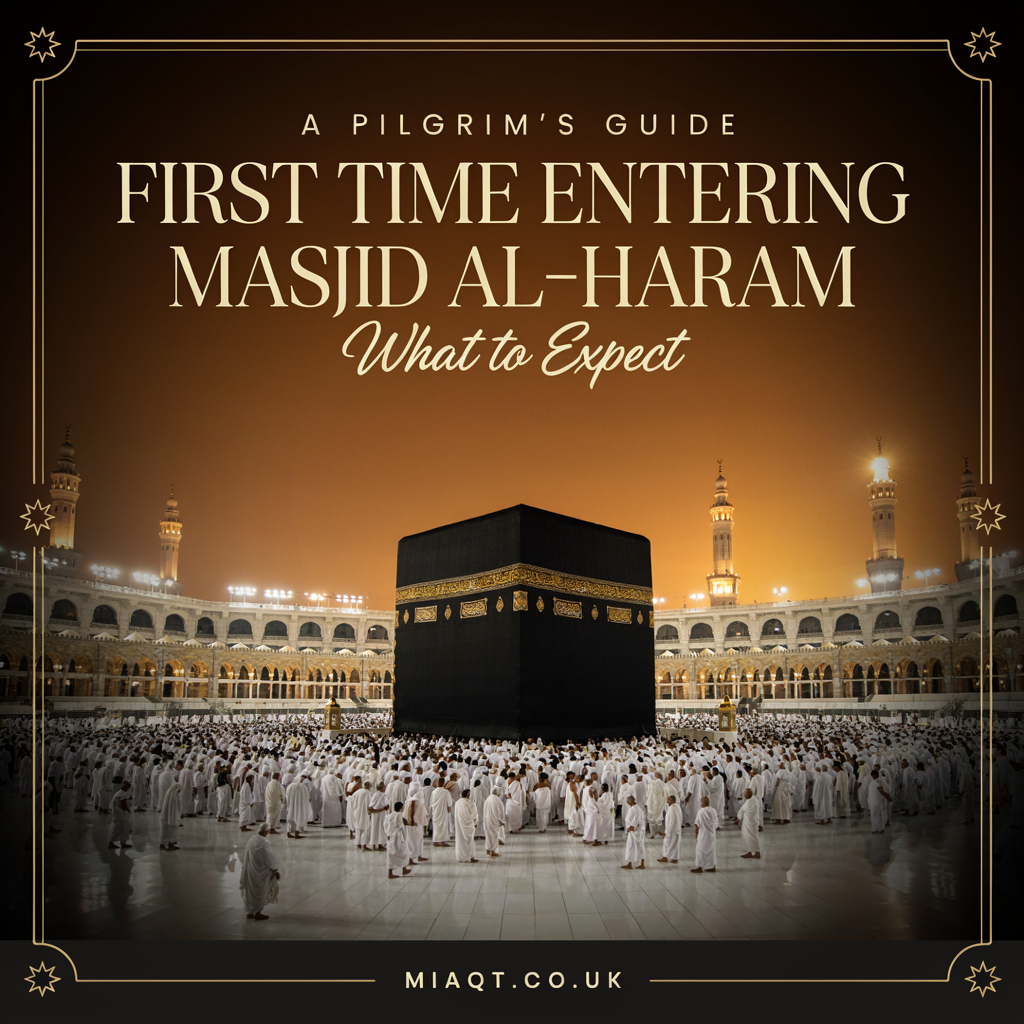
You can prepare for Hajj or Umrah for months. You can watch videos of Masjid al-Haram, study maps of Makkah and see the Ka’bah countless times on television and social media. But none of that fully prepares you for the moment you enter Masjid al-Haram yourself. I learned that during Hajj in 2026.
I thought I knew what seeing the Ka’bah would feel like. I didn’t. For me, the first few moments weren’t about taking photographs, remembering a long list of duas or trying to understand everything around me. They were much simpler.
I saw part of the Ka’bah.
I stopped.
My eyes filled with tears.
And the words that came naturally were:
“Ya Allah, mujhe maaf kar dena.”
O Allah, please forgive me.
If you’re preparing to enter Masjid al-Haram for the first time, this guide will help with both sides of that moment: the practical things you need to know and the experience that no guide can completely prepare you for.
First Time Entering Masjid al-Haram
Before Your First Visit to Masjid al-Haram
The best way to enjoy those first moments is to deal with as many practical matters as possible before you arrive. You don’t want your first sight of the Haram to be dominated by questions such as:
Which gate are we using?
Where is my hotel?
Does everyone have their phone?
Where are we meeting if we get separated?
What exactly do I do during Umrah?
Some uncertainty is inevitable, particularly on your first visit. But preparation removes a lot of unnecessary stress.
Before leaving your hotel, make sure you have:
- A charged phone
- Your hotel name and location saved
- Any essential identification
- A small amount of money or payment card
- Necessary medication
- A small bag for footwear
- A power bank if you expect to stay for several hours
- An agreed family meeting point
If you’re going specifically to perform Umrah, make sure you understand the rites before arriving.
Your first visit will already be emotional enough without trying to learn Tawaf and Sa’i from your phone while standing in a crowd.
For a wider orientation to the city, accommodation, transport and other practical matters, see our Makkah Guide for Hajj & Umrah Pilgrims.
Approaching Masjid al-Haram for the First Time
For many pilgrims, the experience starts well before they actually see the Ka’bah. As you move closer to the Haram, Makkah begins to feel different. More pilgrims appear around you. People are walking towards the mosque in Ihram. Families are moving together.
You hear different languages everywhere.
Some people are arriving.
Others are returning to their hotels after Salah or Umrah.
And somewhere among all those people is you.
You’ve finally reached the place you’ve spent months—or perhaps years—planning to visit.
Try not to rush these moments unnecessarily.
If you’re with family, stay together.
Pay attention to the route you’re taking.
Notice the landmarks around you.
And remember that reaching the mosque isn’t a race.
Which Gate Should You Use?
Masjid al-Haram is vast and has many entrances.
There isn’t one entrance that every first-time pilgrim should use.
The most convenient gate can depend on:
- Your hotel location
- The direction you’re approaching from
- Crowd-management arrangements
- Where you’re trying to reach inside the mosque
- Mobility requirements
- Temporary access restrictions
Your hotel staff or group leader may suggest the most convenient route based on where you’re staying.
More importantly, once you’ve found a route that works for you, learn it.
Take note of the gate.
Take a photograph of nearby identifying signs if useful.
Save the location on your phone.
The mosque may feel overwhelming on your first visit, but after several visits you’ll gradually begin recognising the routes.
Stop and Remember Where You Entered
This deserves its own section because it sounds ridiculously simple until you’re standing outside the Haram later wondering where your hotel went.
The surroundings can look completely different after dark.
You may also leave from a different area from where you entered.
And after Salah, thousands of people can be moving around you.
So when entering Masjid al-Haram for the first time:
look back.
Notice what is behind you.
Remember the gate.
Look for a building, sign or obvious landmark.
If necessary, take a quick photograph.
This takes 20 seconds.
It can save you a lot of confusion later.
The First Time I Saw the Ka’bah
This is the part of the journey I remember most clearly.
I travelled for Hajj with my family. There were five of us, including my brothers.
When we first entered Masjid al-Haram, we were walking through the gate area and pillars.
At first, I didn’t suddenly see the whole Ka’bah perfectly framed in front of me like you see in photographs.
I caught sight of one corner through the pillars.
And that was enough.
We stopped.
For a moment, nobody really said anything.
We had spent our lives seeing the Ka’bah in photographs and videos. We had faced towards it for every Salah.
Now it was physically there.
In front of us.
My eyes filled with tears.
I remember standing behind one of the pillars, looking towards the Ka’bah.
Before Hajj, you think about the duas you’ll make when you finally reach Makkah.
You might even make a list.
But in that moment, my long list disappeared.
The words that came from inside me were simply:
“Ya Allah, mujhe maaf kar dena.”
O Allah, please forgive me.
That was it.
Not a beautifully prepared speech.
Not a complicated dua.
Just forgiveness.
And sometimes I think that says more about the experience than anything I could have planned beforehand.
Then Someone Said: “Haji, Haji…”
There is another part of the memory that always makes the experience feel real to me.
We had stopped.
Of course, Masjid al-Haram isn’t a private viewing area.
Thousands of other people are trying to move through the same space.
A Saudi security officer was keeping the crowd flowing.
He called towards us:
“Haji, Haji…”
and indicated that we needed to move.
So we moved.
It was almost a reminder that even one of the most emotional moments of your life is happening in the middle of a functioning mosque filled with thousands of other pilgrims having their own moments.
I actually treasure that part of the memory too.
It made it real.
Don’t Expect Your First Ka’bah Experience to Look Like Instagram
This is something I want first-time pilgrims to understand.
You might have imagined the moment.
Perhaps you picture yourself walking through a gate and suddenly seeing the entire Ka’bah directly ahead.
Maybe that happens.
Maybe it doesn’t.
You might see only part of it initially.
Someone may walk in front of you.
Security may ask you to keep moving.
Your family may be trying to stay together.
You might be tired after travelling.
You might be thinking about your Umrah.
Don’t allow expectations created by photographs and videos to make you feel that your own experience was somehow imperfect.
There is no required cinematic moment.
Your first sight will be your first sight.
Let it happen naturally.
What Should You Do When You First See the Ka’bah?
Many first-time pilgrims worry about this.
They have heard different things about special duas or what they are “supposed” to say when first seeing the Ka’bah.
You don’t need to turn the moment into a performance.
Praise Allah.
Make sincere dua.
Ask for forgiveness.
Ask for what is important to you.
Remember your parents and family.
Ask Allah to accept your journey.
And if all you can do for a few moments is stand there emotionally and say Alhamdulillah, don’t feel you’ve wasted the moment.
Sincerity matters more than producing a perfectly rehearsed speech.
For specific questions concerning prescribed duas or religious rulings, refer to trusted scholars rather than treating travel articles or social-media posts as substitutes for Islamic scholarship.
Should You Make a Dua List Before Going?
I still think a dua list is useful.
The fact that I didn’t immediately remember mine doesn’t mean you shouldn’t prepare one.
You may spend many hours in Masjid al-Haram during your journey.
Having a list can help you remember people and matters you genuinely wanted to make dua for.
You could divide it into simple categories:
For yourself
Forgiveness, guidance, steadfastness, halal rizq, good character and acceptance of your worship.
For your family
Parents, spouse, children, brothers, sisters and relatives.
For the Hereafter
Forgiveness, protection, a good ending and Jannah.
For others
Friends, people who asked you to make dua, the Ummah and those going through hardship.
Keep the list on your phone or in a small notebook.
But when you first see the Ka’bah, don’t panic if your mind goes blank.
Mine did.
Don’t Block the Entrance to Take Photographs
You’ll understand the temptation immediately.
You see the Ka’bah.
Your hand reaches for your phone.
But look around first.
If you’re standing in a busy passage or entrance, other pilgrims need to move.
Security staff are managing enormous numbers of people, particularly during Hajj, Ramadan and busy Umrah periods.
Move somewhere appropriate before stopping.
You will have opportunities for photographs.
You don’t need to capture everything within the first 30 seconds.
Put Your Phone Away for a Few Minutes
Take a photograph if you want one.
Then consider putting the phone away.
You have probably spent years looking at the Ka’bah through a screen.
Now you don’t need the screen.
Look at it.
There is a strange habit we have developed where something extraordinary happens and our first instinct is to watch it through the camera on our phone.
Your family doesn’t need a livestream of every second.
Social media can wait.
Some moments are better experienced first and photographed second.
If You’re About to Perform Umrah, Regain Your Focus
The emotion of arriving can make you forget that you also have rites to perform.
Take a moment.
Breathe.
Remember your intention.
If you’re performing Umrah, you’ll be moving towards Tawaf and later Sa’i.
You should already understand the basic sequence before arriving.
Don’t depend entirely on following the person in front of you.
Crowds can separate groups very quickly.
Learn the rites beforehand and know what you’re doing.
Your First Tawaf Can Feel Overwhelming
Seeing Tawaf online and entering the Mataf yourself are very different experiences.
There are people everywhere.
Some are moving quickly.
Others slowly.
Some are elderly.
Some are using mobility assistance.
Families are trying to remain together.
People may be making dua in dozens of languages.
For your first Tawaf, focus less on achieving some “perfect” experience and more on performing your worship properly, patiently and without harming others.
Be especially careful about suddenly stopping in the flow of pilgrims.
If you need to check something, try to move appropriately rather than creating an obstruction.
We’ll cover this properly in our separate Mataf Guide: Performing Tawaf Around the Ka’bah.
Don’t Make Reaching Hajar al-Aswad Your First Mission
When some pilgrims first enter the Haram, they become determined to get as close to the Ka’bah or Hajar al-Aswad as physically possible.
Remember where you are.
Don’t push.
Don’t hurt someone.
Don’t become angry.
Don’t allow your desire to perform something virtuous to result in poor behaviour towards another pilgrim.
Crowd conditions vary enormously.
Sometimes getting closer may be manageable.
At other times, it may be extremely difficult.
Use judgement and follow proper scholarly guidance regarding your rites.
Expect to Walk Much More Than You Think
Masjid al-Haram looks compact on a phone screen.
It doesn’t feel compact when you’re walking through it.
Your day might include:
hotel → Haram → walking inside → Tawaf → Sa’i → finding an exit → walking back.
It adds up.
If you’ve just arrived after travelling, you may already be tired.
Stay hydrated.
Rest when appropriate.
Don’t use all your energy in the first few hours because excitement has taken over.
This is particularly important during Hajj, when you need your strength for the days ahead.
Travelling With Elderly Parents? Slow Down
Your first sight of the Ka’bah may make you want to move quickly towards it.
Remember who is with you.
If you’re accompanying elderly parents, grandparents or somebody with reduced mobility, their experience matters too.
Walk at their pace, not yours.
Keep them close.
Don’t assume they are immediately behind you.
Crowds can separate people in seconds.
If they require mobility assistance, investigate the available wheelchair or cart arrangements rather than exhausting them unnecessarily.
Your responsibility towards your family is part of the journey too.
Choose a Proper Family Meeting Point
Before you disappear into the crowd, agree on what happens if you’re separated.
Do not say:
“We’ll meet by the Ka’bah.”
That is not a meeting point.
Neither is:
“We’ll meet outside the mosque.”
Choose somewhere everyone can identify.
And make sure each person knows:
- Hotel name
- Hotel location
- Main contact number
- Agreed meeting point
- What to do if their phone stops working
This matters particularly when travelling with children, elderly relatives or people who aren’t confident using maps.
Your First Salah in Masjid al-Haram
There is another moment you may remember for years.
The first time you stand for Salah inside Masjid al-Haram and face the Ka’bah isn’t quite like facing the Qiblah at home.
The direction you’ve faced throughout your life is now physically in front of you.
Try to arrive early enough that you’re not spending the minutes before Salah squeezing through crowds searching desperately for somewhere to stand.
Settle.
Put your phone away.
And allow yourself to understand where you are.
Drink Zamzam
For many pilgrims, the first drink of Zamzam inside Masjid al-Haram is another simple but meaningful experience.
You’ve probably drunk Zamzam before.
Perhaps somebody brought a bottle home from Umrah or Hajj.
But drinking it there feels different.
Take a cup.
Drink calmly.
Make dua.
And remember other people need access too, so don’t unnecessarily block the area around the dispensers.
You May Feel More Emotional Than You Expected
Some people cry immediately.
Some don’t.
Some become quiet.
Some smile.
Some seem perfectly calm at first and become emotional later.
There isn’t a correct reaction.
Don’t compare yourself to videos of other pilgrims.
And don’t think:
“Why am I not crying?”
Faith isn’t measured by whether a camera could see tears on your face.
Your relationship with Allah is your own.
Allow the experience to unfold naturally.
You May Also Feel Tired, Confused or Overwhelmed
This needs saying too.
Not every moment of pilgrimage feels spiritually perfect.
Perhaps you’ve been travelling for many hours.
Maybe you haven’t slept properly.
You’re hot.
Your feet hurt.
You don’t understand the signs.
Someone in your group is stressed.
You can’t find the correct exit.
Then you feel guilty because you think:
“I’m in Makkah. I should be feeling amazing.”
You are still human.
Physical exhaustion doesn’t mean you aren’t grateful to be there.
Rest.
Eat.
Sleep.
Return to the Haram refreshed.
Hajj and Umrah aren’t improved by deliberately exhausting yourself.
Don’t Try to Do Everything on Your First Visit
You don’t have to:
touch everything,
visit every corner,
perform endless additional Tawaf,
take hundreds of photographs,
find every historical landmark,
and remain inside until you can barely walk.
If your schedule allows, you’ll return.
Let Masjid al-Haram become familiar gradually.
The first visit can simply be the beginning.
Practical First-Visit Checklist
Before entering Masjid al-Haram for the first time, I would make sure of these things:
- Phone fully charged
- Hotel pinned on your map
- Gate/entrance remembered
- Family meeting point agreed
- Small shoe bag ready
- Necessary medication with you
- Only essential belongings carried
- Umrah steps understood if performing Umrah
- Elderly family members accounted for
- Enough time allowed before Salah
- Heart prepared for the reason you’re there
And perhaps one more:
Don’t plan exactly how you’re supposed to feel.
Common First-Time Mistakes
A few mistakes are particularly easy to make on your first visit.
Stopping immediately in a busy entrance
You may be overwhelmed by your first sight of the Ka’bah, but be aware of people moving behind you.
Forgetting your gate
Take note before moving deeper into the mosque.
Carrying too much
A large backpack quickly becomes annoying during Tawaf and in crowds.
Spending the first ten minutes filming
Capture the memory, but don’t let recording replace experiencing.
Losing your family
Agree on a meeting point before entering crowded areas.
Rushing towards the Ka’bah
You have arrived. You don’t need to push through people to prove it.
Expecting perfection
Your first visit may include tears and dua.
It may also include tired feet, confusion and somebody telling you to move.
Mine did.
And I wouldn’t change the memory.
Frequently Asked Questions
What should I do before entering Masjid al-Haram for the first time?
Make sure you understand any worship you’re about to perform, have your hotel location saved, charge your phone, carry only essential belongings and agree on a meeting point if travelling with others.
What should I say when I first see the Ka’bah?
Make sincere dua and remember Allah. You don’t need to panic about producing a long, perfectly memorised speech. For questions about specific prescribed duas and their authenticity, consult reliable Islamic scholarship.
Will I see the Ka’bah immediately when I enter Masjid al-Haram?
Not necessarily.
Your route, entrance, pillars, structures and crowd arrangements may mean you see only part of the Ka’bah initially. My own first sight was of one corner through the pillars.
Don’t worry about creating the perfect reveal.
Can I take pictures when I first see the Ka’bah?
Follow current mosque rules and staff instructions concerning photography. Most importantly, don’t obstruct walkways or other worshippers for photographs.
Which gate should first-time visitors use?
There isn’t one universal best gate. Your most convenient entrance depends on where you’re staying, the direction you’re approaching from and current access arrangements.
Learn the entrance most convenient for your hotel and route.
What if I get lost inside Masjid al-Haram?
Stay calm, move somewhere safe away from heavy pedestrian flow where possible, use signage/maps and ask authorised staff for assistance.
Knowing your hotel name and having an agreed family meeting point makes this much easier.
Should I carry my shoes with me?
A small shoe bag can be extremely useful. It reduces the risk of forgetting where you left your footwear and makes moving between areas easier where carrying footwear is permitted.
Is Masjid al-Haram difficult for elderly pilgrims?
The scale, crowds and walking can be challenging.
Allow additional time, move at the elderly person’s pace and investigate appropriate mobility assistance where necessary.
How long should I spend in Masjid al-Haram on my first visit?
There is no required amount of time simply for a first visit. Your plans depend on whether you’re performing Umrah, attending Salah or simply spending time in worship.
Don’t exhaust yourself merely because it’s your first day.
Is it normal to cry when seeing the Ka’bah?
Many pilgrims become emotional, while others react differently.
There is no reaction you need to manufacture. Tears aren’t a requirement and their absence doesn’t diminish your pilgrimage.
Your First Visit Only Happens Once
Eventually, you may become familiar with Masjid al-Haram.
You’ll learn the route from your hotel.
You’ll recognise certain entrances.
You’ll know approximately where you’re going.
You’ll stop checking Google Maps every few minutes.
But you will never enter Masjid al-Haram for the first time again.
That’s why I wouldn’t spend too much energy trying to manufacture the perfect moment.
Mine certainly wasn’t staged.
I walked in with my family.
I saw one corner of the Ka’bah through the pillars.
We stopped.
There were tears.
I stood there and the words that came to me were:
“Ya Allah, mujhe maaf kar dena.”
Then a security officer reminded us that thousands of other pilgrims needed to get through too.
“Haji, Haji…”
And we moved on.
Simple.
Unplanned.
And unforgettable.
If your first visit is still ahead of you, prepare for the practical things.
Learn your Umrah.
Know your route.
Look after your family.
Remember your gate.
But leave some room for the experience itself.
You don’t know what you will feel when the Ka’bah finally appears in front of you.
And perhaps you aren’t supposed to know.
May Allah invite you to His Sacred House, make your journey easy, forgive your sins, accept your Hajj or Umrah, and make your first sight of the Ka’bah a memory that remains in your heart for the rest of your life. Ameen.